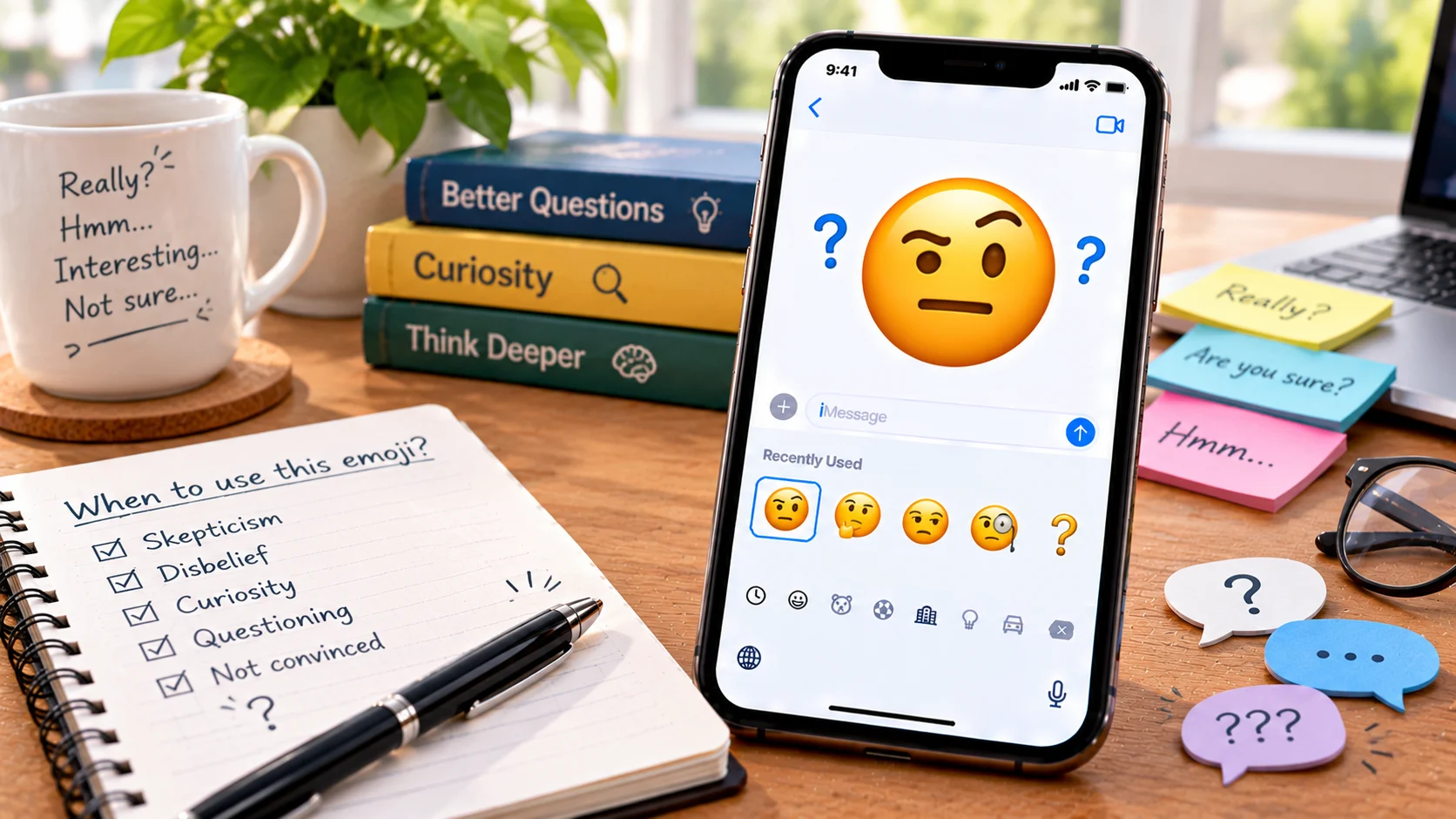
🤨 usually means “Really?”, “Are you sure?”, or “I don’t believe that.” It expresses skepticism, suspicion, or disbelief, but can also be playful or sarcastic when the conversation is lighthearted. The meaning depends on the words around it, the relationship between the people messaging, and the sender’s usual communication style. It does not automatically mean someone is angry, accusing you of lying, or showing romantic interest.
The eyebrow raise emoji 🤨, officially called Face with Raised Eyebrow, usually expresses skepticism, disbelief, suspicion, or mild disapproval. People use it in texts when something sounds questionable, unexpected, or hard to believe. It can also show curiosity, playful judgment, or a sarcastic reaction, depending on the conversation.
For example, if someone says, “I finished the entire project in five minutes 🤨,” the emoji may suggest that you doubt their claim. Between friends, it can be a funny way to say, “Really?” In a serious conversation, however, it may sound critical or distrustful.
What Does 🤨 Mean in Text Messages?
In texting, 🤨 is a visual way to question something without writing a full sentence. It often communicates doubt, surprise, or a feeling that something does not quite add up.
Its meaning usually falls into a few categories.
1. Skepticism or disbelief
The sender thinks a statement may be inaccurate, exaggerated, or difficult to believe.
Example: “You got that expensive phone for $20? 🤨”
Likely meaning: “That sounds suspicious. Are you sure?”
2. Suspicion or questioning someone’s intentions
The emoji can suggest that someone is unsure another person’s explanation or behavior makes sense.
Example: “You only text me when you need a favor 🤨”
Likely meaning: “I’m noticing a pattern, and I’m questioning it.”
This use can feel confrontational if the topic is sensitive.
3. Playful judgment
Friends may use 🤨 to tease each other about an unusual choice, funny excuse, or questionable decision.
Example: “Pineapple on every pizza? 🤨”
Likely meaning: “I’m judging that choice, but I’m joking.”
4. Confusion or curiosity
Sometimes the sender is simply asking for an explanation rather than expressing distrust.
Example: “Wait, the meeting is at 6 a.m.? 🤨”
Likely meaning: “Did I understand that correctly?”
5. Sarcasm or mild disapproval
The raised eyebrow can create a dry, sarcastic reaction when the sender finds something ridiculous or unimpressive.
Example: “He said he was five minutes away an hour ago 🤨”
Likely meaning: “That excuse is hard to believe.”
The words and situation determine the reaction feels funny, doubtful, or critical.
Is the Eyebrow Raise Emoji Rude or Sarcastic?
The 🤨 emoji is not automatically rude, but it can sound judgmental because it often communicates doubt or disapproval.
- Friendly: A friend shares an unbelievable story, and you respond with 🤨 to tease them.
- Sarcastic: Someone makes an exaggerated claim, and you use 🤨 to show that you are not convinced.
- Potentially rude: Someone shares a serious concern, and you respond with only 🤨 instead of acknowledging what they said.
- Neutral: You use it to ask someone to clarify a confusing statement.
If you want to keep the message light, add words that show your intent.
For example, “Wait, really? 😂🤨” sounds more playful than a standalone 🤨 in many conversations. However, even additional emojis cannot guarantee how the other person will interpret your message.
What Does 🤨 Mean When Someone Sends It to You?
When someone sends you 🤨, they may be questioning your statement, reacting to something unexpected, or teasing you. The message alone does not tell you which interpretation is correct.
Look at the surrounding conversation:
- After a surprising claim: They may want proof or clarification.
- After a joke: They may be pretending to doubt you for comic effect.
- After an excuse: They may be skeptical about it is true.
- After a personal comment: They may be questioning your intentions or meaning.
- During a serious disagreement: They may be expressing disapproval or distrust.
Consider the sender’s usual style, too. Someone who regularly jokes with you may use 🤨 differently from someone who communicates formally or is already upset.
Does 🤨 Mean Flirting?
Not by itself. The eyebrow raise emoji can add playful teasing to a conversation, including a flirtatious one, but it is not a reliable sign of romantic interest.
For example:
“You remembered that detail about me? 🤨”
This could be playful curiosity, mild surprise, or flirtatious teasing. The rest of the conversation matters more than the emoji alone.
Related Emojis and Their Meanings
These emojis can express doubt, confusion, judgment, or surprise, but each has a slightly different tone.
| Emoji | Official Name | Common Meaning | Tone | Where or When It Is Used |
|---|---|---|---|---|
| 🤨 | Face with Raised Eyebrow | Doubt, suspicion, disbelief | Skeptical, questioning | Reacting to questionable claims |
| 🤔 | Thinking Face | Thinking, considering, uncertainty | Thoughtful, curious | Weighing an idea or asking a question |
| 🧐 | Face with Monocle | Close examination, scrutiny | Analytical, suspicious | Checking details or jokingly investigating |
| 🙄 | Face with Rolling Eyes | Annoyance, exasperation, disbelief | Dismissive, sarcastic | Reacting to frustrating comments |
| 😒 | Unamused Face | Displeasure, dissatisfaction | Unimpressed, irritated | Showing disapproval or annoyance |
| 😕 | Confused Face | Confusion, uncertainty | Hesitant, puzzled | Responding to unclear information |
| 😐 | Neutral Face | Little or no visible reaction | Flat, restrained | Giving a neutral or deadpan response |
| 😏 | Smirking Face | Self-satisfaction, sly humor, suggestiveness | Playful, smug | Teasing or hinting at something |
| 😳 | Flushed Face | Embarrassment, surprise, or awkwardness | Flustered, startled | Reacting to an unexpected or awkward moment |
🤨 vs. 🤔: What’s the Difference?
The difference is mainly between questioning something and thinking about it.
- 🤨 suggests, “I’m not sure I believe that.”
- 🤔 suggests, “Let me think about that.”
Use 🤨 when a claim sounds questionable. Choose 🤔 when you are considering an idea or deciding what to do.
🤨 vs. 🧐: Skepticism or Investigation?
Both can suggest scrutiny, but 🧐 adds a more deliberate, examining quality. The monocle gives it a look of careful inspection.
Use 🤨 for a quick doubtful reaction and 🧐 when you want to imply that you are examining the details more closely.
🤨 vs. 🙄: Doubt or Annoyance?
These two are easy to confuse, but their expressions differ.
- 🤨 questions something is true or makes sense.
- 🙄 more directly conveys annoyance, exasperation, or an eye-roll reaction.
For example, use 🤨 when a friend makes a questionable claim. Use 🙄 when they repeat the same frustrating excuse again.
🤨 vs. 😏: Suspicion or a Smirk?
The smirking face 😏 often conveys sly confidence, teasing, or suggestiveness. The raised eyebrow emoji is more focused on doubt or questioning.
If you want to show that something seems suspicious, 🤨 is usually clearer. If you want a knowing, playful smirk, 😏 may fit better.
Realistic Text Examples Using 🤨
Here are a few examples of how the emoji can change meaning depending on the message.
| Text Message | Likely Interpretation |
|---|---|
| “I swear I didn’t eat your fries 🤨” | Playful suspicion or teasing |
| “You finished all that work in ten minutes? 🤨” | Disbelief or doubt |
| “Interesting explanation 🤨” | Skepticism that may sound critical |
| “You changed your plans again? 🤨” | Questioning or mild disapproval |
| “The store closes before it opens tomorrow 🤨” | Confusion about contradictory information |
| “You actually remembered my favorite movie 🤨😂” | Playful surprise rather than serious suspicion |
These are hypothetical examples, not fixed definitions. A sender can use the same emoji differently depending on the relationship and the tone of the conversation.
How to Respond to the Eyebrow Raise Emoji
The best response depends on the sender seems curious, doubtful, or playful.
🤨
If they seem skeptical
“I know it sounds unbelievable, but it’s true!”
Clarifies your point without becoming defensive.
😂
If they are joking
“Don’t judge me 😂”
Keeps a friendly exchange lighthearted.
🤔
If you are unsure what they mean
“Wait, what do you mean by that?”
Invites clarification instead of assuming they are upset.
😅
If you made a questionable decision
“Okay, maybe that wasn’t my best idea 😅”
Acknowledges the situation without escalating it.
If the conversation is serious, respond to the actual concern rather than sending another emoji. A clear sentence is often more helpful than guessing what the facial expression means.
Copy and Paste the Eyebrow Raise Emoji
Want to use the eyebrow raise emoji in a text, comment, or social media post?
🤨
Face with Raised Eyebrow Copy 🤨
You can combine it with words or other emojis to make your meaning clearer:
Really? 🤨— Doubt or disbeliefAre you serious? 🤨— Questioning a claimHmm... 🤨— Uncertainty or suspicionWait a minute 🤨😂— Playful disbeliefThat's questionable 🤨— Skepticism or mild criticism
Official Name and Unicode Details
The eyebrow raise emoji has a specific name in the Unicode emoji standard, although its informal meanings depend on how people use it.
- Emoji: 🤨
- Unicode name: Face with Raised Eyebrow
- Earlier Unicode name: Face with One Eyebrow Raised
- Code point: U+1F928
- Unicode version: Unicode 10.0
- Introduction year: 2017
The Unicode Consortium standardizes emoji characters and their encoded identities. It does not assign one universal meaning to every text message in which an emoji appears. Emojipedia describes the expression as conveying possibilities such as suspicion, skepticism, concern, disbelief, and disapproval.
Does the Emoji Look the Same on Every Device?
Not exactly. Apple, Google, Samsung, and other vendors may render 🤨 with small differences in eyebrow shape, eye position, or mouth expression. These design variations can slightly affect how the face feels, but the character remains the same emoji.
FAQs
What does 🤨 mean from a friend?
It often suggests that your friend doubts something you said, finds it surprising, or is teasing you. Check the conversation is serious or playful before deciding how to respond.
Does 🤨 mean someone thinks you are lying?
It can suggest disbelief or suspicion, but it does not prove that the sender believes you are lying. They may simply be confused, joking, or asking for more information.
Is the eyebrow raise emoji passive-aggressive?
Sometimes. A standalone 🤨 after an apology or explanation can feel judgmental or dismissive. In a friendly conversation, it may be harmless teasing. The surrounding words and relationship make the difference.
What is the difference between 🤨 and 🧐?
🤨 usually conveys doubt or skepticism, while 🧐 suggests closer examination or scrutiny. Both can question a statement, but 🧐 often gives the impression of carefully inspecting the details.
Can 🤨 be used as a joke?
Yes. It works well for playful judgment, exaggerated suspicion, and funny reactions to unexpected statements. Adding words or a laughing emoji can help signal that you are not being serious.
How do I know 🤨 is playful or serious?
Look at the message it follows, the subject being discussed, and the sender’s normal communication style. If the meaning could affect an important conversation, ask what they meant instead of relying on the emoji alone.
Conclusion
The 🤨 eyebrow raise emoji is a useful way to express doubt, disbelief, curiosity, or playful judgment without writing a long response. Its tone can range from funny and teasing to skeptical and critical. Pay attention to the surrounding message before interpreting it, and choose a different emoji when you want to express a clearer emotion.
Discover More Related Articles:
- Sad Cowboy Emoji | The Meaning Behind the Smile In 2026
- Party Hat Emoji Meaning | When to Use This Celebration Face In 2026
- Magnifying Glass Emoji Meaning | Search, Curiosity & Hidden Details In 2026

Matthew Garcia is a content writer at EmojisPeace.com, where she creates fun, expressive and easy-to-use emoji collections for every mood and moment. Passionate about digital expression, she helps readers find the perfect emojis to make every message more creative and memorable.