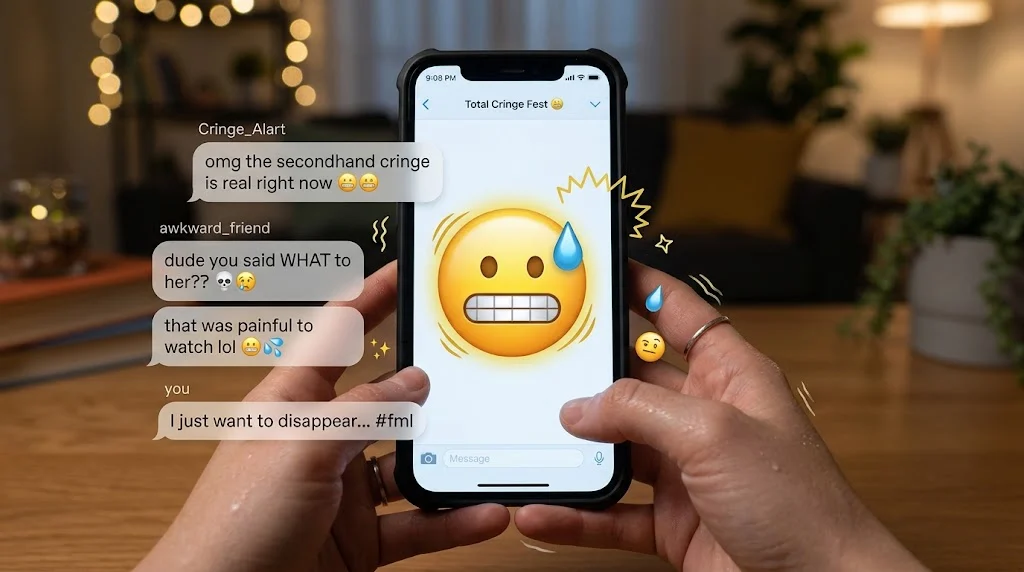
😬 usually means awkward, embarrassed, nervous, or uncomfortable. It is often used as a reaction to cringe-worthy situations, embarrassing mistakes, and secondhand embarrassment. It can also express an uncomfortable smile or a playful reaction when someone does not know what to say.
The cringe emoji 😬, officially called Grimacing Face, usually expresses awkwardness, embarrassment, nervousness, or discomfort. People often send it when something feels uncomfortable, someone makes an embarrassing mistake, or a situation creates an awkward reaction. It can also communicate secondhand embarrassment when watching someone do something awkward.
Depending on the conversation, this emoji may suggest an uncomfortable smile, an uncertain reaction, or a playful way of admitting that something went wrong. Although 😬 is commonly recognized as the cringe face, its meaning is not always negative. Sometimes it simply makes a difficult or embarrassing message sound less serious. The words surrounding it, the situation, and the sender’s usual texting style help determine its intended meaning.
What Does the Cringe Emoji 😬 Mean?
The 😬 emoji shows a yellow face with open eyes and tightly clenched teeth. Its expression resembles someone forcing an uncomfortable smile during an awkward moment.
In everyday messaging, people commonly use it to communicate several feelings.
- Awkwardness: Something feels uncomfortable or socially embarrassing.
- Embarrassment: Someone has made a mistake or experienced an awkward moment.
- Nervousness: A situation creates tension or uncertainty.
- Secondhand embarrassment: Watching another person do something uncomfortable makes you cringe.
- Discomfort: Something feels unpleasant, difficult, or hard to react to.
- Uncertainty: Someone is unsure how to respond to a situation.
The emoji does not always communicate the same emotion. For example, sending 😬 after making a small mistake can make the situation seem funny rather than serious.
However, sending it after an uncomfortable conversation may suggest genuine tension or embarrassment.
Why Do People Use 😬 in Text Messages?
The Grimacing Face emoji is useful because it communicates an uncomfortable reaction without requiring a long explanation.
Here are some common situations where it makes sense.
1. When something embarrassing happens
Someone might use 😬 after forgetting an important detail, making a mistake, or saying something awkward.
Example:
“Oops, I accidentally sent that message to the wrong group 😬”
This suggests embarrassment and acknowledges the mistake.
2. When a situation feels awkward
People may use it when a conversation becomes uncomfortable or someone says something inappropriate.
Example:
“That was a really awkward meeting 😬”
Here, the emoji reinforces the uncomfortable feeling.
3. When reacting to someone else’s embarrassing moment
The emoji can communicate secondhand embarrassment.
Example:
“He called his teacher by the wrong name in front of everyone 😬”
It suggests that watching the situation was uncomfortable.
4. When feeling nervous about something
It can also represent tension before an uncertain event.
Example:
“My job interview starts in five minutes 😬”
In this message, it communicates nervousness rather than embarrassment.
Does 😬 Mean Cringe or Secondhand Embarrassment?
Yes, 😬 can represent both cringe and secondhand embarrassment.
These interpretations are closely related, but there is a small difference.
- Cringe: Something feels awkward, embarrassing, uncomfortable, or difficult to watch.
- Secondhand embarrassment: You feel embarrassed because of something another person does or says.
For example:
“Why did he post that old video? 😬”
This suggests that the video feels embarrassing or uncomfortable to watch.
“She forgot the lyrics during her performance 😬”
This can express secondhand embarrassment because the sender is reacting to someone else’s awkward experience.
The emoji does not necessarily mean the sender is criticizing someone. It can also be a sympathetic reaction to an uncomfortable situation.
Can 😬 Be Sarcastic or Funny?
Yes. The Grimacing Face emoji can add sarcasm or humor to a message, particularly when someone wants to acknowledge an awkward situation without taking it too seriously.
For example:
“Well, that went exactly as planned 😬”
The words sound positive, but the emoji suggests that something probably went wrong.
Another example:
“I definitely didn’t study enough for that exam 😬”
Here, it makes the message sound self-aware and slightly humorous.
However, the emoji alone does not prove that someone is being sarcastic. The surrounding words and conversation determine the reaction is funny, serious, or uncomfortable.
What Does It Mean When Someone Sends You 😬?
When someone sends you 😬, they are usually reacting to something awkward, embarrassing, uncomfortable, or unexpected in your conversation.
The exact interpretation depends on what happened before the emoji.
| Conversation | Possible Meaning |
|---|---|
| You tell them an embarrassing story 😬 | They feel secondhand embarrassment or sympathy. |
| You make an awkward joke 😬 | They may find the joke uncomfortable. |
| You share bad news 😬 | They feel uncomfortable or unsure how to respond. |
| You admit a mistake 😬 | They acknowledge the awkward situation. |
| You mention an upcoming challenge 😬 | They recognize your nervousness. |
It is also worth considering the sender’s usual communication style. Some people use 😬 casually to soften almost any uncomfortable statement, while others reserve it for genuinely awkward situations.
Does it mean they are annoyed with you?
Not necessarily. It may communicate discomfort, surprise, nervousness, or an awkward reaction. Look at the actual message before assuming someone is upset.
Cringe Emoji 😬 Compared With Similar Emojis
Several emojis communicate embarrassment, awkwardness, nervousness, or uncomfortable reactions. However, their facial expressions and emotional intensity are different.
| Emoji | Official Name | Common Meaning | Tone | Where or When It Is Used |
|---|---|---|---|---|
| 😬 | Grimacing Face | Awkwardness, embarrassment, nervousness | Uncomfortable | Cringe moments and mistakes |
| 😖 | Confounded Face | Frustration, distress, discomfort | Intense | Difficult or upsetting situations |
| 😳 | Flushed Face | Shock, embarrassment, surprise | Flustered | Unexpected or embarrassing moments |
| 🫣 | Face with Peeking Eye | Nervous curiosity, embarrassment | Shy, playful | Watching something awkward |
| 🙈 | See-No-Evil Monkey | Embarrassment, playful avoidance | Playful | Funny or uncomfortable situations |
| 😅 | Grinning Face with Sweat | Nervous laughter, relief | Lighthearted | Small mistakes and close calls |
| 😓 | Downcast Face with Sweat | Stress, worry, exhaustion | Worried | Difficult or stressful situations |
| 😵💫 | Face with Spiral Eyes | Confusion, overwhelm, dizziness | Dramatic | Overwhelming or confusing situations |
The most important difference is emotional intensity.
- 😬 vs. 😳: Both can express embarrassment, but 😬 emphasizes an uncomfortable grimace, while 😳 suggests a flushed, surprised, or flustered reaction.
- 😬 vs. 🫣: The peeking face suggests wanting to look while feeling nervous or embarrassed. The grimacing face communicates the uncomfortable reaction more directly.
- 😬 vs. 😅: The sweating smile often makes an awkward moment feel lighter or more humorous. 😬 can communicate stronger discomfort.
- 😬 vs. 🙈: The monkey emoji playfully suggests avoiding what you see, while 😬 shows a direct uncomfortable facial expression.
- 😬 vs. 😖: The confounded face generally communicates more intense frustration or distress than the awkward grimace.
If you want to show an awkward reaction, 😬 is a natural choice. If you want to communicate nervous laughter, 😅 may work better. For a dramatic or embarrassed reaction, 😳 can be more suitable.
Cringe Emoji Examples in Everyday Conversations
Here are some realistic examples showing how the emoji works in different situations.
| Example Message | Likely Meaning |
|---|---|
| “I just waved back at someone who wasn’t waving at me 😬” | Social awkwardness |
| “I forgot her birthday again 😬” | Embarrassment and regret |
| “That joke was so uncomfortable 😬” | Secondhand embarrassment |
| “My presentation is tomorrow and I’m not ready 😬” | Nervousness |
| “I accidentally liked a three-year-old photo 😬” | Playful embarrassment |
| “He really said that out loud? 😬” | Discomfort or surprise |
These examples show why context matters. The same emoji can communicate different levels of awkwardness, from a funny little mistake to a genuinely uncomfortable experience.
How to Respond When Someone Sends 😬
Your response should match the conversation rather than treating the emoji as a message with one fixed meaning.
Here are a few natural responses:
If they are embarrassed:
- “Don’t worry, it happens!”
- “It’s not that bad 😂”
- “We’ve all been there.”
If they are reacting to an awkward situation:
- “I know, that was uncomfortable.”
- “I didn’t know what to say either.”
- “That was definitely awkward.”
If they seem nervous:
- “You’ve got this!”
- “Everything will be fine.”
- “Good luck! Don’t stress too much.”
If you are unsure what they mean:
- “Wait, what happened?”
- “Why the awkward face?”
- “Is everything okay?”
A simple response is usually enough. There is no need to assume that the person is angry, embarrassed about you, or trying to send a hidden romantic message.
Is There a Difference Between the Cringe Emoji and the Awkward Emoji?
People often use the terms cringe emoji and awkward emoji to describe 😬 Grimacing Face.
They generally refer to the same character, but the words describe slightly different reactions.
- Cringe emoji: Often describes an embarrassing or uncomfortable situation that makes someone wince.
- Awkward emoji: Usually describes an uncomfortable social interaction or an uncertain reaction.
For example, watching someone make an embarrassing speech might make you cringe. Receiving an unexpected question during a conversation might simply feel awkward.
The 😬 emoji can represent either situation.
Official Name and Unicode Details
Although many people call 😬 the cringe emoji, its official Unicode name is Grimacing Face.
Here are its identification details:
| Detail | Information |
|---|---|
| Emoji | 😬 |
| Official Unicode Name | Grimacing Face |
| Unicode Code Point | U+1F62C |
| Unicode Version | Unicode 6.1 |
| Introduction Year | 2012 |
| Emoji Version | Emoji 1.0 (2015) |
| Common Search Names | Cringe Face, Awkward Emoji, Nervous Emoji |
The emoji was approved in Unicode 6.1 in 2012 and included in Emoji 1.0 in 2015. Meaning, Copy And Paste+1
One interesting detail is that emoji names and everyday interpretations are not always identical. Unicode provides a standard character name, but people develop informal meanings through everyday communication. Emoji & Pictographs+1
Why Does 😬 Look Different on Different Devices?
The general expression remains recognizable, but the exact design can vary between Apple, Google, Samsung, and other platforms.
Differences may include:
- The shape and width of the mouth.
- How clearly the individual teeth appear.
- The size and position of the eyes.
- The overall intensity of the grimacing expression.
These small design differences can affect how uncomfortable or nervous the emoji appears. Meaning, Copy And Paste
FAQs
1. What is the cringe emoji called?
The cringe emoji 😬 is officially called Grimacing Face in Unicode. People commonly use it to express awkwardness, embarrassment, nervousness, and discomfort.
2. Is 😬 a negative emoji?
It usually communicates an uncomfortable or tense feeling, but it is not always negative. People also use it playfully when making jokes about their own mistakes.
3. Does 😬 mean embarrassment?
Yes. It can express personal embarrassment, especially after an awkward mistake or uncomfortable interaction. It can also represent secondhand embarrassment when watching someone else.
4. Is 😬 the same as 😳?
No. Both can communicate embarrassment, but 😬 shows clenched teeth and an uncomfortable expression, while 😳 represents a flushed or surprised face.
5. Can I use 😬 when something is funny?
Yes. You can use it when something is funny but also awkward or embarrassing. It often adds an uncomfortable or self-conscious feeling to a humorous message.
6. What is the difference between 😬 and 😅?
😬 usually emphasizes awkwardness or discomfort, while 😅 often represents nervous laughter, relief, or an embarrassing situation handled with humor.
7. Is 😬 rude to send someone?
Not automatically. It can be a harmless reaction to an awkward moment. However, sending it after someone’s mistake or embarrassing experience might feel judgmental, depending on the conversation.
8. Can 😬 mean nervousness?
Yes. It can communicate nervous anticipation, uncertainty, or tension before something important, such as an interview, exam, or difficult conversation.
9. What is another emoji for cringe?
Some alternatives include 🫣, 🙈, 😳, and 😅. Each has a slightly different tone, so the best choice depends on you want to express embarrassment, nervousness, or playful discomfort.
Conclusion
The 😬 Grimacing Face emoji is a simple way to express awkwardness, embarrassment, nervousness, and secondhand cringe. Although people commonly call it the cringe emoji, its meaning can change with the situation.
It can make an embarrassing mistake sound funny, show discomfort during an awkward conversation, or communicate nervousness before an important event. Pay attention to the surrounding words and the sender’s tone rather than assuming the emoji always represents the same feeling.
Discover More Related Articles:
- Dog Emoji Mean | From Puppy Love to Everyday Texts In 2026
- Waxing Gibbous Emoji Meaning | What This Moon Really Represents In 2026
- Pumpkin Emoji Mean | Halloween, Fall & Everyday Uses In 2026

Matthew Garcia is a content writer at EmojisPeace.com, where she creates fun, expressive and easy-to-use emoji collections for every mood and moment. Passionate about digital expression, she helps readers find the perfect emojis to make every message more creative and memorable.