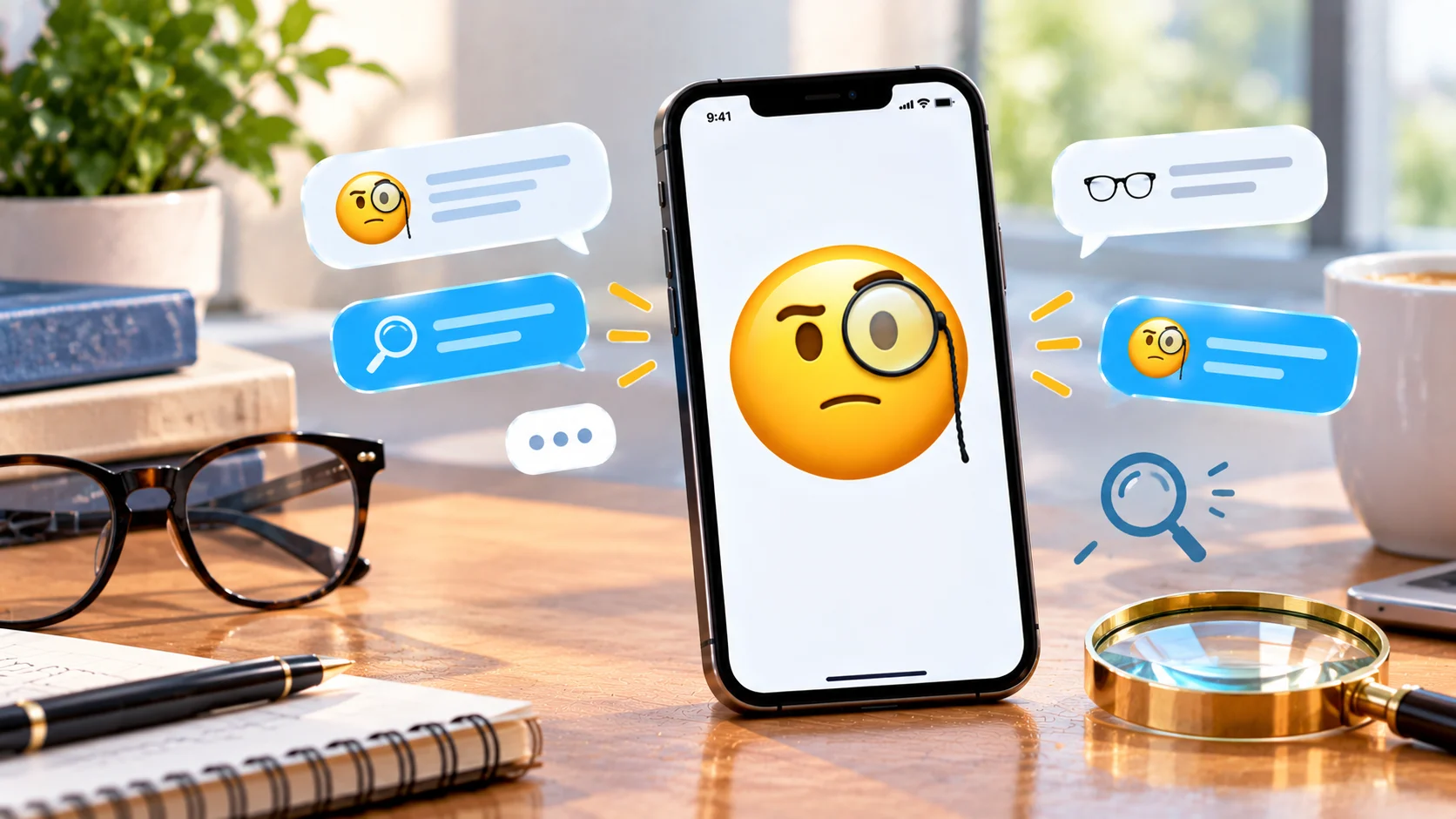
🧐 usually means “I’m looking closely,” “I’m investigating,” or “I’m not completely convinced.” It can express curiosity, careful thought, skepticism, or playful sophistication. In texting, it can also sound teasing or sarcastic. The words around it matter, so 🧐 does not automatically mean suspicion or intelligence.
The monocle emoji 🧐 officially means Face with Monocle. It commonly shows someone looking closely at something, thinking carefully, questioning a claim, or examining details. Depending on the message, it can also suggest skepticism, curiosity, sophistication, or playful “I’m investigating this” energy. Emojipedia describes the face as having a furrowed brow and an upturned head, as if carefully inspecting something.
The exact meaning depends on context. A message like “Interesting… 🧐” may sound curious or skeptical, while “Look who’s fancy 🧐” can use the same emoji for humor or a sophisticated, slightly smug tone.
Monocle Emoji Copy and Paste
🧐
You can copy the Face with Monocle emoji directly and use it in texts, comments, captions, messages, or social posts.
Emoji: 🧐
Official Unicode name: Face with Monocle
Unicode code point: U+1F9D0
Category: Smileys & Emotion
Subcategory: Face-Glasses
Unicode’s current Emoji 18.0 list identifies 🧐 as face with monocle and assigns it the code point U+1F9D0.
What Does the Monocle Emoji 🧐 Mean?
The most common idea behind 🧐 is careful examination.
It can communicate:
- “Let me take a closer look.”
- “I’m investigating this.”
- “Hmm, is that really true?”
- “That sounds suspicious.”
- “I’m thinking about what you said.”
- “Interesting… tell me more.”
- “I see what you’re doing.”
- “Look at me being sophisticated.”
The emoji was approved as part of Unicode 10.0 in 2017 and added to Emoji 5.0 that same year.
Unicode’s name identifies the character, but the name does not define every possible meaning. Unicode itself explains that emoji meanings can extend beyond their character names, with annotations and keywords helping describe intended usage.
🧐 Meaning in Text
In a text message, 🧐 often gives the impression that the sender is examining, questioning, or paying extra attention to something.
For example:
“You said you were only going to buy one thing 🧐”
Here, 🧐 can suggest playful suspicion.
Another example:
“That explanation was interesting 🧐”
This could mean the sender is genuinely curious, skeptical, or lightly teasing you.
The emoji does not automatically mean the sender believes someone is lying. The surrounding conversation determines how strong the suspicion feels.
🧐 Emotional Tone
The monocle emoji has a distinctive tone because it combines a serious-looking facial expression with an old-fashioned monocle.
Depending on context, it can feel:
Curious:
“I wonder what this is about 🧐”
Skeptical:
“Are you sure about that? 🧐”
Analytical:
“Let me check the numbers 🧐”
Playfully suspicious:
“Interesting… you suddenly remembered my birthday 🧐”
Sophisticated:
“Excellent choice, my friend 🧐”
Sarcastic:
“Oh, so now you want to help? 🧐”
The same emoji can therefore move from genuine curiosity to obvious humor.
When Someone Sends 🧐, What Does It Mean?
When someone sends 🧐 by itself, the most useful interpretation is usually “I’m looking at this carefully” or “Hmm, I have questions.”
For example:
You: “I definitely didn’t eat your cake.”
Them: “🧐”
That one-character reply could jokingly communicate, “I don’t believe you.”
But consider a different conversation:
You: “Here’s the design for the new website.”
Them: “🧐”
Here, it may simply mean they are examining the idea.
This is why a single emoji should not be treated as a complete statement. Conversation history and the surrounding words provide important context.
Is 🧐 a Sarcastic Emoji?
It can be. 🧐 is often useful for playful skepticism or mock seriousness.
For example:
“Wow, you answered my text in only three days 🧐”
The emoji adds a teasing, suspicious tone.
Another example:
“So you just happened to be at the same restaurant? 🧐”
Here, the emoji can make the sentence sound more suspicious or playful.
However, 🧐 does not guarantee sarcasm. Someone can use it sincerely when examining information or asking a serious question.
Is the Monocle Emoji Rude?
Not necessarily.
By itself, 🧐 is usually more questioning or observant than openly rude. But it can feel judgmental if it follows an accusation, criticism, or skeptical statement.
Compare:
“Interesting idea 🧐”
This could be curious.
With:
“You really thought that was a good idea? 🧐”
This is much more likely to sound critical or sarcastic.
The words create much of the emotional force.
Is 🧐 a Flirty Emoji?
The monocle emoji does not have a standard romantic or flirty meaning.
Someone might use it in a playful conversation that happens to be flirtatious, but 🧐 alone does not prove attraction or romantic interest.
For example:
“Oh, so that’s your type? 🧐”
Depending on the conversation, this could be playful curiosity, teasing, or flirting. The emoji itself does not determine which interpretation is correct.
🧐 Meaning From Someone
If someone sends you 🧐 after making a comment or reading your message, consider what happened immediately before it.
It may mean:
- They are questioning what you said.
- They want more information.
- They are pretending to investigate.
- They are jokingly suspicious.
- They think something deserves a closer look.
- They are using a sophisticated or “detective” persona for humor.
Avoid assuming that the person is angry or accusing you of something unless their words support that interpretation.
Monocle Emoji vs. Similar Emojis
| Emoji | Official Name | Common Meaning | Tone | Where or When It Is Used |
|---|---|---|---|---|
| 🧐 | Face with Monocle | Scrutiny, curiosity, investigation | Curious, skeptical, playful | Examining claims, teasing, careful observation |
| 🤔 | Thinking Face | Thinking, considering, uncertainty | Thoughtful, neutral | Questions, decisions, reflection |
| 🤨 | Face with Raised Eyebrow | Doubt, skepticism, questioning | Skeptical, suspicious | Questioning a statement or reaction |
| 🤓 | Nerd Face | Studying, knowledge, enthusiasm | Playful, intellectual | School, facts, hobbies, “nerdy” humor |
| 😏 | Smirking Face | Smugness, confidence, suggestive humor | Teasing, smug, sometimes flirty | Jokes, teasing, double meanings |
| 👀 | Eyes | Watching, noticing, curiosity | Curious, playful | Interesting news, gossip, attention |
| 🔍 | Magnifying Glass Tilted Left | Searching, examining, investigation | Neutral, investigative | Looking for details or information |
| 🕵️ | Detective | Investigation, detective work | Playful, mysterious | Solving mysteries, jokes, investigation |
The most commonly confused emojis here are 🧐, 🤔, and 🤨.
🧐 has a stronger “let me inspect this” feeling. 🤔 is more about thinking or considering something. 🤨 usually carries more direct doubt or skepticism.
👀 can also overlap with 🧐 when someone wants to say they are paying attention, but 👀 is simpler and less analytical.
🧐 vs. 🤔: What’s the Difference?
🧐 Face with Monocle suggests inspection, scrutiny, or a closer look.
🤔 Thinking Face suggests thought, uncertainty, or consideration.
Compare:
“Hmm, I need to check those numbers. 🧐”
This sounds like careful examination.
“Hmm, I need to think about it. 🤔”
This focuses more on making a decision.
🧐 vs. 🤨: What’s the Difference?
These two are especially easy to confuse.
🧐 often suggests investigation or careful observation.
🤨 more directly communicates doubt or skepticism.
For example:
“Let me investigate this a little more 🧐”
sounds curious.
“You expect me to believe that? 🤨”
sounds more doubtful.
Both can be sarcastic, but 🤨 generally makes the skepticism more obvious.
🧐 vs. 🤓: What’s the Difference?
Both can sometimes have an intellectual or knowledgeable feel, but they serve different purposes.
🧐 focuses on examining or questioning something.
🤓 Nerd Face is more associated with studying, knowledge, enthusiasm about facts, or a playful “nerdy” identity.
For example:
“Let’s check the evidence 🧐”
focuses on investigation.
“I actually love doing math problems 🤓”
focuses on enthusiasm for a subject.
How People Use 🧐 in Realistic Messages
“Wait… how did you know that? 🧐”
Likely meaning: genuine curiosity with a slightly suspicious edge.
“That sounds suspicious 🧐”
Likely meaning: direct playful skepticism.
“Let me look at this again 🧐”
Likely meaning: careful examination.
“Well, well, well… 🧐”
Likely meaning: playful observation or teasing.
“Interesting choice of words 🧐”
Likely meaning: the sender noticed something and may be questioning it.
“I see you’ve done your research 🧐”
Likely meaning: playful recognition of someone’s knowledge or preparation.
How to Respond to 🧐
The best response depends on what the sender appears to mean.
If they seem curious:
“What caught your attention? 😄”
If they are teasing you:
“Why are you looking at me like that? 😂”
If they seem skeptical:
“Okay, what part don’t you believe? 😅”
If they’re joking about investigating:
“Detective mode activated? 🕵️”
If you are unsure:
“What does that look mean? 😂”
A short clarification can prevent you from reading too much into a single emoji.
Does 🧐 Mean Smart or Intelligent?
It can suggest an intellectual or sophisticated character, especially because of the traditional monocle design, but it does not literally mean “smart.”
For example:
“Let me examine the evidence 🧐”
creates an analytical impression.
But:
“Look at this fancy dinner 🧐”
could simply be humorous.
The “smart” or “sophisticated” feeling comes from the visual style and context rather than an official definition that says the emoji represents intelligence.
Does 🧐 Mean Suspicious?
It can suggest suspicion, especially when paired with questioning language.
For example:
“You said you were asleep at 8, but you posted at 10 🧐”
Here, the emoji clearly strengthens the skeptical tone.
But 🧐 can also be used for simple curiosity:
“I wonder what’s inside this box 🧐”
So “suspicious” is one possible interpretation, not a guaranteed meaning.
Why Does the Monocle Emoji Look So Serious?
The emoji depicts a yellow face with a monocle, furrowed eyebrows, and an expression that can look like careful inspection. Emojipedia describes the design as if the face is looking closely at something and notes interpretations including pondering, questioning, skeptical observation, and sophistication.
The monocle itself also gives the emoji a deliberately old-fashioned appearance. That visual style is one reason it works well for jokes involving being a detective, critic, intellectual, or overly serious observer.
Does the Monocle Emoji Look the Same Everywhere?
No. Emoji artwork can vary between platforms and vendors.
The underlying Unicode character is the same U+1F9D0, but individual companies can design their own visual version. Emojipedia’s vendor pages show that the appearance of 🧐 can differ between emoji sets.
These design differences can affect details such as the shape of the monocle, facial expression, eyes, eyebrows, and overall style.
The basic meaning remains connected to Face with Monocle, but the visual tone can feel slightly different depending on the platform.
Official Monocle Emoji Facts
Emoji: 🧐
Official Unicode name: Face with Monocle
Code point: U+1F9D0
Unicode version: Unicode 10.0
Emoji version: Emoji 5.0
Category: Smileys & Emotion
Subcategory: Face-Glasses
Unicode’s current Emoji 18.0 charts list 🧐 as face with monocle with the code point U+1F9D0.
The character was approved in 2017 as part of Unicode 10.0 and added to Emoji 5.0 in 2017.
FAQs
What does the 🧐 emoji mean?
🧐 usually expresses careful observation, curiosity, questioning, or skepticism. It can also create a sophisticated, playful, or sarcastic tone depending on the message.
What is the official name of 🧐?
The official Unicode name is Face with Monocle. Its Unicode code point is U+1F9D0.
What does 🧐 mean from a girl or guy?
The emoji does not have different standard meanings based on the sender’s gender. Look at the surrounding words, conversation history, and tone instead.
Is 🧐 a suspicious emoji?
It can be used to show suspicion or doubt, especially after a questionable statement. However, it can also simply mean curiosity or careful examination.
Is 🧐 a sarcastic emoji?
It can add sarcasm or playful skepticism to a message, but the emoji itself is not automatically sarcastic. The wording and conversation determine the tone.
What is the difference between 🧐 and 🤨?
🧐 tends to suggest looking closely or investigating, while 🤨 more directly conveys doubt or skepticism. Both can be used playfully.
What is the difference between 🧐 and 🤔?
🧐 is more focused on inspection or scrutiny, while 🤔 usually represents thinking, considering, or uncertainty.
Can 🧐 mean flirting?
It can appear in a playful or flirtatious conversation, but it has no standard flirting meaning. The surrounding message matters more than the emoji alone.
Conclusion
The monocle emoji 🧐 is officially called Face with Monocle and commonly conveys careful observation, curiosity, scrutiny, or questioning. It can also add a playful sophisticated, skeptical, or sarcastic tone.
When choosing between similar emojis, think about the feeling you want: 🧐 for inspection, 🤔 for thinking, 🤨 for stronger doubt, and 👀 for simply showing attention.
Discover More Related Articles:
- Hehe Emoji Meaning | What [hehe] Means on TikTok & in Texts In 2026
- Chain Emoji Meaning | What Does It Mean in Text In 2026
- Thumbs Up Emoji Copy & Paste | What It Means & Why One Small Gesture Can Say So Much In 2026

Jessica Miller is a content writer at EmojisPeace.com, where she creates fun and easy-to-follow guides about emojis, their meanings and creative ways to use them. She loves helping readers express themselves with the perfect emoji for every moment.