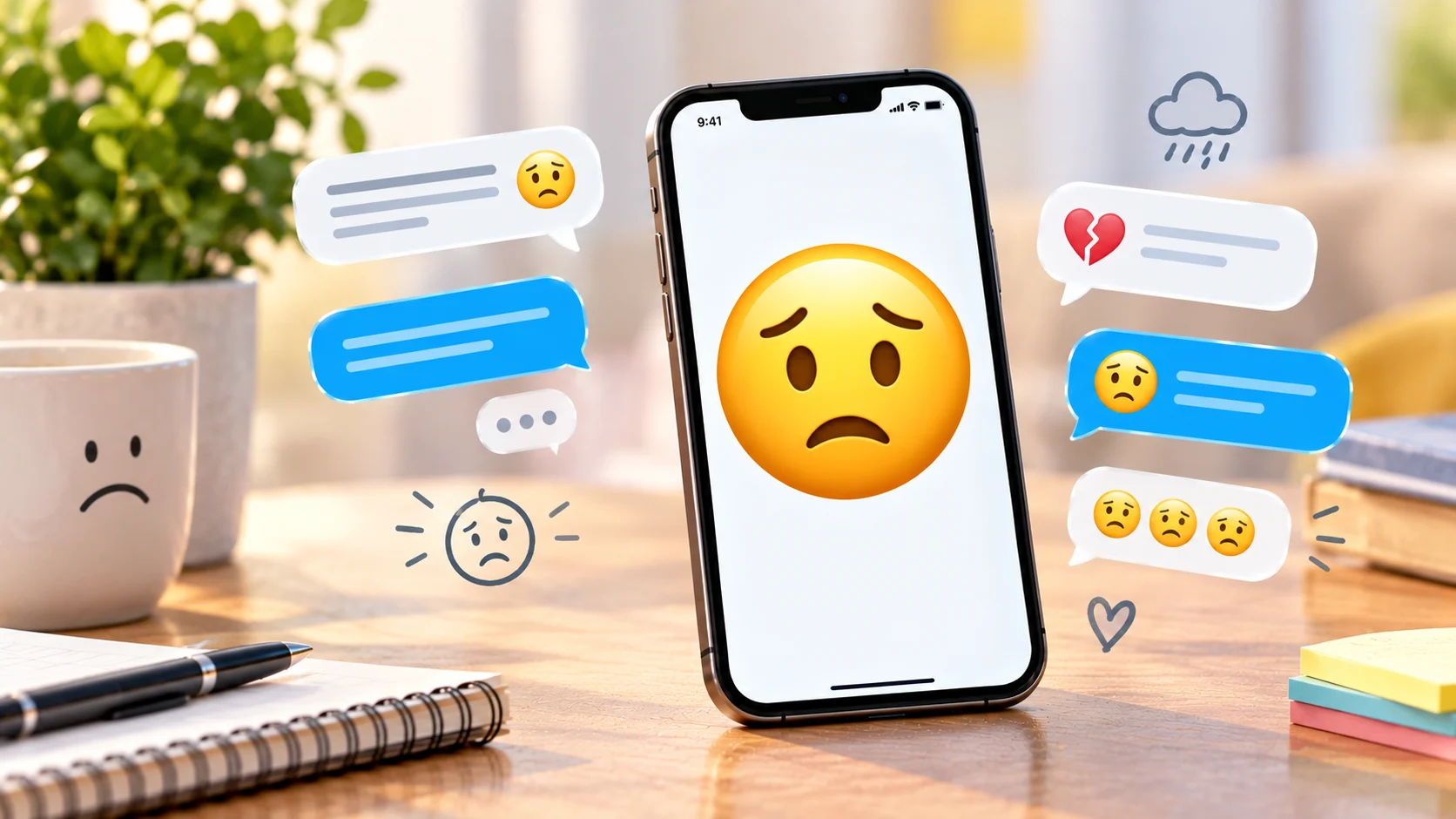
😟 usually means worry, concern, nervousness, stress, or mild sadness. It often shows that something feels wrong or uncertain. In a text, 😟 can mean “I’m worried,” “I’m concerned,” or “I don’t feel good about this.” The surrounding words determine how serious the emotion is.
The concerned emoji 😟 is commonly used to show worry, concern, nervousness, stress, or mild unhappiness. Its official Unicode name is Worried Face, not “Concerned Face.” Unicode identifies 😟 as U+1F61F and places it in the “face-concerned” group.
In texting, 😟 can mean “I’m worried about this,” “That doesn’t sound good,” or “I’m concerned about you.” The exact feeling depends on the message around it, so it can range from mild concern to stronger anxiety or disappointment.
What Does the Concerned Emoji 😟 Mean?
Although people often call 😟 the concerned emoji, its official Unicode name is Worried Face. Unicode lists keywords such as anxious, butterflies, nervous, sad, stress, stressed, surprised, worried, and worry.
The face has raised or furrowed eyebrows, open eyes, and a frown. This expression gives it a tense, uneasy feeling rather than the stronger fear shown by 😨 or 😱.
Emojipedia describes 😟 as expressing moderately sad or tense emotions that can include concern, anxiety, alarm, disappointment, and unhappiness.
So, depending on the conversation, 😟 can communicate:
- Concern about another person
- Worry about a situation
- Nervousness about what may happen
- Stress or uncertainty
- Mild unhappiness
- Disappointment
- A reaction to bad or unexpected news
It does not automatically mean something serious has happened.
😟 Concerned Emoji Meaning in Text
In messages, 😟 often adds emotional concern to words that might otherwise sound neutral.
For example:
“You haven’t replied all day 😟”
Here, the emoji can suggest genuine worry about the other person’s well-being.
Compare that with:
“I don’t think this plan is going to work 😟”
Now the same emoji expresses concern about a situation rather than a person.
It can also soften a short statement:
“That doesn’t sound good 😟”
The emoji makes the message feel more emotionally affected and concerned.
What Does 😟 Mean From Someone?
When someone sends 😟 directly to you, they may be showing that they are worried about you, concerned by something you said, or uneasy about a situation.
For example:
“You said you haven’t been feeling great 😟”
Here, the emoji likely reinforces concern or sympathy.
But it is better not to assume exactly what the sender feels from 😟 alone. Their words, your conversation history, timing, and usual communication style provide more context.
If someone simply sends:
“😟”
it could mean anything from “I’m worried” to “That makes me uncomfortable” or “I’m not sure about this.”
Is 😟 a Sad Emoji or a Worried Emoji?
😟 is closer to worry or concern than straightforward sadness.
A useful distinction is:
😟 Worried Face: “I’m concerned about what is happening.”
😢 Crying Face: “I’m sad or hurt.”
😭 Loudly Crying Face: “I’m extremely upset or crying intensely.”
😞 Disappointed Face: “I’m unhappy or disappointed about the outcome.”
These emotions can overlap. Someone who is worried may also be sad, but 😟 usually puts more emphasis on uneasiness and concern.
😟 vs. 😰: Concerned or Anxious?
The difference between 😟 and 😰 can be subtle.
😟 Worried Face usually shows worry, concern, nervousness, or uneasiness without the visible sweat element.
😰 Anxious Face with Sweat adds a stronger sense of anxiety, nervousness, pressure, or distress. Unicode officially calls 😰 Anxious Face with Sweat.
For example:
“I’m worried about tomorrow 😟”
sounds concerned.
“My flight is delayed and I might miss my connection 😰”
can suggest a more intense or stressful situation.
The surrounding message still matters more than a strict emotional scale.
Is the Concerned Emoji 😟 Flirty?
😟 does not have a standard flirty meaning.
Someone might use it while talking to a romantic partner or potential partner, but the emoji itself usually communicates concern, worry, or uneasiness rather than attraction.
For example:
“You disappeared without saying goodbye 😟”
could sound emotionally concerned, but the message is romantic depends on the relationship and the rest of the conversation.
Avoid treating 😟 by itself as proof of flirting or romantic interest.
Can 😟 Be Sarcastic?
Yes, context can make 😟 sarcastic or playful.
For example:
“Oh no, you have to eat another slice of pizza 😟”
The words make the situation obviously playful, so the emoji can act as exaggerated fake concern.
Another example:
“You got promoted? That’s terrible 😟”
Here, the surrounding wording can make the worried expression intentionally ironic.
The emoji itself does not have a fixed sarcastic meaning. The sentence creates that interpretation.
Concerned Emoji 😟 in Different Situations
When Someone Is Worried About You
“Please text me when you get home 😟”
This can express genuine concern for someone’s safety or well-being.
When Something Seems Wrong
“The website isn’t working again 😟”
Here, 😟 shows frustration or concern about a problem.
When Someone Gives Bad News
“I have to cancel our plans tomorrow 😟”
The emoji may communicate regret or disappointment.
When Someone Is Unsure
“Are you sure this is a good idea? 😟”
The emoji reinforces hesitation or doubt.
When Used as a Joke
“You finished the entire cake without me 😟”
The exaggerated concern can make the message playful rather than genuinely upset.
Emojis Similar to the Concerned Emoji
| Emoji | Official Name | Common Meaning | Tone | Where or When It Is Used |
|---|---|---|---|---|
| 😟 | Worried Face | Concern, worry, uneasiness | Concerned | Bad news, uncertainty, personal worries |
| 😰 | Anxious Face with Sweat | Anxiety, nervousness, stress | More tense | Pressure, stressful situations, nervous reactions |
| 😕 | Confused Face | Confusion, uncertainty, doubt | Uncertain | Mixed signals, unclear information |
| 😥 | Sad but Relieved Face | Sadness mixed with relief | Emotional | Difficult situations that end with some relief |
| 😞 | Disappointed Face | Disappointment, unhappiness | Sad | Letdowns, failed plans, unwanted outcomes |
| 😧 | Anguished Face | Distress, worry, emotional pain | Stronger distress | Serious or upsetting situations |
| 😨 | Fearful Face | Fear, fright, alarm | Fearful | Scary or threatening situations |
| 🥺 | Pleading Face | Pleading, vulnerability, wanting sympathy | Soft/emotional | Requests, apologies, affection, emotional reactions |
The closest comparisons are 😟, 😰, and 😨. 😟 usually communicates concern or worry, 😰 adds visible anxiety or stress, while 😨 is more clearly about fear. 😞 is more focused on disappointment, and 😕 is more about confusion or uncertainty. Unicode’s current emoji list places these faces in closely related concerned and negative-emotion groups.
😟 vs. 😕: Concerned or Confused?
These two emojis are easy to mix up.
😟 generally says:
“I’m worried about this.”
😕 generally says:
“I don’t understand this.”
For example:
“The doctor wants another test 😟”
shows concern.
“I don’t understand what the doctor meant 😕”
shows confusion.
A person can use both if they are confused and worried:
“I’m not sure what this means 😕😟”
😟 vs. 😞: Worried or Disappointed?
😟 Worried Face looks toward a problem that may happen or is currently causing concern.
😞 Disappointed Face is more naturally connected with an unwanted result or letdown.
Compare:
“I hope everything goes well tomorrow 😟”
with:
“I can’t believe the event was canceled 😞”
The first focuses on worry about what is ahead. The second focuses on disappointment about what happened.
😟 vs. 🥺: Concerned or Pleading?
🥺 can look emotional and vulnerable, but it often has a different conversational purpose.
“Please don’t cancel 😟”
can express concern or disappointment.
“Please don’t cancel 🥺”
can sound more like a plea or an attempt to gain sympathy.
Neither interpretation is guaranteed, but the wording around the emoji can make the difference clearer.
How to Respond to 😟
The best response depends on why the person sent it.
If they seem worried about you:
“I’m okay, don’t worry. ❤️”
If they are concerned about a problem:
“Yeah, I’m worried about it too. I’ll figure it out.”
And if you are unsure what they mean:
“What’s wrong? 😟”
If they are joking:
“Haha, you’ll survive. 😂”
Concerned Emoji Copy and Paste
😟 — Worried Face
You can copy and paste it anywhere that supports emoji.
Related options:
😰 — Anxious Face with Sweat
😕 — Confused Face
😞 — Disappointed Face
😥 — Sad but Relieved Face
😧 — Anguished Face
😨 — Fearful Face
🥺 — Pleading Face
Choose 😟 when you want the message to feel concerned or worried without necessarily suggesting intense fear or sadness.
Official Name and Unicode Details
The official Unicode name for 😟 is WORRIED FACE.
- Emoji: 😟
- Unicode code point: U+1F61F
- Official name: Worried Face
- Unicode Emoji version: Emoji 1.0
- Unicode approval: Unicode 6.1
- Current Unicode data: Emoji 18.0
Emojipedia reports that Worried Face was approved in Unicode 6.1 in 2012 and added to Emoji 1.0 in 2015.
Unicode’s current chart continues to identify U+1F61F as Worried Face and lists related keywords including worry, worried, anxious, nervous, stress, and stressed.
Does the Concerned Emoji Look Different on Different Devices?
Yes. Emoji artwork can vary between platforms and vendors even when the underlying Unicode character is the same.
For example, Emojipedia notes that Apple’s 😟 design uses an eye expression also seen on 😯 Hushed Face, while an earlier Samsung design included sweat droplets.
These visual differences can slightly change how an emoji feels. The standardized character remains Worried Face, even though its artwork can differ.
FAQs
What does the concerned emoji 😟 mean?
😟 officially means Worried Face and commonly expresses concern, worry, nervousness, stress, or mild unhappiness. The exact emotion depends on the surrounding message.
What does 😟 mean in texting?
In texting, 😟 often means “I’m worried,” “I’m concerned,” or “That doesn’t sound good.” It can also show uncertainty or disappointment depending on the conversation.
Is 😟 a sad emoji?
😟 can express mild sadness, but worry and concern are usually more central to its meaning. 😢 and 😞 are often clearer choices when the main emotion is sadness or disappointment.
What is the difference between 😟 and 😰?
😟 is Worried Face, while 😰 is Anxious Face with Sweat. 😰 can add a stronger sense of anxiety, pressure, or nervousness, although context can overlap.
What is the difference between 😟 and 😕?
😟 usually expresses worry or concern, while 😕 more often expresses confusion or uncertainty. A message can contain both emotions at the same time.
Does 😟 mean someone is flirting?
Not by itself. 😟 has no standard flirty meaning, and any romantic interpretation would depend on the surrounding conversation and relationship.
Can 😟 be sarcastic?
Yes. A clearly playful sentence can turn 😟 into exaggerated or fake concern, but the emoji itself does not officially mean sarcasm.
Conclusion
The concerned emoji 😟 is officially called Worried Face and usually communicates worry, concern, nervousness, or uneasiness. It can also express mild sadness, disappointment, or stress when the context supports those readings.
When choosing between similar emojis, think about the main feeling: 😟 for concern, 😰 for anxiety, 😕 for confusion, 😞 for disappointment, and 😨 for fear. No single emoji can fully explain a person’s feelings without the surrounding conversation.
Discover More Related Articles:
- Hehe Emoji Meaning | What [hehe] Means on TikTok & in Texts In 2026
- Chain Emoji Meaning | What Does It Mean in Text In 2026
- Thumbs Up Emoji Copy & Paste | What It Means & Why One Small Gesture Can Say So Much In 2026

Matthew Garcia is a content writer at EmojisPeace.com, where she creates fun, expressive and easy-to-use emoji collections for every mood and moment. Passionate about digital expression, she helps readers find the perfect emojis to make every message more creative and memorable.
5 thoughts on “Concerned Emoji 😟 Meaning | What Does It Mean in Text In 2026”