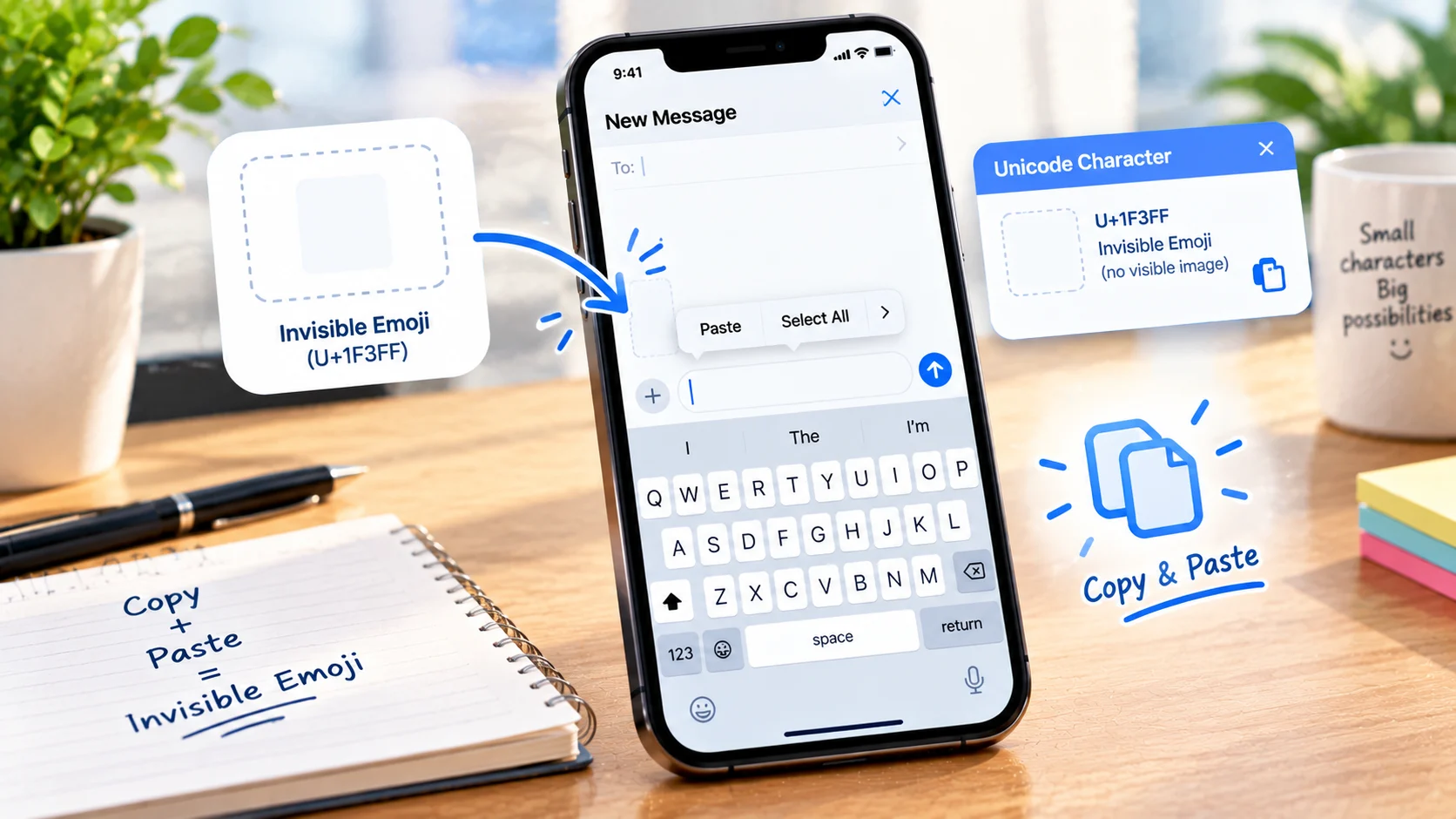
There is no official Unicode “invisible emoji.” The phrase usually refers to invisible Unicode characters such as the Zero Width Space (U+200B) or other blank-looking characters. For copy and paste, use a compatible invisible character rather than an emoji. Support varies by website, app, game, and text field.
An invisible emoji is usually not an actual emoji. People often use the term to describe an invisible or blank Unicode character that looks empty but can still be part of a text string. One commonly used example is the Zero Width Space (U+200B). Unicode defines it as a character with no visible width that can create an invisible line-break opportunity.
If you want invisible text for a blank-looking message, username, profile space, or formatting experiment, the character you need depends on the app. Some platforms accept invisible Unicode characters, while others remove, ignore, or block them.
Invisible Emoji Copy and Paste
If you are looking for an invisible character to copy, this is a Zero Width Space (U+200B):
Copy the character between these brackets: []
The space between the brackets is intentionally invisible. There is a real Unicode character inside them even though you cannot normally see it.
You can also copy a blank-looking character such as:
ㅤ
This is Hangul Filler (U+3164). Unlike U+200B, it has a visible character width even though it appears blank. It is therefore better described as a blank-looking character, not a true zero-width character.
Because different platforms handle Unicode differently, a character that works in one text field may be removed or rejected somewhere else.
Is There an Invisible Emoji?
No. “Invisible emoji” is not the official name of a Unicode emoji.
Emoji are visible characters or sequences that are designed to produce emoji-style pictographs. Invisible Unicode characters are different. They are generally used for text processing, joining, spacing, line breaking, direction, or other formatting behavior.
Unicode identifies U+200B as ZERO WIDTH SPACE. It has no width and is used to provide an invisible opportunity for a line break.
Another commonly misunderstood character is U+200D ZERO WIDTH JOINER (ZWJ). Emojipedia explains that ZWJ is not an emoji itself; it is an invisible character that can join other characters together to create certain emoji sequences.
What Does an Invisible Emoji Mean?
An invisible character does not have an emotional meaning like 😀, ❤️, 😂, or 😭.
Its purpose depends on the particular Unicode character.
For example:
- U+200B Zero Width Space — provides an invisible break opportunity.
- U+200D Zero Width Joiner — connects characters and is used in emoji sequences.
- U+200C Zero Width Non-Joiner — prevents certain characters from joining.
- U+2060 Word Joiner — prevents a line break between characters.
- U+00AD Soft Hyphen — provides an optional hyphenation point.
Unicode identifies these as characters with formatting, joining, or text-layout functions rather than ordinary visible symbols.
Why Do People Use Invisible Characters?
People search for invisible emoji or invisible text for several practical reasons.
Blank-looking messages
An invisible character can sometimes create a message that appears empty even though the message field contains a Unicode character.
This works depends on the messaging service. Some apps automatically remove invisible characters.
Blank usernames or profile spaces
Some websites and games may accept blank-looking Unicode characters in names or profile fields.
However, this is controlled by each platform. A service can restrict particular Unicode characters, normalize them, or prevent names that appear empty.
Spacing and formatting
Zero-width characters can have legitimate technical uses. Unicode specifically describes U+200B as a way to create additional invisible line-break opportunities where a normal space cannot be used.
Emoji combinations
ZWJ is especially relevant to emoji. It can join multiple characters into a single emoji sequence.
For example, the invisible joiner can help turn separate characters into a combined emoji sequence when that sequence is supported by the emoji standard and the platform.
Zero Width Space vs. Zero Width Joiner
These two characters are easy to confuse because both are invisible.
| Character | Official Unicode Name | Code Point | Main Purpose | Emoji Connection |
|---|---|---|---|---|
| Zero Width Space | U+200B | Invisible break opportunity | Not an emoji itself | |
| | Zero Width Non-Joiner | U+200C | Prevents joining | Used in text shaping |
| | Zero Width Joiner | U+200D | Joins characters | Used in many emoji sequences |
| | Word Joiner | U+2060 | Prevents line breaks | General text formatting |
| | Soft Hyphen | U+00AD | Optional hyphenation | Not an emoji |
The most important difference is between U+200B and U+200D. A Zero Width Space is primarily a text-layout character, while a Zero Width Joiner can connect characters as part of an emoji sequence. Unicode and Emojipedia both distinguish these functions.
Invisible Emoji vs. Blank Character
These terms are often mixed together online, but they are not exactly the same.
An invisible character normally means a Unicode character that has no visible rendering or appears empty.
A blank character may look empty but still occupy space. For example, Hangul Filler (U+3164) can appear blank while taking up character width.
An invisible emoji is usually an informal search term rather than the name of an official Unicode emoji.
This distinction matters because different characters behave differently when you paste them into a text field.
Which Invisible Character Should You Use?
Choose the character based on what you actually need.
For zero-width text: U+200B Zero Width Space is the relevant character.
For emoji composition: U+200D Zero Width Joiner is the relevant character.
And for preventing a line break: U+2060 Word Joiner is designed for that purpose. Unicode recommends Word Joiner for keeping characters together across a line break.
There is no single invisible character that works everywhere.
Invisible Emoji Examples
Zero Width Space
Copy the character inside the brackets:
[]
There is a U+200B character between the brackets. It normally has no visible width.
Zero Width Joiner
The Zero Width Joiner (U+200D) is also invisible when used by itself.
Its more important role is connecting characters in supported sequences. Emojipedia describes it as a character that joins two or more characters to create a new emoji sequence.
Blank-looking Hangul Filler
ㅤ
This character is different from a zero-width space. It can appear empty but occupies space, so it may behave differently in usernames, messages, or layouts.
Does Invisible Text Really Work Everywhere?
No.
Invisible characters are handled differently by different apps and websites. A platform may:
- Accept the character normally
- Remove it automatically
- Replace or normalize it
- Prevent it from being submitted
- Count it toward a character limit
- Display a visible placeholder in some circumstances
Unicode itself defines how the characters work, but it does not control how every website, game, social network, or messaging app processes them.
This is why a copy-and-paste invisible character can work in one text field and fail in another.
Can Invisible Characters Be Detected?
Yes.
“Invisible” does not mean “nonexistent.”
A text editor, Unicode inspector, developer tool, or character-analysis utility can identify characters that do not have a normal visible glyph. Unicode’s documentation explains that default-ignorable characters can be rendered invisibly, while software can still process their underlying character values.
For example, two strings may look identical on screen but contain different Unicode characters.
That can matter when comparing usernames, checking copied text, debugging formatting, or investigating why two apparently identical strings behave differently.
Are Invisible Characters Safe?
Invisible characters are legitimate parts of Unicode and have many normal technical uses.
However, hidden characters can also make text harder to inspect. For that reason, you should be careful when copying text from an unknown source, especially when it involves usernames, links, account identifiers, code, or other information where exact character matching matters.
An invisible character is not automatically harmful, but its hidden nature means you should not assume two visually identical strings are actually identical.
Why Does ZWJ Matter for Emojis?
The Zero Width Joiner is one of the clearest examples of why an “invisible emoji” can be a confusing phrase.
ZWJ itself is invisible, but it can participate in an emoji sequence that produces a visible emoji.
In simple terms:
Visible emoji + invisible ZWJ + visible emoji → supported combined emoji sequence
This is why some emoji appear to be a single character even though they are made from multiple Unicode characters.
Emojipedia specifically describes ZWJ as an invisible character used to join characters together into emoji sequences.
Common Invisible Character Mistakes
Mistake 1: Calling every blank Unicode character an emoji
Not every character that looks blank is an emoji. Many are ordinary Unicode formatting or spacing characters.
Mistake 2: Assuming Zero Width Space and Zero Width Joiner do the same thing
They do not. U+200B is associated with invisible line-break opportunities, while U+200D is used as a joiner, including in emoji sequences.
Mistake 3: Assuming one character works on every platform
Compatibility depends on the software processing the text.
Mistake 4: Assuming invisible means zero characters
An invisible Unicode character can still be present in the underlying text.
Invisible Emoji and Copy-Paste: What to Know
If your goal is simply to paste blank-looking text, U+200B Zero Width Space is one of the most relevant characters to understand.
If your goal is to create an emoji combination, look at U+200D Zero Width Joiner instead.
And if your goal is a blank-looking name or profile field, compatibility becomes especially important. A character that works in one service may not work after an update or may be rejected by another service.
So rather than searching for one universal “invisible emoji,” identify the type of invisible Unicode character your specific use requires.
FAQs
Is there a real invisible emoji?
No. “Invisible emoji” is an informal term usually used for blank-looking or zero-width Unicode characters. U+200B and U+200D are invisible Unicode characters, not standalone emojis.
What is the invisible character to copy and paste?
A commonly used option is U+200B Zero Width Space: copy the character inside these brackets []. It has no normal visible width, although some platforms may remove it.
What is the Unicode code for invisible text?
One common invisible character is U+200B, officially named ZERO WIDTH SPACE. Unicode describes it as a character used to create an invisible line-break opportunity.
What is the difference between invisible emoji and ZWJ?
ZWJ means Zero Width Joiner, U+200D. It is invisible by itself but can join characters together to form supported emoji sequences.
Can I send a completely blank message with an invisible character?
Sometimes. An invisible Unicode character can make a message appear empty, but messaging services can remove or reject such characters, so there is no universal guarantee.
Why does my invisible character disappear after I paste it?
Some apps strip zero-width or formatting characters during input or processing. The character may also be normalized or rejected by the particular service.
Conclusion
There is no official Unicode emoji called “Invisible Emoji.” When people search for one, they are usually looking for an invisible Unicode character that can be copied and pasted.
For most zero-width text uses, U+200B Zero Width Space is the key character to know. For creating combined emoji sequences, U+200D Zero Width Joiner is more relevant. The two have different purposes, and neither should be confused with a normal visible emoji.
Discover More Related Articles:
- Hehe Emoji Meaning | What [hehe] Means on TikTok & in Texts In 2026
- Chain Emoji Meaning | What Does It Mean in Text In 2026
- Thumbs Up Emoji Copy & Paste | What It Means & Why One Small Gesture Can Say So Much In 2026

Sophia Martinez is a content writer at EmojisPeace.com, where she creates fun, engaging, and easy-to-read emoji guides, meanings and digital communication content. She enjoys helping readers express themselves better with the perfect emojis for every mood and moment.
3 thoughts on “Invisible Emoji | How to Send Blank Messages, Hidden Text & Invisible Characters In 2026”