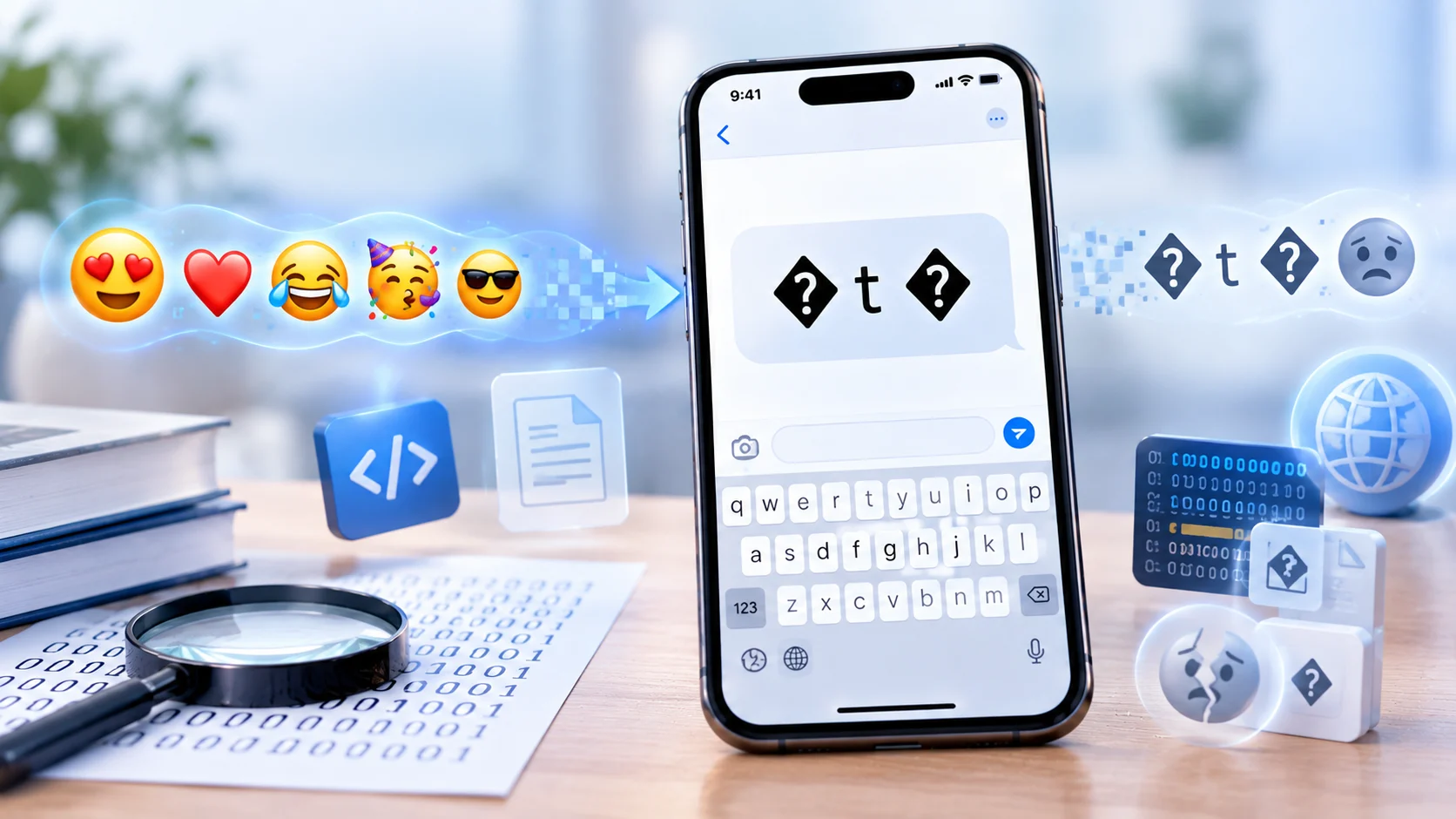
�t� is not an official emoji. The � character is the Unicode Replacement Character, used when unknown or unrepresentable character data needs to be substituted.
Have you ever received an emoji in a text message only to find that it appears as strange symbols instead of a recognizable picture? The expression “�t�” may look confusing, but it is likely the result of a character encoding problem rather than an actual emoji. When a device, website, or messaging application cannot correctly interpret a character, it may display unusual symbols or replacement characters. Understanding this issue can help you avoid misinterpreting messages and identify why an emoji is not displaying properly.
The exact meaning of “�t�” cannot be confirmed from these characters alone because the original emoji may have been corrupted during copying, sending, or displaying. In digital communication, emojis often convey emotions, reactions, and context that plain text cannot fully express. However, when encoding errors occur, their intended meaning can become difficult to identify. In this guide, we will explore what these symbols may indicate, why emojis sometimes appear incorrectly, and how you can recover or identify the original emoji from its source.
What Does �t� Mean?
The sequence �t� does not have one standard meaning in texting, social media, or emoji language.
The key part is �, which has the Unicode code point U+FFFD and the official name REPLACEMENT CHARACTER. Unicode defines it as a general substitute for an unknown character from another encoding or for certain conversion errors.
The t is simply the letter “t.” When you see a sequence such as:
�t�
it can mean that some characters around the letter were lost, misread, or replaced during text conversion.
For that reason, you should not interpret �t� as if it were a face, heart, hand gesture, or other emoji.
Is �t� an Emoji?
No. �t� is not an emoji.
Unicode’s character set contains many symbols and special characters, but the Replacement Character serves a technical purpose. It is used as a substitute when the original character cannot be represented correctly.
This is different from a normal emoji such as:
- 😀 Grinning Face
- 😂 Face with Tears of Joy
- ❤️ Red Heart
- 👍 Thumbs Up
- 🥹 Face Holding Back Tears
Those are actual Unicode emoji characters or sequences with defined identities and standardized representations.
By contrast, � is a replacement marker.
Why Does the � Symbol Appear?
A replacement character can appear when text passes through a system that cannot correctly interpret the original character data.
Unicode explains that U+FFFD can be used when an unknown character from another encoding cannot be mapped to a known Unicode character. It can also indicate a conversion error involving an ill-formed Unicode sequence.
Common situations include:
- An emoji was copied through software that handled the character incorrectly.
- Text was converted between incompatible or incorrectly identified encodings.
- A file contains damaged or incomplete character data.
- Older software does not properly support a character or emoji sequence.
- A message contains an emoji sequence that a particular system cannot process correctly.
- Text was decoded using the wrong character encoding.
That means seeing � does not tell you exactly which original emoji was there.
What Does “�” Mean?
You may sometimes see:
�
instead of:
�
This is another clue that the text has gone through an encoding or decoding problem.
The visible sequence � is not a new emoji. It can occur when the bytes representing the Unicode Replacement Character are interpreted using the wrong character encoding.
You may also encounter longer broken strings such as:
😂
instead of 😂.
In these cases, the original character has not necessarily changed its meaning. The problem is that the character data is being interpreted or displayed incorrectly.
The Unicode Standard specifically documents conversion errors and the use of U+FFFD as a substitution character when invalid or unconvertible data is encountered.
Why Does a Broken Emoji Look Like Random Characters?
Computers store and transmit text as encoded data. An emoji is represented by Unicode code points and then encoded into a form such as UTF-8 when stored or transmitted.
If the receiving system interprets that data incorrectly, the intended character may not appear.
Instead, you might see:
�
�
😂
???
□
or another placeholder.
These displays can look like slang or secret codes, but they are often signs that the original character was not interpreted correctly.
Unicode notes that an invalid byte sequence can be represented by U+FFFD, the Replacement Character.
Is � the Same as a Missing Emoji?
Not necessarily.
A missing emoji and a replacement character can be related, but they are not exactly the same thing.
A device may show a blank box or another placeholder because it lacks the font or emoji artwork needed to display a valid character. In other cases, the character data itself may have been damaged or incorrectly decoded.
The Replacement Character has a more specific technical purpose: it represents an unknown or unrepresentable character during text processing.
So if you see �, don’t automatically assume the sender intentionally sent a broken emoji.
Can You Tell Which Emoji Was Originally Sent?
Usually, not from �t� alone.
The Replacement Character does not preserve enough information to identify the exact original emoji in every situation. It may represent character data that was unknown or could not be converted correctly.
For example, if someone intended to send:
😂
but the character data was damaged during conversion, you might receive a broken representation rather than the laughing emoji.
If the original data has already been replaced by U+FFFD, simply looking at the replacement character may not reveal which emoji was lost.
This is why the surrounding message, original device, app, file, or source can sometimes be necessary to determine what happened.
Common Broken Emoji Examples
Here are some examples of what broken emoji text can look like:
| What You See | What It Usually Indicates | Is It an Emoji? |
|---|---|---|
| � | Replacement Character | No |
| �t� | Replacement characters around ordinary text | No |
| � | Encoding/decoding artifact involving � | No |
| 😂 | Broken representation of an emoji such as 😂 | Not as displayed |
| ??? | Unsupported or lost character data | No |
| □ | Missing glyph or unsupported display | Not necessarily |
These examples should not be treated as exact one-to-one translations. A broken sequence can have different causes depending on how the text was processed.
�t� vs. a Real Emoji
The easiest way to understand the difference is to compare the technical character with a genuine emoji.
| Character | What It Is | Typical Meaning or Function |
|---|---|---|
| � | Replacement Character | Marks unknown or unrepresentable character data |
| 😀 | Grinning Face | Happiness, friendliness, or a cheerful reaction |
| 😂 | Face with Tears of Joy | Strong amusement or laughter |
| ❤️ | Red Heart | Love, affection, or care |
| 👍 | Thumbs Up | Approval, agreement, or acknowledgment |
| 🥹 | Face Holding Back Tears | Strong emotion, gratitude, tenderness, or being moved |
The first character is fundamentally different from the others. � is not communicating an emotion by itself.
What Does � Mean in a Text Message?
If someone sends a message containing �, it is usually better to consider the possibility of a display or encoding problem before assigning an emotional meaning to it.
For example:
“That was so funny �”
If the sentence clearly appears to be missing an emoji at the end, the � may have replaced an emoji that failed to render.
But:
“�t�”
does not provide enough information to determine what the sender intended.
The safest interpretation is that some character data did not display correctly.
What Does � Mean on Social Media?
The same basic principle applies to social media.
If a post, comment, caption, or profile contains �, it does not automatically represent a new slang emoji.
It may appear because content was copied, converted, imported, or displayed using software that did not correctly preserve the original character data.
Emojipedia notes that emoji support can vary between apps and platforms, and that emoji artwork can differ even when the underlying standardized character is the same. It also documents cases where unsupported emoji sequences have appeared incorrectly in software.
What Does �t� Mean on iPhone or Android?
Seeing �t� on an iPhone or Android phone does not give the sequence a special iOS or Android meaning.
The underlying issue is generally related to how the character data was encoded, decoded, stored, or rendered.
A newer phone can still display broken characters if the problem occurred before the text reached the phone—for example, during copying, database conversion, web-page processing, email transmission, or another stage of handling the text.
Also, a platform may receive a valid emoji but display it differently from another platform. Emoji artwork varies by vendor even though the underlying standardized character remains the same.
How to Fix �t� or a Broken Emoji
If you are seeing �t� instead of the expected emoji, try these practical steps:
1. Update the app or device
Make sure the operating system and the app displaying the message are reasonably up to date. Emoji support is rolled out by platform and app vendors after Unicode adds new characters.
2. Ask the sender to resend it
If the original message is available, asking the sender to resend the emoji can restore the intended character.
3. Try another app
Copy the text into another modern application. If it displays correctly there, the problem may be related to the original app or its text-rendering support.
4. Avoid repeatedly copying corrupted text
Once an original character has been replaced by U+FFFD, copying the replacement character does not recreate the original emoji.
5. Check the original source
If the strange text came from a website, email, document, or database, compare it with the original source. The source may still contain the correct character.
Emojipedia has documented real-world cases where older software or email systems displayed emoji sequences incorrectly, showing why the application handling the text can matter.
How to Respond if Someone Sends �t�
If someone sends �t� and you think an emoji may have disappeared, a simple clarification is better than guessing.
“I think your emoji didn’t come through. Can you resend it?”
Or, for a casual conversation:
“What was supposed to be there? It shows up as �t� on my end.”
This is especially useful because the replacement character does not reveal the original emoji’s emotional meaning.
Does �t� Have a Secret Meaning?
No standard secret meaning is assigned to �t�.
The Unicode Replacement Character is a technical substitute, not a slang emoji. Unicode defines U+FFFD as a general replacement for an unknown or unrepresentable character.
Someone could theoretically use strange characters intentionally as part of a joke, meme, username, or stylized message. In that situation, the person’s own context gives the sequence meaning. But there is no standard emoji definition that says �t� means a particular emotion, reaction, or phrase.
Is �t� a New Emoji?
No. �t� is not a newly released emoji.
Unicode continues to add new emoji characters and sequences, but the Replacement Character is a long-established technical character. Unicode 18.0 continues to identify U+FFFD as REPLACEMENT CHARACTER.
New emoji can also take time to appear on different phones and apps because platform vendors need to implement their own artwork and support.
Related Characters and Broken Emoji Symbols
| Symbol | Official Name or Description | What It Usually Means | Tone | Where You May See It |
|---|---|---|---|---|
| � | Replacement Character | Unknown or unrepresentable character | Technical | Broken text and conversions |
|  | Object Replacement Character | Placeholder for an embedded object | Technical | Documents and text streams |
| □ | Missing-glyph box | Character cannot be displayed by the font | Neutral | Websites, apps, documents |
| ??? | Unknown text | Character information was lost or unavailable | Neutral | Damaged or unsupported text |
| 😂 | Mojibake-style emoji text | Emoji bytes interpreted incorrectly | Confusing | Copied or incorrectly decoded text |
| � | Mojibake involving U+FFFD | Replacement character displayed incorrectly | Technical | Encoding problems |
| 😀 | Grinning Face | Happiness or cheerful reaction | Positive | Normal emoji messages |
The most important distinction is between � and an actual emoji. The first is a technical replacement character, while 😀 and other emoji are standardized characters with intended visual and semantic identities.
Why Emoji Meanings Can Still Depend on Context
There is an important difference between emoji meaning and emoji rendering.
A normal emoji can have different interpretations depending on its surrounding words and conversation. Research on emoji interpretation has found that people can differ in how they understand the same emoji, and that context plays a role in interpretation.
But � is different. Before asking what emotion it expresses, you first need to determine it is actually an emoji at all.
In the case of �t�, the technical evidence points toward a character-display or encoding issue rather than a standard emoji meaning.
FAQs
What does this emoji mean �t�?
�t� is not a standard emoji or recognized emoji phrase. The � characters are Unicode Replacement Characters, so the sequence most likely indicates missing, corrupted, or incorrectly decoded character data.
Is � a real emoji?
No. � is U+FFFD REPLACEMENT CHARACTER, a Unicode character used as a substitute when another character is unknown or cannot be represented correctly.
Why does my emoji show as �?
A character may appear as � when the original data cannot be decoded or represented correctly. Unicode specifically defines U+FFFD for this type of substitution.
What does � mean in a text?
� is usually an encoding artifact involving the Replacement Character rather than an emoji with its own meaning. It can appear when character data is interpreted using the wrong encoding.
Can � tell me which emoji someone sent?
Not reliably. Once an original character has been replaced by U+FFFD, the replacement symbol alone may not contain enough information to identify the original emoji.
How do I fix a broken emoji?
Try updating the relevant app or device, opening the text in another application, or asking the sender to resend the emoji. If the original character has already been replaced with �, the original may need to be recovered from the source.
Conclusion
If you searched “what does this emoji mean �t�,” the answer is simpler than it first appears: �t� is not a standard emoji with a hidden meaning.
The � character is Unicode’s Replacement Character (U+FFFD). It can appear when character data is unknown, unrepresentable, or incorrectly converted. The exact emoji or symbol that may have been lost cannot always be recovered from �t� alone.
So if this strange sequence appears in a text, comment, email, or copied message, treat it as a possible broken-character problem first, rather than trying to assign it an emotional or slang meaning.
Discover More Related Articles:
- Buck Teeth Emoji | What This Funny Toothy Symbol Says About Smiles & More In 2026
- Sad Meme Emoji | The Best Emojis for Emotional Memes, Fake Tears & Relatable Moments In 2026
- Horse Emoji Meaning | What Does the Horse Emoji Mean in Text In 2026

Jessica Miller is a content writer at EmojisPeace.com, where she creates fun and easy-to-follow guides about emojis, their meanings and creative ways to use them. She loves helping readers express themselves with the perfect emoji for every moment.