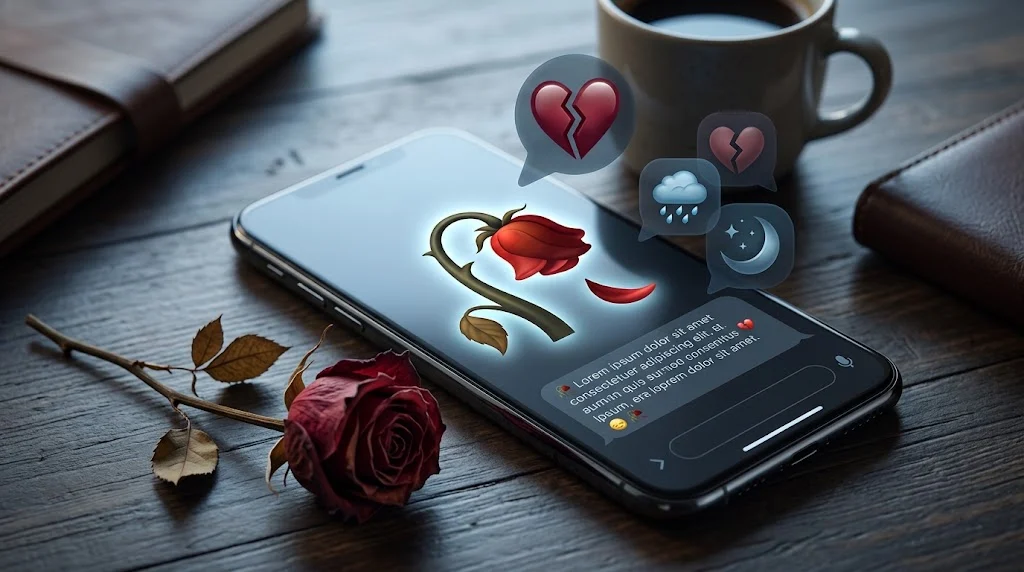
🥀 usually means a wilted or dying flower, sadness, heartbreak, disappointment, or something coming to an end. It can also suggest fading beauty, lost feelings, or emotional exhaustion. In memes and casual posts, 🥀 can be intentionally dramatic or ironic. So “I’m devastated 🥀” might describe real sadness or something as minor as a disappointing meal.
Have you ever seen a 🌹🥀 emoji and wondered why a beautiful rose suddenly looks wilted or lifeless? The dying rose emoji 🥀 often expresses sadness, heartbreak, fading love, disappointment, or the feeling that something beautiful has come to an end. Unlike a fresh rose 🌹, which commonly symbolizes romance, beauty, and affection, a wilted rose can communicate emotional pain, lost feelings, or a relationship that is slowly falling apart. Its meaning, however, depends on the conversation, the sender’s emotions, and the context in which it appears.
In texting and on social media, people use the 🥀 emoji to express brokenhearted feelings, emotional exhaustion, unrequited love, or a sad aesthetic without writing a lengthy explanation. It can also represent fading beauty, nostalgia, or the end of a meaningful chapter in life. Understanding the dying rose emoji meaning helps you interpret messages more accurately and recognize the emotions behind this small but expressive symbol. It appears in a caption, a status, or a private message, 🥀 can convey feelings that words sometimes struggle to express.
What Is the Dying Rose Emoji Called?
The official name of 🥀 is Wilted Flower, not “Dying Rose.” Unicode lists the character as U+1F940 WILTED FLOWER.
It is commonly called the dying rose emoji, dead rose emoji, or wilted rose emoji because many emoji designs show a drooping red flower that looks like a rose. Emojipedia notes that different platforms have sometimes depicted different flowers, so the official name is deliberately broader than “rose.”
The emoji was approved in Unicode 9.0 in 2016 and added to Emoji 3.0 in 2016.
Dying Rose Emoji Copy and Paste
🥀 — Wilted Flower
You can copy and paste it anywhere you want:
🥀 🥀 🥀
For a heartbreak-style message, you can also combine it with:
💔🥀 — heartbreak or lost love
🖤🥀 — dark or melancholy mood
😔🥀 — sadness or disappointment
😭🥀 — intense or exaggerated sadness
🌹🥀 — a rose fading or love changing
These combinations do not have fixed official meanings. The surrounding message creates the interpretation.
What Does 🥀 Mean in Text?
In texting, 🥀 commonly adds a feeling of sadness, disappointment, heartbreak, or emotional fading.
For example:
“I really thought it would work out 🥀”
This sounds like disappointment or lost hope.
But:
“They ran out of fries 🥀”
is probably exaggerated for humor. The person is not necessarily expressing serious emotional pain.
That difference is important because 🥀 can move between genuine sadness and dramatic irony depending on the conversation.
What Does the Dying Rose Emoji Mean in a Relationship?
In a relationship or romantic conversation, 🥀 can suggest love fading, heartbreak, disappointment, separation, or a relationship that did not work out.
For example:
“I guess some things aren’t meant to last 🥀”
The wilted flower creates a feeling of something beautiful that has faded.
However, 🥀 does not automatically mean a breakup. Someone might use it for unrequited feelings, missing someone, a disappointing date, an old memory, or simply a sad romantic aesthetic.
The surrounding words are more reliable than the emoji by itself.
Is 🥀 a Sad Emoji?
Yes, sadness is one of its strongest common interpretations.
Emojipedia describes 🥀 as a flower that has wilted or is dying and says it can express sadness, heartbreak, grief, or disappointment, sometimes ironically.
The visual idea is simple: a fresh flower represents life and beauty, while a wilted flower suggests that something has changed, weakened, or ended.
That makes 🥀 useful for feelings such as:
- heartbreak
- disappointment
- loneliness
- grief
- fading love
- lost hope
- emotional exhaustion
- nostalgia
- an ending or change
Not every use is serious, though. Online humor often turns the same visual into an exaggerated reaction.
The Newer Ironic Meaning of 🥀
One of the most useful things to understand about the dying rose emoji is its newer ironic use.
During 2025, 🥀 gained attention as a replacement for the more familiar 💔 in some online meme and comment culture. Recent reporting has described the wilting rose as a symbol of sadness or mock-heartbreak, where people intentionally make ordinary disappointments sound dramatically tragic.
For example:
“My favorite restaurant is closed today 🥀”
The person may be genuinely disappointed, but the emoji makes the reaction deliberately dramatic.
Another example:
“You probably have a job 🥀”
In a meme-style context, 🥀 can communicate ironic sadness rather than serious heartbreak. This kind of use was documented in online discussions during the emoji’s 2025 surge.
Why Does 🥀 Feel Funny in Some Posts?
The contrast is what creates the joke.
A wilted flower looks emotionally heavy, but the text may describe something extremely ordinary.
Minor problem + dramatic 🥀 = ironic sadness
That is why you may see 🥀 attached to jokes, memes, comments, captions, or exaggerated complaints.
Is the Dying Rose Emoji Trending?
The wilted rose emoji became a notable internet trend during 2025, particularly through ironic uses and its role as an alternative to 💔. Emojipedia documented a spike in ironic use in early 2025, while later reporting described the emoji as one of the fastest-growing emojis in popularity during 2025.
That trend is useful context, but it should not be treated as a permanent definition. Emoji slang changes quickly, and a meaning that feels current can become less common later.
The safest interpretation is still based on the message itself: 🥀 visually represents a wilted or dying flower, while online culture has expanded that idea into heartbreak, disappointment, and ironic sadness.
Dying Rose Emoji Meaning in Different Situations
When someone sends 🥀 after bad news
It may express genuine sadness or sympathy.
“I didn’t get the job 🥀”
Here, the emoji likely reinforces disappointment.
When someone uses 🥀 after a breakup
It can symbolize heartbreak or love that has faded.
“We tried, but it just wasn’t working anymore 🥀”
The flower works as a metaphor for something that once felt alive but has withered.
When someone uses 🥀 in a meme
The meaning may be intentionally exaggerated.
“My Wi-Fi went down for five minutes 🥀”
The dramatic flower makes the complaint humorous.
When someone uses 🥀 in a caption
It may be aesthetic rather than literal.
A caption about rain, memories, an ending, or a fading relationship can use 🥀 to create a melancholy mood without describing a specific event.
🥀 vs. 🌹: What’s the Difference?
The difference is mainly freshness and emotional direction.
🌹 Rose usually represents a healthy rose and can suggest love, beauty, romance, appreciation, or affection.
🥀 Wilted Flower represents a flower that has faded or wilted and more often suggests sadness, loss, disappointment, or something ending.
So:
“I still love you 🌹”
feels affectionate or romantic.
“I guess it’s over 🥀”
feels sad, fading, or final.
The two can also be placed together:
🌹🥀
This can visually suggest a transition from something beautiful or alive to something faded, although the combination has no official fixed meaning.
🥀 vs. 💔: Which One Means Heartbreak?
Both can communicate heartbreak, but they create different tones.
💔 Broken Heart is more direct. It clearly signals emotional pain, heartbreak, or a relationship ending.
🥀 Wilted Flower is more indirect and metaphorical. It can suggest something beautiful that has faded, lost its life, or come to an end.
In casual internet humor, 🥀 can also feel more dramatic, poetic, or ironic than 💔. Recent coverage of its 2025 rise specifically described it as an alternative to the broken-heart emoji in some online communities.
Emojis Similar to the Dying Rose Emoji
| Emoji | Official Name | Common Meaning | Tone | Where or When It Is Used |
|---|---|---|---|---|
| 🥀 | Wilted Flower | Sadness, fading, loss, disappointment | Melancholy or ironic | Sad posts, heartbreak, memes, captions |
| 🌹 | Rose | Love, beauty, romance, appreciation | Romantic or warm | Love messages, compliments, celebrations |
| 💔 | Broken Heart | Heartbreak, emotional pain, lost love | Sad and direct | Breakups, disappointment, emotional messages |
| 🖤 | Black Heart | Dark affection, sadness, emotional depth | Dark or understated | Moody messages, aesthetics, sympathy |
| ❤️🩹 | Mending Heart | Healing after emotional pain | Hopeful and supportive | Recovery, comfort, moving forward |
| 😔 | Pensive Face | Sadness, regret, disappointment | Quiet and serious | Personal messages and reflective reactions |
| 😭 | Loudly Crying Face | Intense sadness or exaggerated emotion | Emotional or dramatic | Crying, bad news, memes, exaggerated reactions |
| 🍂 | Fallen Leaf | Change, passing time, autumn, endings | Reflective or nostalgic | Seasonal posts, memories, change |
The most important comparison is 🥀 versus 🌹: one shows a flower that has faded, while the other shows a fresh rose. 🥀 versus 💔 is also important because both can express heartbreak, but 💔 is more direct while 🥀 can be more metaphorical or ironic.
Can 🥀 Mean Death?
It can symbolize death, loss, or something no longer living, but that is not its only meaning.
The official Unicode keyword includes “dying,” and the image represents a wilted flower.
In a memorial or mourning context, 🥀 may therefore suggest loss.
For example:
“Remembering you today 🥀”
Here, the flower may represent grief or remembrance.
But sending 🥀 in an ordinary conversation does not automatically mean that someone has died.
Can 🥀 Mean a Breakup?
Yes, it can suggest a breakup or love that has faded.
However, 🥀 does not prove that a breakup happened. It may represent disappointment, unrequited feelings, missing someone, or simply a sad romantic mood.
Compare:
“We broke up yesterday 💔🥀”
The words establish the breakup.
But:
“Some things just fade 🥀”
is more open-ended and could refer to a relationship, friendship, memory, opportunity, or another kind of loss.
Is 🥀 Flirty or Romantic?
The dying rose emoji is not inherently flirty.
Because roses are strongly associated with romance, 🥀 can appear in romantic messages. But the wilted form usually shifts the tone toward sadness, fading feelings, heartbreak, or dramatic irony rather than straightforward flirting.
If someone sends 🥀 by itself, do not assume it means they are attracted to you. Look at the rest of the conversation.
What Does 🥀 Mean From Someone?
When someone sends 🥀, the most likely interpretation depends on what happened immediately before it.
If you shared bad news, it may show sympathy or sadness.
If you were discussing a breakup, it may reinforce heartbreak or fading feelings.
If you were joking about a small inconvenience, it may be an ironic “I’m devastated” reaction.
If it appears in a moody caption or aesthetic post, it may simply create a melancholy visual tone.
There is no universal “secret message” attached to 🥀.
How to Respond to the Dying Rose Emoji
If someone uses 🥀 seriously, a supportive response may work best:
“I’m sorry. That sounds really hard.”
If the conversation is clearly a joke:
“Not the dramatic wilted rose 😭”
If you’re unsure what they mean:
“Everything okay?”
If they are talking about a breakup:
“I get it. Some things really do take time to heal.”
The safest response comes from the surrounding message, not from the emoji alone.
Dying Rose Emoji Examples
“I thought we’d make it work 🥀”
Likely meaning: heartbreak or a relationship that has faded.
“My favorite show got canceled 🥀”
Likely meaning: exaggerated disappointment, possibly humorous.
“Some memories never come back 🥀”
Likely meaning: nostalgia, loss, or reflection.
“No coffee this morning 🥀”
Likely meaning: playful or dramatic disappointment rather than serious sadness.
“Thinking of everyone we’ve lost 🥀”
Likely meaning: grief, remembrance, or mourning.
Dying Rose Emoji Copy and Paste Combos
There is no official meaning assigned to specific emoji combinations, but these combinations can visually communicate different moods:
💔🥀 — heartbreak or love fading
🖤🥀 — dark or melancholy mood
😔🥀 — quiet sadness
😭🥀 — intense or exaggerated sadness
🌹🥀 — fading love or a changing relationship
🥀🍂 — endings, change, or fading beauty
🥀🕯️ — remembrance or mourning
🥀⏳ — passing time or something fading
Treat these as creative combinations, not fixed emoji definitions.
Official Dying Rose Emoji Facts
The emoji people commonly call the dying rose emoji is officially named Wilted Flower.
- Emoji: 🥀
- Official Unicode name: WILTED FLOWER
- Code point: U+1F940
- Unicode approval: Unicode 9.0
- Emoji version: Emoji 3.0
- Unicode keywords: dying, flower, wilted
Unicode’s current Emoji 18.0 chart places 🥀 in the plant-flower group next to 🌹 Rose, and its official annotations include “dying” and “wilted.”
Emojipedia notes that the exact flower can look different across platforms. Some designs show a red rose-like flower, while other vendors have used different-looking flowers.
Why Does the Dying Rose Look Different on Some Phones?
Emoji artwork is created by individual platform vendors, so the same Unicode character can have different artwork.
Emojipedia notes that 🥀 has appeared as a faded red rose on some platforms, while other designs have depicted flowers that look more like a tulip or sunflower.
That means the emotional idea stays broadly similar, but the visual impression can vary.
If one person sees a clearly wilted red rose and another sees a different drooping flower, both are still seeing the same Unicode emoji: 🥀 Wilted Flower.
FAQs
What is the official name of the dying rose emoji?
The official Unicode name is Wilted Flower, not Dying Rose. Its code point is U+1F940, and Unicode lists “dying” and “wilted” among its keywords.
What does 🥀 mean in texting?
🥀 commonly expresses sadness, heartbreak, disappointment, loss, or something fading away. In memes and casual posts, it can also create an intentionally dramatic or ironic “I’m devastated” reaction.
Is 🥀 the same as a rose emoji?
No. 🌹 is officially Rose, while 🥀 is officially Wilted Flower. 🌹 usually has a fresh, romantic, or positive feeling, while 🥀 more often suggests fading, sadness, loss, or disappointment.
Does 🥀 mean heartbreak?
It can. The wilted flower is often used as a metaphor for love or something beautiful that has faded, while 💔 expresses heartbreak more directly.
Why is the dying rose emoji used in memes?
🥀 can make an ordinary disappointment look dramatically sad, which creates an ironic joke. Its use as a mock-heartbreak reaction became especially visible during the 2025 online emoji trend.
Does 🥀 mean someone died?
Not necessarily. It can symbolize grief or loss in a mourning context, but it is also commonly used for heartbreak, disappointment, fading feelings, and ironic sadness.
Is 🥀 a romantic emoji?
It can appear in romantic messages, especially around heartbreak or fading love, but it is not automatically romantic or flirty. The surrounding words and situation determine the meaning.
Conclusion
The dying rose emoji 🥀 is officially called Wilted Flower, and its core visual idea is a flower that has faded or is dying. In everyday messages, it can express sadness, heartbreak, disappointment, grief, fading love, or the feeling that something has come to an end.
Its newer online use adds another layer: 🥀 can be a deliberately dramatic or ironic way to say “I’m devastated” over something minor. That makes context especially important when interpreting it.
Discover More Related Articles:
- Buck Teeth Emoji | What This Funny Toothy Symbol Says About Smiles & More In 2026
- Sad Meme Emoji | The Best Emojis for Emotional Memes, Fake Tears & Relatable Moments In 2026
- Horse Emoji Meaning | What Does the Horse Emoji Mean in Text In 2026

Sophia Martinez is a content writer at EmojisPeace.com, where she creates fun, engaging, and easy-to-read emoji guides, meanings and digital communication content. She enjoys helping readers express themselves better with the perfect emojis for every mood and moment.