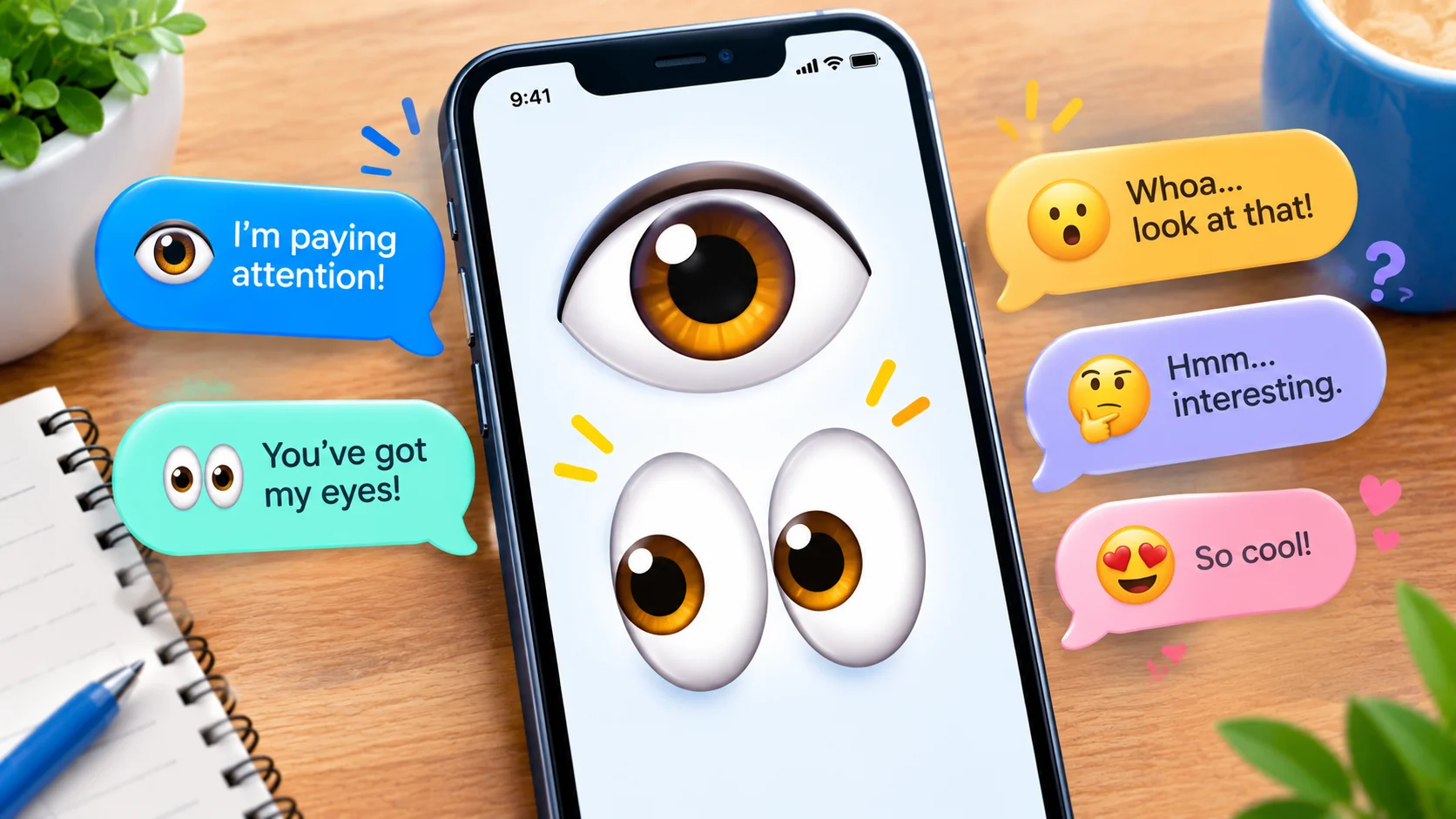
👁️ usually represents seeing, watching, or an eye itself. 👀 often means “I’m looking,” “That’s interesting,” or “I noticed something.” The surrounding message determines the reaction feels curious, playful, suspicious, or flirtatious.
The eye emoji 👁️ and eyes emoji 👀 can express attention, curiosity, suspicion, or interest, but they are two different emoji characters. The single eye 👁️ usually represents an actual eye, looking, or seeing, while the pair of eyes 👀 often means “I’m watching,” “I noticed that,” or “Tell me more.” In texts and social media comments, 👀 can also suggest gossip, surprise, attraction, or anticipation.
For example, “I saw what you posted 👀” can suggest curiosity or playful suspicion. By contrast, “Keep an eye on this 👁️” may refer more directly to watching or paying attention. Neither emoji has one fixed meaning in every conversation.
What Does the Eye Emoji Mean in Texts?
The eye emojis are useful when you want to react to something without explaining your entire response. The pair 👀 is especially flexible because it can communicate interest, surprise, or suspicion with just two eyes.
1. Curiosity and Interest
When someone shares a teaser, surprising detail, or incomplete story, 👀 can mean they want to know more.
Example: “I have some exciting news, but I’ll tell you later 👀”
Likely meaning: “Now I’m curious. Tell me more!”
2. Gossip or an Interesting Secret
The eyes emoji can signal that something sounds juicy, surprising, or worth paying attention to.
Example: “Apparently, there’s a big announcement coming tomorrow 👀”
Likely meaning: “That sounds interesting. I’m paying attention.”
This use can be playful, but it does not necessarily mean the sender is spreading gossip.
3. Watching or Noticing Something
Sometimes 👀 means that the sender has seen a post, caught a detail, or noticed what someone is doing.
Example: “I saw your comment on that post 👀”
Likely meaning: “I noticed that!”
Depending on the relationship, this can sound teasing, curious, or slightly suspicious.
4. Suspicion or Side-Eye
The eyes emoji may suggest that something seems questionable or that the sender is waiting for an explanation.
Example: “You said you were staying home, but I saw your story 👀”
Likely meaning: “I noticed the contradiction. What’s going on?”
The emoji alone does not prove that the sender is angry or accusing you of lying. The words and conversation history matter.
5. Attraction or Appreciation
In some conversations, 👀 is a playful reaction to an attractive photo, a new outfit, or someone’s appearance.
Example: “That new profile picture 👀”
Likely meaning: “I noticed that, and I like what I see.”
This can feel flirtatious, but it can also be a friendly compliment. One emoji cannot establish romantic interest.
6. Paying Attention
The single eye 👁️ may be used to represent seeing, observing, or focusing on something. It can also appear in creative captions, symbolic messages, or unusual emoji combinations.
Example: “Keep your 👁️ on the prize.”
Likely meaning: “Stay focused on your goal.”
Here, the eye works as a visual symbol rather than an emotional reaction.
👁️ vs. 👀: What’s the Difference?
👁️
Eye
One eye; seeing, observing, or symbolic imagery.
👀
Eyes
A pair of eyes; noticing, curiosity, or watching.
Although they look related, these are separate Unicode characters with different designs.
- 👁️ Eye: Better suited to literal references to an eye, seeing, or symbolic imagery.
- 👀 Eyes: Often better for reactions to posts, interesting news, gossip, and unexpected developments.
For example, “Look at this 👀” sounds like an invitation to pay attention to something interesting. “I can see it now 👁️” gives the single eye a more literal or symbolic role.
Related Emojis and Their Meanings
| Emoji | Official Name | Common Meaning | Tone | Where or When It Is Used |
|---|---|---|---|---|
| 👁️ | Eye | Seeing, observing, an actual eye | Neutral, symbolic | Visual references or captions |
| 👀 | Eyes | Curiosity, noticing, watching | Playful, interested | Gossip, posts, surprising news |
| 🧐 | Face with Monocle | Examining, questioning, scrutiny | Analytical, skeptical | Investigating a detail |
| 🤨 | Face with Raised Eyebrow | Doubt or suspicion | Questioning, skeptical | Reacting to questionable claims |
| 🙈 | See-No-Evil Monkey | Embarrassment or not wanting to look | Shy, playful | Awkward moments or surprises |
| 🫣 | Face with Peeking Eye | Nervous curiosity or peeking | Anxious, curious | Watching something uncomfortable |
| 😳 | Flushed Face | Shock, embarrassment, or surprise | Startled, flustered | Unexpected or awkward moments |
| 🧿 | Nazar Amulet | Protection from the evil eye in cultural contexts | Symbolic, protective | Cultural references to the protective amulet |
Which Eye Emoji Should You Use?
Choose 👀 when you want to react to something interesting, show curiosity, or hint that you’ve noticed a detail. Use 👁️ when the single eye itself is important or you want a more literal or symbolic reference.
The other emojis add a clearer emotional signal. For example, 🤨 expresses doubt more directly, 🫣 combines peeking with nervousness, and 🙈 suggests avoiding something embarrassing. The 🧿 emoji is different from both eye emojis because it represents a protective amulet rather than a human gaze.
What Does 👀 Mean on Social Media?
On social media, 👀 often works as a short reaction to content that catches someone’s attention. The exact interpretation depends on what the person is responding to.
- Instagram comments: It can react to a photo, a new look, or an intriguing post.
- TikTok comments: It can suggest curiosity about a reveal, an unexpected moment, or a developing story.
- Snapchat messages: It can signal that someone noticed a detail or is curious about what is happening.
- Group chats: It can hint that a conversation has become interesting or that someone is waiting for more information.
These are possible uses, not fixed meanings assigned by each platform. The same 👀 can feel friendly in one conversation and suspicious in another.
How to Respond When Someone Sends 👀
You can usually respond to the message itself rather than trying to decode the emoji in isolation.
👀
If they seem curious
“I’ll tell you the whole story in a minute!”
Useful when they want more details.
😂
If they’re teasing you
“Why are you watching me? 😂”
Keeps the exchange lighthearted.
🫣
If something embarrassing happened
“I know, I can’t believe that happened either 🫣”
Matches a nervous or awkward reaction.
🤔
If you’re unsure what they mean
“What did you notice? 👀”
Invites them to explain without assuming their intent.
Copy and Paste the Eye Emojis
👁️
Eye
Copy
👀
Eyes
Copy
Here are a few ways to use them naturally:
Wait, what happened? 👀I see you 👀Tell me everything 👀Keep an eye on the details 👁️That new outfit 👀🔥
Official Name and Unicode Details
The single eye and pair of eyes have separate official Unicode identities.
| Detail | Single Eye 👁️ | Eyes 👀 |
|---|---|---|
| Official Unicode name | Eye | Eyes |
| Code point | U+1F441 | U+1F440 |
| Unicode version | Unicode 7.0 | Unicode 6.0 |
| Approval year | 2014 | 2010 |
| Added to Emoji 1.0 | 2015 | 2015 |
The Unicode Consortium defines emoji characters and their encoding. It does not prescribe one universal interpretation for every conversation. The meaning of an emoji can shift with context, culture, and how people use it.
The appearance may also vary across Apple, Google, Samsung, and other platforms. In particular, the single eye and pair of eyes have different shapes and gazes, which can affect how a message feels visually.
FAQs
Does 👀 mean someone is watching you?
It can suggest watching or noticing something, but it is often a playful reaction to a message, photo, or piece of news. It does not necessarily mean someone is literally monitoring you.
Does the eye emoji mean flirting?
Sometimes 👀 is used to show interest in someone’s appearance or to make a playful comment. However, it can also express curiosity or surprise, so it does not prove romantic interest on its own.
What does 👁️👄👁️ mean?
This combination pairs the eye, mouth, and eye emojis to create an unusual face-like expression. It is often used to convey awkwardness, shock, intense staring, or a deliberately strange reaction. The intended tone depends on the surrounding message.
Is 👀 positive or negative?
It can be either. It may show excitement and curiosity, or it may suggest suspicion and judgment. The words that accompany it and the situation usually make the difference.
What is the difference between 👀 and 🤨?
👀 often communicates attention or curiosity, while 🤨 more clearly expresses doubt or skepticism. If you want to say “I’m interested in what happens next,” 👀 may fit better. If you want to say “I’m not sure I believe that,” 🤨 is more direct.
Conclusion
The eye emoji 👁️ and eyes emoji 👀 both relate to seeing and noticing, but they serve different purposes in everyday messages. The single eye often has a literal or symbolic meaning, while the pair of eyes is a flexible reaction to interesting news, gossip, attraction, or something suspicious. Read the surrounding words before deciding what the sender intends.
Discover More related Articles:
- Thinking Emoji Meaning | Is It Curiosity, Doubt or Sarcasm In 2026
- Poop Emoji | From Funny Jokes to Sarcastic Reactions In 2026
- Sparkle Emoji Mean | From Magic to Subtle Sarcasm In 2026

Matthew Garcia is a content writer at EmojisPeace.com, where she creates fun, expressive and easy-to-use emoji collections for every mood and moment. Passionate about digital expression, she helps readers find the perfect emojis to make every message more creative and memorable.