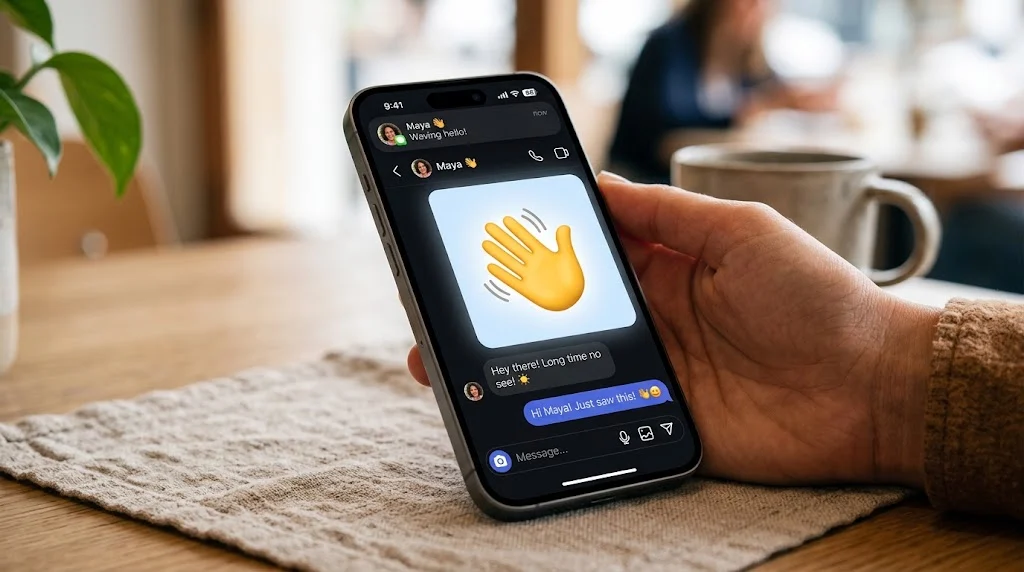
👋 usually means “hello,” “hi,” or “goodbye.” It has a friendly, casual tone and is often used when starting or ending a conversation.
For example:
- “Hey! 👋” → friendly hello
- “Welcome to the group! 👋” → warm greeting
- “Talk to you tomorrow 👋” → goodbye or see you later
- “Oh, hey 👋” → casual acknowledgment
The exact meaning depends on the conversation is beginning, ending, or reacting to something.
The hello emoji 👋 is commonly used as a friendly way to say hello, hi, or welcome. Its official Unicode name is Waving Hand, and it shows a raised hand making a waving gesture. It can also mean goodbye, see you later, or a friendly acknowledgment, depending on the conversation. In some situations, the same emoji can feel playful, awkward, dismissive, or sarcastic, so the words around it matter. (Unicode; Emojipedia)
What Does the Hello Emoji 👋 Mean?
Although people often call 👋 the hello emoji, its official Unicode name is Waving Hand. The gesture itself can naturally represent either a greeting or farewell.
That gives the emoji two main uses:
Greeting: “Hi, nice to see you.”
Farewell: “Bye, talk to you later.”
It can also simply acknowledge someone’s presence without starting a full conversation.
For example:
“Hey, I just got here 👋”
This sounds like a casual greeting.
But:
“I have to go now. See you tomorrow 👋”
clearly uses the same emoji as a goodbye.
👋 Meaning in Texting
In text messages, 👋 usually adds a friendly and approachable tone to a short message.
Someone might send:
“Good morning 👋”
This feels warmer than simply saying “Good morning.”
It can also be useful when introducing yourself:
“Hi, I’m Alex 👋”
Here, the emoji helps make the introduction feel relaxed and friendly.
A standalone 👋 can also function as a very short “hello” when the sender wants to get someone’s attention.
Does 👋 Mean Hello or Goodbye?
It can mean either one.
The timing of the message usually provides the answer.
| Message | Likely Meaning |
|---|---|
| “Hey everyone 👋” | Hello or greeting |
| “Welcome! 👋” | Friendly welcome |
| “Nice meeting you 👋” | Goodbye or farewell |
| “I’m heading home 👋” | Goodbye |
| “See you Monday 👋” | See you later |
This flexibility comes directly from the real-world waving gesture. People wave when they meet someone and when they leave.
What Does 👋 Mean From Someone?
If someone sends you 👋 by itself, it usually means “Hi,” “Hey,” or “Hello.”
If it appears at the end of a message, it is more likely to mean “Bye” or “See you later.”
For example:
“Hey! How are you? 👋”
is a greeting.
But:
“Okay, I’ll talk to you later 👋”
is a farewell.
The emoji itself does not contain a hidden message. The surrounding words and timing provide most of the meaning.
Is 👋 Friendly?
Yes. 👋 is generally a friendly and casual emoji.
It can make a short greeting feel more welcoming and personal.
Examples include:
“Welcome aboard 👋”
“Hey there! 👋”
“Good to see you 👋”
It is not automatically intimate or romantic. It works just as naturally between friends, coworkers, family members, acquaintances, or people meeting for the first time.
Is 👋 Flirty?
The waving hand emoji is not inherently flirty.
Someone could use it in a flirtatious conversation, but the emoji alone does not prove romantic interest.
For example:
“Hey stranger 👋”
could be playful or mildly flirtatious depending on the existing relationship.
On the other hand:
“Hi everyone 👋”
is simply a group greeting.
If you are trying to determine someone is flirting, look at the complete conversation rather than treating 👋 as a romantic signal.
Can 👋 Sound Rude or Sarcastic?
Usually, 👋 is friendly, but context can change its tone.
For example:
“Okay, bye then 👋”
could be a completely normal goodbye, but it could also sound dismissive if the conversation is tense.
Similarly:
“Sure, whatever 👋”
may feel sarcastic because of the surrounding words.
The emoji does not automatically create the sarcasm. The wording, punctuation, relationship, and conversation history can give the waving gesture a different tone.
When Does 👋 Feel Awkward?
A standalone 👋 can sometimes feel awkward when the sender and recipient do not know each other well.
For example:
“Hi 👋”
is perfectly normal, but if it arrives without any other context, the recipient may wonder what the sender wants to discuss.
It can also feel slightly formal or distant when compared with a simple “Hey,” depending on the person’s texting style.
That does not mean the emoji has a negative meaning. It simply shows why context matters.
Hello Emoji Compared With Similar Emojis
| Emoji | Official Name | Common Meaning | Tone | Where or When It Is Used |
|---|---|---|---|---|
| 👋 | Waving Hand | Hello, goodbye, or acknowledgment | Friendly, casual | Greetings, farewells, introductions, quick reactions |
| 🙋 | Person Raising Hand | Volunteering, asking to speak, or getting attention | Polite, enthusiastic | Questions, group chats, participation |
| 🤚 | Raised Back of Hand | Stop, wait, or raising a hand | Direct, assertive | Pausing a conversation or signaling “hold on” |
| ✋ | Raised Hand | Stop, high-five, or getting attention | Direct, energetic | Warnings, high-fives, interruptions |
| 🫶 | Heart Hands | Love, appreciation, or support | Warm, affectionate | Gratitude, encouragement, caring messages |
| 🤝 | Handshake | Agreement, cooperation, or greeting | Professional, respectful | Deals, introductions, teamwork |
| 💁 | Person Tipping Hand | Casual explanation, confidence, or attitude | Playful, expressive | Jokes, reactions, playful comments |
| 🤗 | Smiling Face with Open Hands | Warm welcome, affection, or openness | Warm, cheerful | Welcoming someone, support, friendly reactions |
The closest match to 👋 is usually 🤚 or ✋ visually, but their meanings are different. 👋 specifically suggests a wave, while ✋ and 🤚 can suggest stopping, waiting, or raising a hand.
🤝 can also represent a greeting, but it carries a stronger sense of agreement, cooperation, or a formal handshake. 🫶 is much more affectionate and should not be treated as another version of “hello.”
👋 vs. 🙋: What’s the Difference?
These emojis can both appear when someone wants to acknowledge others, but their gestures are different.
👋 Waving Hand = “Hi,” “Bye,” or “I’m here.”
🙋 Person Raising Hand = “I have a question,” “Pick me,” or “I want to participate.”
For example:
“Hey everyone 👋”
is a greeting.
“I have a question 🙋”
is asking for attention or participation.
👋 vs. 🤚: What’s the Difference?
The difference is mainly the gesture.
👋 represents waving.
🤚 Raised Back of Hand represents a raised hand and can suggest “wait,” “stop,” or simply raising your hand.
If your goal is to say hello, 👋 is the clearer choice.
How to Use 👋 in a Message
The hello emoji works best when you want your message to feel casual and friendly.
Starting a conversation
“Hey! 👋 How’s your day going?”
Introducing yourself
“Hi, I’m Jordan 👋”
Welcoming someone
“Welcome to the team! 👋”
Ending a conversation
“I’ll catch up with you tomorrow 👋”
Acknowledging someone
“Oh hey, I didn’t see your message earlier 👋”
The emoji can stand alone, but adding a few words usually makes the intended meaning clearer.
How to Respond to 👋
Your response can be as simple as another greeting.
Friendly:
“Hey! 👋”
Warm:
“Hi! Great to hear from you 😊”
Casual:
“Hey there! What’s up?”
If they’re saying goodbye:
“Bye! Talk soon 👋”
If you are unsure the person is greeting you or ending the conversation, simply respond naturally based on the surrounding message.
Common Misunderstandings About 👋
One common mistake is assuming that 👋 always means hello. Because its official name is Waving Hand, it can just as naturally represent a farewell.
Another mistake is assuming that it is automatically flirtatious. It is not. The emoji is broadly useful in everyday conversations and does not establish romantic interest by itself.
It is also easy to confuse 👋 with ✋. Both show a raised hand, but 👋 specifically conveys a waving gesture, while ✋ more often communicates a raised palm, stop, high-five, or attention.
Official Name and Unicode Details
The official Unicode name for 👋 is Waving Hand. Its Unicode code point is U+1F44B. Unicode lists it among the human hand and gesture emoji. (Unicode)
Emojipedia describes 👋 as a hand waving, commonly used for greetings and farewells. Its appearance can vary slightly across platforms, although the basic waving-hand concept remains recognizable. (Emojipedia)
The emoji was introduced with Unicode 6.0 and included in Emoji 1.0. (Emojipedia)
FAQs
What does the hello emoji 👋 mean?
The hello emoji 👋 usually means “hello,” “hi,” or “hey.” It can also mean goodbye or “see you later” because the emoji represents a waving hand.
Is 👋 a hello or goodbye emoji?
It can be both. At the beginning of a conversation, 👋 usually works as a greeting. At the end of a conversation, it usually signals goodbye or farewell.
What does 👋 mean from a girl or guy?
The meaning does not depend on the sender’s gender. 👋 generally indicates a greeting, farewell, or friendly acknowledgment. The surrounding conversation is more useful for understanding the sender’s intention.
Does 👋 mean flirting?
Not by itself. 👋 is normally a friendly greeting or farewell. It can appear in a flirtatious conversation, but the emoji alone does not establish romantic interest.
Can I use 👋 in a professional message?
Yes, especially in a casual workplace or informal introduction. In a very formal business message, a simple written greeting may be more appropriate.
What is the difference between 👋 and ✋?
👋 represents a waving hand and is commonly used for greetings and farewells. ✋ shows a raised palm and can suggest “stop,” “wait,” a high-five, or getting someone’s attention.
What is the difference between 👋 and 🙋?
👋 is primarily a wave, while 🙋 shows a person raising a hand. 🙋 is more closely associated with volunteering, asking a question, or wanting to participate.
Can 👋 be sarcastic?
Yes, depending on the message. A phrase such as “Okay, bye then 👋” can sound dismissive or sarcastic when used during an argument. The tone comes mainly from the surrounding conversation.
Conclusion
The hello emoji 👋 is officially called Waving Hand and is one of the clearest emojis for a casual greeting. It can mean hello, goodbye, welcome, or a simple acknowledgment, with the position of the emoji in the conversation often revealing which meaning is intended.
It is generally friendly rather than romantic, although the surrounding conversation can give it a more playful or personal tone. If you want a straightforward way to say “Hi!” or “See you later,” 👋 is a natural choice.
Discover More Related Articles:
- Buck Teeth Emoji | What This Funny Toothy Symbol Says About Smiles & More In 2026
- Sad Meme Emoji | The Best Emojis for Emotional Memes, Fake Tears & Relatable Moments In 2026
- Horse Emoji Meaning | What Does the Horse Emoji Mean in Text In 2026

Jessica Miller is a content writer at EmojisPeace.com, where she creates fun and easy-to-follow guides about emojis, their meanings and creative ways to use them. She loves helping readers express themselves with the perfect emoji for every moment.
1 thought on “👋 Hello Emoji Meaning | What the Waving Hand Really Says In 2026”