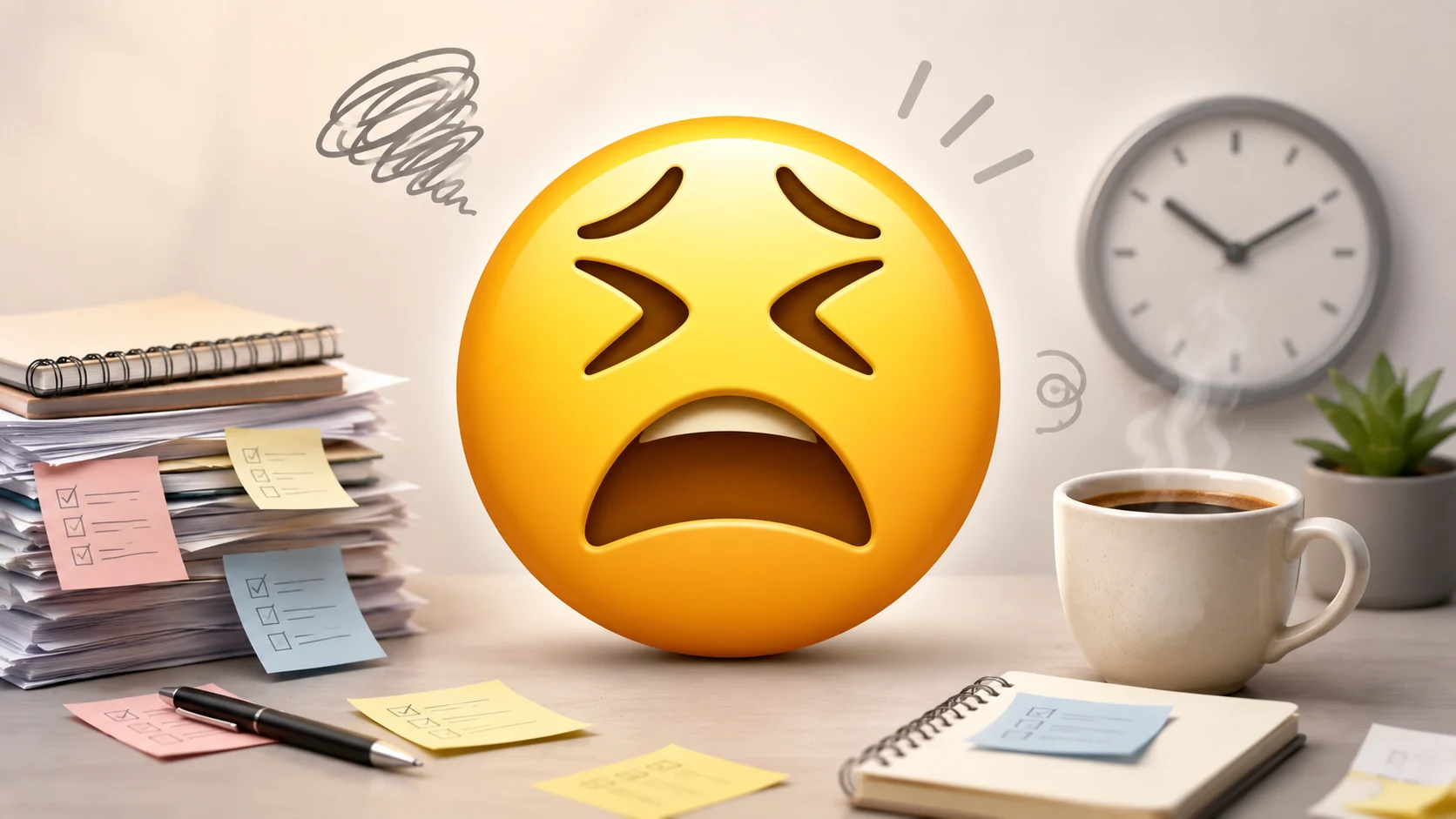
😫 Tired Face usually means “I’m exhausted,” “I’m worn out,” or “This is too much for me.” Its scrunched eyes and open frown give it a stronger, more intense feeling than a simple sleepy emoji.
The tired emoji face 😫, officially called Tired Face, usually expresses exhaustion, feeling worn out, or being overwhelmed. It can also show frustration, distress, or a dramatic “I can’t deal with this” reaction.
The exact feeling depends on the message around it. Someone may use 😫 literally after a long day, or use it playfully to exaggerate how difficult, exhausting, frustrating, or even overwhelmingly good something feels.
What Does the Tired Emoji Face 😫 Mean?
The 😫 emoji is the Tired Face. Its facial expression shows tightly scrunched eyes, furrowed brows, and a wide open frown, creating an impression of physical or emotional strain. Emojipedia describes it as an emoji intended to represent tiredness, while also noting that it can take on frustration, sadness, excitement, and affection depending on context.
In everyday texting, the most common interpretations include:
- Mental fatigue: “This assignment is killing me 😫”
- Frustration: “Why is this taking so long 😫”
- Feeling overwhelmed: “I have five things due tomorrow 😫”
- Dramatic reaction: “That dessert looks so good 😫”
- Playful exaggeration: “You really made me watch all three movies 😫”
The emoji does not automatically mean that someone needs sleep. It can describe a situation that feels draining, annoying, difficult, or simply too intense.
How Strong Is the Emotion?
😫 generally feels stronger than emojis such as 😪 Sleepy Face or 😌 Relieved Face. The expression looks strained rather than peacefully tired.
It can therefore communicate something closer to:
“I’m completely worn out.”
or:
“I cannot handle this right now.”
However, the strength is not fixed. A message such as “Long day 😫” may describe ordinary tiredness, while “This deadline is tomorrow 😫” can communicate stress and frustration at the same time.
Tired Emoji Face Meaning in Text Messages
In texting, 😫 often adds emotional emphasis to words that might otherwise sound flat.
For example:
“I’ve been studying since 7 a.m. 😫”
This most likely means the sender is genuinely exhausted.
“This traffic is unbelievable 😫”
Here, the emoji emphasizes frustration rather than sleepiness.
“You expect me to choose just one? 😫”
This could be playful exaggeration, especially if the choice is between several appealing options.
The emoji can also soften a complaint by making it look more expressive or humorous. Instead of simply saying “This is annoying,” a sender might add 😫 to make the reaction feel more dramatic and conversational.
When 😫 Means More Than Being Tired
One of the most useful things to remember about 😫 is that tiredness is only one possible interpretation.
Frustration
Someone may use it after dealing with a difficult problem:
“I’ve restarted the computer three times 😫”
The sender may not be physically tired at all. The emoji communicates frustration and emotional exhaustion.
Overwhelm
It can also signal that there is simply too much happening:
“Three meetings, a dentist appointment, and dinner plans today 😫”
Here, 😫 suggests being overloaded rather than literally falling asleep.
Dramatic or Playful Reaction
Sometimes the emoji is intentionally exaggerated:
“You ate the last slice of pizza 😫”
The situation is not necessarily serious. The emoji makes the complaint humorous and dramatic.
Strong Positive Reaction
In some contexts, 😫 can even accompany a positive reaction when something feels overwhelmingly good or exciting:
“That concert was incredible 😫”
This interpretation is highly dependent on the surrounding words. The emoji alone does not prove that the sender is happy or excited.
What Does 😫 Mean From Someone?
If someone sends you 😫, look at the rest of the message before deciding what they mean.
“I’m so tired 😫” is a straightforward expression of exhaustion.
“I can’t believe this happened again 😫” is more likely frustration or distress.
“Stop sending me pictures of that food 😫” could be playful exaggeration.
“You’re too much 😫😂” may be humorous rather than genuinely upset.
The sender’s normal communication style also matters. Someone who frequently uses dramatic emojis may use 😫 casually, while another person may reserve it for stronger feelings.
Is 😫 Flirty?
😫 is not inherently a flirting emoji. It can appear in playful or affectionate conversations, but the emoji by itself does not establish romantic interest.
For example:
“You look way too good in that picture 😫”
could be playful or flirtatious because of the words around the emoji.
By contrast:
“I have to wake up at 5 tomorrow 😫”
has no obvious romantic meaning.
If you’re trying to understand someone’s intent, consider the complete message and the existing relationship rather than treating the emoji as a standalone signal.
Related Emojis and Their Meanings
| Emoji | Official Name | Common Meaning | Tone | Where or When It Is Used |
|---|---|---|---|---|
| 😫 | Tired Face | Exhaustion, frustration, feeling overwhelmed | Intense, dramatic | Complaints, stressful situations, exaggerated reactions |
| 😩 | Weary Face | Distress, weariness, frustration | Dramatic, emotional | Difficult situations, complaints, “I can’t take this” reactions |
| 😪 | Sleepy Face | Sleepiness, tiredness, sometimes sadness | Mild, subdued | Bedtime, lack of sleep, feeling drowsy |
| 😴 | Sleeping Face | Sleeping, bedtime, being very sleepy | Calm, peaceful | Goodnight messages, naps, sleep-related comments |
| 🥱 | Yawning Face | Tiredness, boredom, yawning | Casual, sometimes dismissive | Bedtime, boring situations, long days |
| 😓 | Downcast Face with Sweat | Stress, worry, difficulty, relief after strain | Anxious, uncomfortable | Awkward or stressful situations |
| 😞 | Disappointed Face | Disappointment, sadness, discouragement | Sad, subdued | Bad news, failed expectations, setbacks |
| 😣 | Persevering Face | Struggling, enduring difficulty, determination | Strained, serious | Hard tasks, pain, persistence, difficult moments |
| 😭 | Loudly Crying Face | Intense crying or strong emotion | Very emotional, dramatic | Sadness, emotional reactions, exaggerated responses |
The closest visual comparison is 😩 Weary Face. Both can communicate exhaustion and frustration, but 😫 has scrunched, X-shaped eyes, while 😩 has closed, crescent-shaped eyes. Emojipedia specifically describes them as similar in appearance and meaning.
For actual sleepiness, 😪 Sleepy Face, 😴 Sleeping Face, or 🥱 Yawning Face may be clearer choices. Unicode lists these emojis separately, with 😪 and 😴 associated with sleep and 🥱 associated with yawning, boredom, and tiredness.
😫 vs. 😩: What’s the Difference?
These two emojis are easy to confuse.
😫 Tired Face has tightly scrunched eyes and a broad open frown. It often gives the impression of exhaustion, frustration, or being unable to deal with something.
😩 Weary Face has closed, crescent-shaped eyes and can suggest weariness, distress, or giving up. It can also be used playfully.
There is no strict rule that prevents them from being interchangeable. The choice often comes down to the expression you want: 😫 can look more strained and intense, while 😩 can feel more weary or defeated.
😫 vs. 😪 vs. 😴
These emojis all relate to tiredness, but they communicate different ideas.
- 😫 Tired Face: “I’m exhausted or overwhelmed.”
- 😪 Sleepy Face: “I’m drowsy or feeling sleepy.”
- 😴 Sleeping Face: “I’m asleep, going to sleep, or very sleepy.”
So if you are saying “I have been working all day,” 😫 may fit better. If you’re saying “I’m falling asleep,” 😪 or 😴 may be clearer.
Text Message Examples
“I worked a double shift today 😫”
Likely meaning: Genuine physical exhaustion.
The words directly describe a tiring day, so the emoji reinforces the literal meaning.
“This math problem makes no sense 😫”
Likely meaning: Frustration and mental exhaustion.
The sender is probably not saying they need sleep; they are reacting to a difficult problem.
“You finished the whole pizza without me 😫”
Likely meaning: Playful disappointment.
The exaggerated expression can turn a minor complaint into a humorous reaction.
“That puppy is way too cute 😫”
Likely meaning: Overwhelming affection or excitement.
Here, the positive wording changes the emoji from ordinary exhaustion to an exaggerated emotional reaction.
How to Respond to 😫
Your response should match the situation rather than assuming what the emoji means.
If they seem genuinely exhausted:
“Sounds like you’ve had a long day. Get some rest.”
If they are frustrated:
“Ugh, that sounds frustrating. Want to tell me what happened?”
That last approach can be useful when the message is too short to interpret confidently.
Common Misunderstandings About 😫
Does 😫 Always Mean Tired?
No. Although Tired Face is officially named for tiredness, people can use it for frustration, distress, emotional overload, or exaggerated reactions.
Does 😫 Mean Someone Is Angry?
Not necessarily. It can accompany frustration, but it is not an official “anger” emoji. If someone writes “I’m so mad 😫,” the words establish the anger; the emoji adds intensity to the reaction.
Is 😫 a Sad Emoji?
It can suggest sadness or distress in some contexts, but it is more closely associated with tiredness and strain. If the message is specifically about crying or sadness, 😢 or 😭 may communicate that feeling more directly.
Can 😫 Be Used as a Joke?
Yes. Its exaggerated facial expression makes it suitable for playful complaints and dramatic reactions. The surrounding message determines the situation is serious or humorous.
Official Name and Technical Details
The official Unicode name is Tired Face. Its Unicode code point is U+1F62B. Unicode lists Tired Face separately from U+1F629 Weary Face, U+1F62A Sleepy Face, and U+1F971 Yawning Face.
Tired Face was approved in Unicode 6.0 in 2010 and later added to Emoji 1.0 in 2015.
Its visual design can vary slightly between platforms. The basic expression remains recognizable, but details such as the eyes, mouth, and shading may differ.
FAQs
What does the tired emoji face 😫 mean?
😫 usually expresses exhaustion, feeling worn out, frustration, or being overwhelmed. Its exact meaning depends on the surrounding message and situation.
What is the difference between 😫 and 😩?
Both can express tiredness and frustration, but 😫 has scrunched, X-shaped eyes while 😩 has closed, crescent-shaped eyes. They can overlap in casual texting.
Can 😫 mean “I can’t handle this”?
Yes. In a stressful or frustrating conversation, 😫 can emphasize that something feels overwhelming or difficult to deal with.
Does 😫 mean flirting?
Not by itself. It can appear in playful or flirtatious messages, but the surrounding words and relationship context are much more important than the emoji alone.
Can 😫 be sarcastic?
Yes. Someone may use it for an intentionally dramatic complaint, especially when the situation is minor or humorous. The surrounding text usually makes that tone clearer.
Conclusion
The tired emoji face 😫 is best understood as an expression of exhaustion, strain, frustration, or emotional overload. It can be literal, serious, playful, or exaggerated depending on the conversation.
When choosing between 😫, 😩, 😪, 😴, and 🥱, focus on the feeling you want to communicate. 😫 works best when the reaction is more than simple sleepiness especially when something feels exhausting, frustrating, or like “too much.”
Discover More Related Articles:
- Okay Emoji Meaning | What It Means in Text & How to Use It In 2026
- Toilet Emoji | When to Use It & the Unexpected Ways It Appears Online In 2026
- Emoji Pedia | What It Is & How to Find Emoji Meanings In 2026

Jessica Miller is a content writer at EmojisPeace.com, where she creates fun and easy-to-follow guides about emojis, their meanings and creative ways to use them. She loves helping readers express themselves with the perfect emoji for every moment.