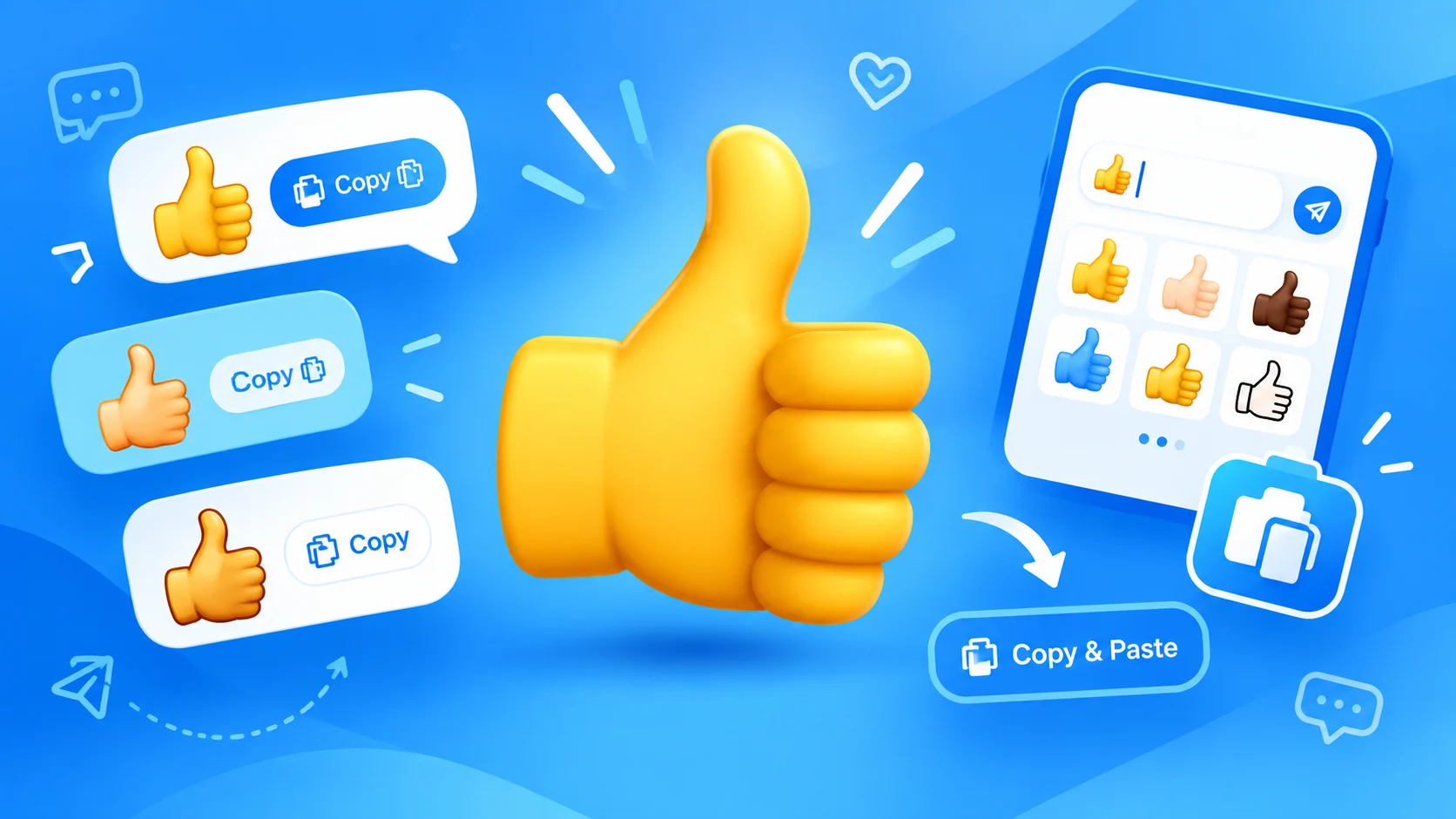
👍 means approval, agreement, “yes,” “good,” “okay,” or “got it.” It is commonly used as a quick positive reaction or acknowledgment.
Need a thumbs up emoji copy and paste? Here it is: 👍. You can copy the emoji directly and paste it into texts, comments, messages, emails, or social posts. Skin-tone versions are also available below.
The 👍 emoji usually expresses approval, agreement, support, or acknowledgment. However, the tone can change with the message around it. A simple “Thanks! 👍” may feel warm and positive, while a lone “👍” can sometimes feel brief, dry, or sarcastic depending on the conversation.
Copy it here: 👍 but remember that a one-emoji reply can feel more neutral or abrupt when the surrounding conversation is serious.
Copy and Paste the Thumbs Up Emoji
Standard thumbs up
👍
Copy: 👍
Thumbs up skin-tone versions
Unicode supports five skin-tone variations for the thumbs up emoji.
- 👍🏻 Thumbs Up: Light Skin Tone
- 👍🏼 Thumbs Up: Medium-Light Skin Tone
- 👍🏽 Thumbs Up: Medium Skin Tone
- 👍🏾 Thumbs Up: Medium-Dark Skin Tone
- 👍🏿 Thumbs Up: Dark Skin Tone
You can copy any version above and paste it wherever emojis are supported.
What Does 👍 Mean?
The thumbs up emoji usually communicates approval or agreement. It can stand for:
- Yes
- Okay
- Sounds good
- I agree
- Good job
- Nice
- Got it
- I support that
- Thanks for letting me know
Unicode lists the emoji with keywords including +1, good, hand, like, thumb, up, and yes.
For example:
“I finished the report. 👍”
This can mean “Good,” “Nice work,” or simply acknowledge that the report is finished.
“See you at 7 👍”
Here, it most likely means “Okay” or “Sounds good.”
The emoji does not have one fixed emotional meaning in every conversation. The words around it, the relationship between the people, and the usual communication style can all affect how it feels.
👍 Meaning in Texting
In texting, 👍 is often a short way to acknowledge a message without writing a full response.
Someone might send:
“I’ll send you the address later.”
“👍”
The response can simply mean “Okay, understood.”
It can also show agreement:
“Let’s order pizza tonight.”
“👍 Sounds good.”
When used with words, its meaning is often easy to understand. When it appears by itself, the tone can be more open to interpretation.
Can 👍 Sound Rude or Sarcastic?
Usually, no. A thumbs up is commonly used as a positive acknowledgment. However, a standalone 👍 can sometimes be interpreted as curt, dismissive, passive-aggressive, or sarcastic, especially when the conversation is tense or someone expected a more detailed response. Emojipedia also notes this possible sarcastic or passive-aggressive interpretation.
Compare these examples:
“Thanks for helping me! 👍”
This normally feels positive and appreciative.
“Fine. 👍”
This could feel colder because the word “Fine” already carries a potentially negative tone.
“I guess that’s your decision. 👍”
Here, the surrounding sentence may make the emoji feel sarcastic rather than supportive.
The emoji itself does not prove sarcasm. Context matters.
Is the Thumbs Up Emoji Friendly or Flirty?
👍 is generally friendly, neutral, or supportive, rather than a clear sign of flirting.
For example:
“Good luck with your interview tomorrow! 👍”
This is naturally supportive.
“That sounds good 👍”
This is usually simple agreement.
If someone sends 👍 during a romantic or playful conversation, it can take on that conversation’s tone. But the emoji by itself is not enough to establish romantic interest.
What Does 👍 Mean From Someone?
When someone sends you 👍, the most likely interpretation is that they are agreeing, acknowledging what you said, or confirming something.
The exact meaning depends on what came before it.
If you write:
“Are we still meeting at 6?”
“👍”
It probably means yes or confirmed.
If you write:
“I’m sorry I missed your call.”
“👍”
The meaning is less clear. It might mean “Okay,” but it could also feel emotionally distant depending on the relationship and the rest of the conversation.
Avoid assuming that the emoji automatically means anger, rejection, flirting, or sarcasm.
Examples of 👍 in Different Contexts
Agreement
“Want to watch a movie tonight?”
“👍”
Likely meaning: Yes or sounds good.
Acknowledgment
“I left the package by the front door.”
“👍 Thanks!”
Likely meaning: Got it, and thank you.
Approval
“I changed the design to this version.”
“Looks good 👍”
Likely meaning: I approve of it.
Short or possibly cold reply
“I spent hours working on this and finally finished it.”
“👍”
Possible meaning: Acknowledgment, but the short reply could feel less enthusiastic than the sender intended.
👍 Compared With Similar Emojis
| Emoji | Official Name | Common Meaning | Tone | Where or When It Is Used |
|---|---|---|---|---|
| 👍 | Thumbs Up | Approval, agreement, okay | Positive, neutral | Quick confirmations, reactions, everyday texts |
| 👎 | Thumbs Down | Disapproval, no, dislike | Negative, direct | Rejecting an idea or showing disagreement |
| 👌 | OK Hand | Okay, all good, satisfactory | Casual, positive | Confirmations and relaxed conversations |
| ✌️ | Victory Hand | Peace, victory, positive mood | Friendly, upbeat | Celebrations, photos, casual messages |
| 🤝 | Handshake | Agreement, cooperation, deal | Respectful, positive | Agreements, teamwork, congratulations |
| 👏 | Clapping Hands | Applause, praise, congratulations | Supportive, enthusiastic | Celebrating an achievement or complimenting someone |
| 🙌 | Raising Hands | Celebration, excitement, praise | Energetic, joyful | Good news, success, excitement |
| ❤️ | Red Heart | Love, affection, strong appreciation | Warm, affectionate | Close relationships, thanks, support |
The most important distinction is between 👍 and 👌. Both can mean “okay,” but 👍 more directly signals approval or agreement, while 👌 can emphasize that something is satisfactory or “all good.”
👏 and 🙌 are more energetic than 👍. If you want to celebrate someone’s achievement, applause or raised hands may communicate more enthusiasm.
❤️ carries much more emotional warmth than 👍 and can suggest affection or love depending on context.
Official Name and Unicode Details
The emoji is displayed as 👍 and has the Unicode code point U+1F44D. Unicode’s current emoji charts list its CLDR short name as “thumbs up,” while the underlying Unicode character name is THUMBS UP SIGN.
The character was approved in Unicode 6.0 in 2010 and later included in Emoji 1.0 in 2015, according to Emojipedia.
Technical details are useful when you need to identify the exact character, but for ordinary messaging, simply copying 👍 is enough.
How to Respond to 👍
Your response can depend on what the sender is acknowledging.
For a simple confirmation:
“Sounds good!”
For friendly agreement:
“Perfect 👍”
For a work-related message:
“Thanks for confirming.”
If you are unsure what the person meant, you can clarify naturally:
“Just checking—does that mean yes?”
You do not need to treat every thumbs up as having a hidden meaning.
Common Misunderstandings About 👍
One common mistake is assuming that every 👍 means exactly the same thing.
A thumbs up after good news may show enthusiasm or approval. The same emoji after a disagreement may feel much colder. A one-character reply can also seem less expressive than a sentence with the emoji attached.
Another mistake is assuming that 👍 automatically signals flirting or romantic interest. It does not. The surrounding conversation provides much more information than the emoji alone.
Platform designs can also differ slightly because companies create their own artwork for emoji characters. The underlying Unicode character remains the same, while its visual appearance can vary across devices and services.
FAQs
What is the thumbs up emoji to copy and paste?
The standard thumbs up emoji is 👍. Copy it directly from this page and paste it into a message, comment, email, or other place that supports emoji.
What does 👍 mean in a text?
It usually means okay, yes, I agree, good, or got it. The exact tone depends on the message and conversation.
Is 👍 a positive emoji?
Yes, it generally communicates approval, agreement, or acknowledgment. In some contexts, however, a standalone thumbs up can feel brief or sarcastic.
What is the Unicode for 👍?
The thumbs up emoji uses Unicode code point U+1F44D. Unicode’s current charts identify its CLDR short name as “thumbs up.”
Can I copy and paste different skin-tone thumbs up emojis?
Yes. You can copy 👍🏻 👍🏼 👍🏽 👍🏾 👍🏿 as well as the standard 👍. Unicode documents these as thumbs up sequences combined with skin-tone modifiers.
Does 👍 mean yes?
Often, yes. In questions such as “Are we meeting at 6?” a 👍 can function as a quick confirmation. Context still determines the exact meaning.
Is 👍 rude?
Not inherently. It is commonly used as a positive acknowledgment, but a single 👍 can sometimes feel abrupt or passive-aggressive depending on the conversation.
Conclusion
👍 is one of the simplest ways to express approval, agreement, acknowledgment, or “sounds good.” For a quick copy-and-paste response, the standard emoji is 👍, with five skin-tone variations also available.
Its tone is not always identical, though. A thumbs up paired with friendly words can feel warm, while a lone 👍 in a tense conversation may feel short or sarcastic. When the context is unclear, look at the complete message rather than interpreting the emoji by itself.
Discover More Related Articles:
- Yoga Emoji | Balance, Peace, Mindfulness & Calm In 2026
- Blue Emoji Thumbs Up | Support, Approval & Positive Vibes In 2026
- Black Cat Emoji | What This Mysterious Cat Really Says In 2026

Jessica Miller is a content writer at EmojisPeace.com, where she creates fun and easy-to-follow guides about emojis, their meanings and creative ways to use them. She loves helping readers express themselves with the perfect emoji for every moment.
11 thoughts on “Thumbs Up Emoji Copy & Paste 👍 | What It Means & Why One Small Gesture Can Say So Much In 2026”