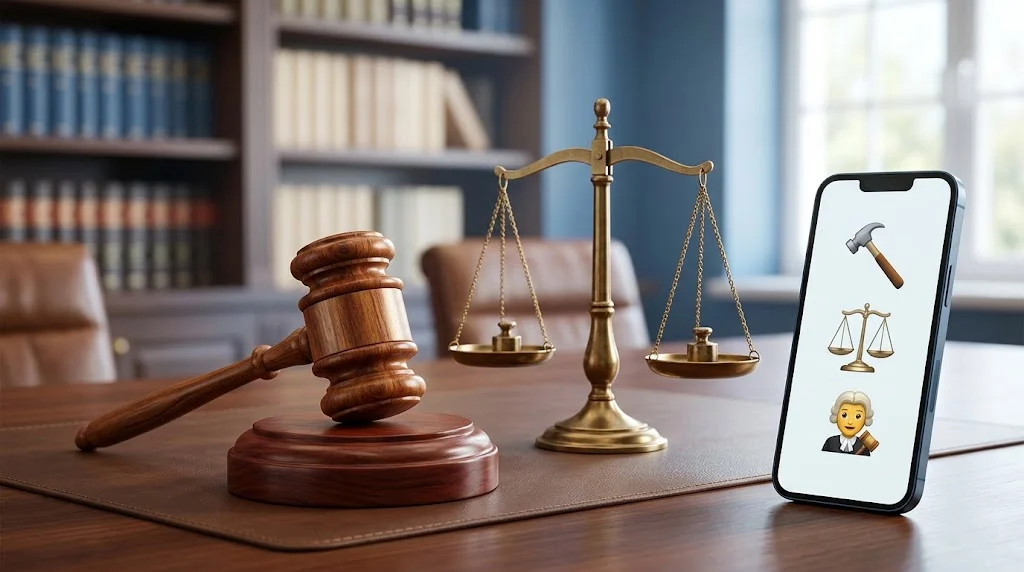
There is no official standalone gavel emoji. 🔨 Hammer is the closest simple object, while ⚖️ Balance Scale and 🧑⚖️ Judge are better for justice or courtroom meanings. Use 🔨 for a playful “gavel” effect, ⚖️ for justice or fairness, and 🧑⚖️ for a judge or court-related message.
If you are searching for a gavel emoji, there is one important detail: there is currently no standalone gavel emoji in Unicode. The closest choices are 🔨 Hammer, ⚖️ Balance Scale, and 🧑⚖️ Judge. Unicode’s current Emoji 18.0 data lists 🔨 as Hammer, ⚖️ as Balance Scale, and 🧑⚖️ as Judge.
If you want to show a courtroom, justice, or a final ruling, the best choice depends on your message. 🔨 can work as a playful gavel substitute, while ⚖️ and 🧑⚖️ communicate legal meaning more directly.
Gavel Emoji Copy and Paste
Looking for something you can copy right now? These are the closest useful options:
🔨 — Hammer
⚖️ — Balance Scale
🧑⚖️ — Judge
👨⚖️ — Man Judge
👩⚖️ — Woman Judge
If you specifically want the feeling of a judge striking a gavel, 🔨 is the closest simple object. If you want the reader to understand “judge” immediately, 🧑⚖️ is clearer.
Is There an Official Gavel Emoji?
No. Unicode Emoji 18.0 does not list a separate emoji with the name Gavel. Instead, it includes 🔨 Hammer, with the code point U+1F528, and ⚖️ Balance Scale, with the code point U+2696.
Unicode also includes 🧑⚖️ Judge, which is a sequence made from a person, a Zero Width Joiner, and the balance-scale character. The current Unicode list identifies it as “judge” and associates it with justice, law, and scales.
So, if a website or post calls 🔨 the official “gavel emoji,” that is not the official Unicode name.
What Is the Closest Emoji to a Gavel?
🔨 Hammer
🔨 Hammer is the closest simple object to a gavel. Its official Unicode name is Hammer, and its standard use is connected with a claw hammer, tools, construction, building, and forceful action.
In a courtroom joke, however, people can use 🔨 as a visual stand-in for a gavel:
“Case closed. 🔨”
Here, the emoji does not suddenly become an official gavel. The surrounding words create the courtroom interpretation.
⚖️ Balance Scale
⚖️ Balance Scale is a stronger choice when the main idea is justice, fairness, law, or balance. Unicode lists keywords including “balance,” “justice,” “scale,” “scales,” and “Libra.”
For example:
“Everyone deserves a fair hearing. ⚖️”
This communicates justice rather than the physical object used by a judge.
🧑⚖️ Judge
🧑⚖️ Judge is useful when the focus is specifically on a judge or courtroom authority. Emojipedia describes it as a person presiding over court proceedings and notes that the emoji includes a gavel in its design. It was added to Emoji 12.1 in 2019.
That makes it one of the clearest choices for a message such as:
“The judge has made a decision. 🧑⚖️”
Which Emoji Should You Use?
The easiest way to choose is to focus on the idea you want to communicate.
Use 🔨 when you mean a hammer, hard work, forceful action, or a playful gavel-style joke.
Use ⚖️ when you mean justice, fairness, law, balance, or a legal decision.
Use 🧑⚖️ when you mean a judge, courtroom proceedings, or judicial authority.
Use 🏛️ when the subject is a courthouse, government institution, or formal public building.
This distinction helps prevent a reader from interpreting a literal hammer as a legal symbol when you actually mean justice.
Gavel Emoji Meaning in Text
The meaning of 🔨 in a text depends on the words around it.
In a construction message:
“Finally fixing that shelf today 🔨”
Likely meaning: a literal hammer or repair work.
In a mock courtroom message:
“You ate the last cookie. Guilty. 🔨”
Likely meaning: a playful judge’s gavel or final verdict.
In a forceful statement:
“Time to get this project finished. 🔨”
Likely meaning: determination, effort, or forceful action.
The emoji itself remains Hammer. The gavel interpretation comes from the context.
Gavel Emoji Examples: 🔨 vs. ⚖️ vs. 🧑⚖️
“Order in the court! 🔨”
The wording creates a humorous courtroom setting, so 🔨 can represent a gavel even though its official name is Hammer.
“Justice should be fair. ⚖️”
The Balance Scale reinforces the idea of fairness and justice.
“The judge has ruled. 🧑⚖️”
The Judge emoji directly identifies the judicial role.
“Case closed. 🔨⚖️”
Using both emojis can combine the playful gavel idea with the broader idea of justice.
Gavel Emoji vs. Similar Court and Justice Emojis
| Emoji | Official Name | Common Meaning | Tone | Where or When It Is Used |
|---|---|---|---|---|
| 🔨 | Hammer | Hammer, force, action | Strong or playful | Tools, work, jokes, mock verdicts |
| ⚖️ | Balance Scale | Justice, fairness, law | Serious or neutral | Legal topics and fairness |
| 🧑⚖️ | Judge | Judge and courtroom authority | Formal or playful | Courtroom references and rulings |
| 🏛️ | Classical Building | Court, government, institution | Formal | Legal or government settings |
| 📜 | Scroll | Document, decree, official text | Formal or dramatic | Rules, announcements, proclamations |
| ⚔️ | Crossed Swords | Conflict or confrontation | Dramatic | Arguments, battles, fictional conflicts |
The biggest difference is between 🔨 and ⚖️. 🔨 is an actual hammer emoji, so its gavel meaning is usually metaphorical. ⚖️ directly connects with justice and fairness.
🧑⚖️ Judge is more specific to a person and a judicial role. If your sentence is about a judge rather than the physical gavel, it is usually the clearer choice.
Can 🔨 Be Used as a Gavel?
Yes, 🔨 can be used informally as a gavel substitute, especially in jokes, mock verdicts, or messages that imitate courtroom language.
For example:
“After reviewing the evidence, I find you guilty of stealing my fries. 🔨”
The humor comes from treating an ordinary conversation like a courtroom ruling.
However, 🔨 should not be described as the official Unicode gavel emoji. Unicode identifies it as Hammer.
Why Does 🔨 Sometimes Look Like a Gavel?
There is an interesting history behind this search.
Emojipedia documented that older Apple emoji designs showed 🔨 in a form that looked like a gavel or mallet. The emoji was not removed; its appearance changed, while its standardized name became Hammer.
This explains why some people remember seeing what looked like a judge’s gavel on an older iPhone. The historical design can make the modern 🔨 emoji seem like a dedicated gavel character even though it is not.
Is the Gavel Emoji Flirty?
🔨 does not have a standard romantic or flirty meaning. If someone uses it in a playful conversation, the surrounding message and relationship between the people involved matter more than the emoji itself.
There is no universal rule that 🔨 means attraction, rejection, or romantic interest.
How to Respond to a Gavel-Style Emoji
If someone uses 🔨 as a playful verdict, you can respond in the same joking style:
“Your honor, I object. 😂”
If they are declaring a playful decision:
“Fine, verdict accepted. 😄”
If you are not sure whther they mean a hammer or a gavel:
“Is that a hammer or are you giving me a courtroom verdict? 😄”
For a serious legal conversation, a simple response that matches the subject is better than assuming the emoji has a hidden meaning.
Official Names and Technical Details
For easy identification:
- 🔨 Hammer — U+1F528
- ⚖️ Balance Scale — U+2696
- 🧑⚖️ Judge — a person + Zero Width Joiner + balance scale sequence
- 👨⚖️ Man Judge — man + Zero Width Joiner + balance scale
- 👩⚖️ Woman Judge — woman + Zero Width Joiner + balance scale
Unicode’s current Emoji 18.0 list includes all of these judicial and tool-related characters and sequences.
Emojipedia identifies the Judge emoji as a ZWJ sequence and notes that it depicts a person presiding over court proceedings while wielding a gavel.
FAQs
Is there a gavel emoji?
No, Unicode currently has no standalone gavel emoji. 🔨 Hammer is the closest simple object, while 🧑⚖️ Judge and ⚖️ Balance Scale communicate courtroom and justice meanings.
What emoji looks like a gavel?
🔨 Hammer is the closest common emoji to a gavel. Its official name is Hammer, although some platforms historically displayed designs that looked more like a gavel or mallet.
What emoji means justice?
⚖️ Balance Scale is closely associated with justice, fairness, and law. 🧑⚖️ Judge is more specific to a person performing a judicial role.
Can I use 🔨 as a gavel emoji?
Yes. 🔨 can work as an informal gavel substitute in a mock verdict or courtroom joke, but its official Unicode name remains Hammer.
What is the best emoji for a judge’s ruling?
🧑⚖️ is a clear choice when the focus is the judge, while ⚖️ works well for justice or fairness. 🔨 can add a humorous gavel-like effect.
Conclusion
There is currently no standalone gavel emoji, but you have several good substitutes. Choose 🔨 for a playful gavel reference, ⚖️ for justice and fairness, and 🧑⚖️ when you want to represent a judge or courtroom.
The key is context: 🔨 officially means Hammer, but in the right sentence it can easily create the visual idea of a judge bringing down a gavel.
Discover More Related Articles:
- Blushing Emoji Meme | Meaning, Uses & Funny Reactions In 2026
- Funny Emoji Faces | Meanings, Uses & How to Choose the Right One In 2026
- Spiral Emoji Meaning | What It Means in Text & How to Use It In 2026

Jessica Miller is a content writer at EmojisPeace.com, where she creates fun and easy-to-follow guides about emojis, their meanings and creative ways to use them. She loves helping readers express themselves with the perfect emoji for every moment.