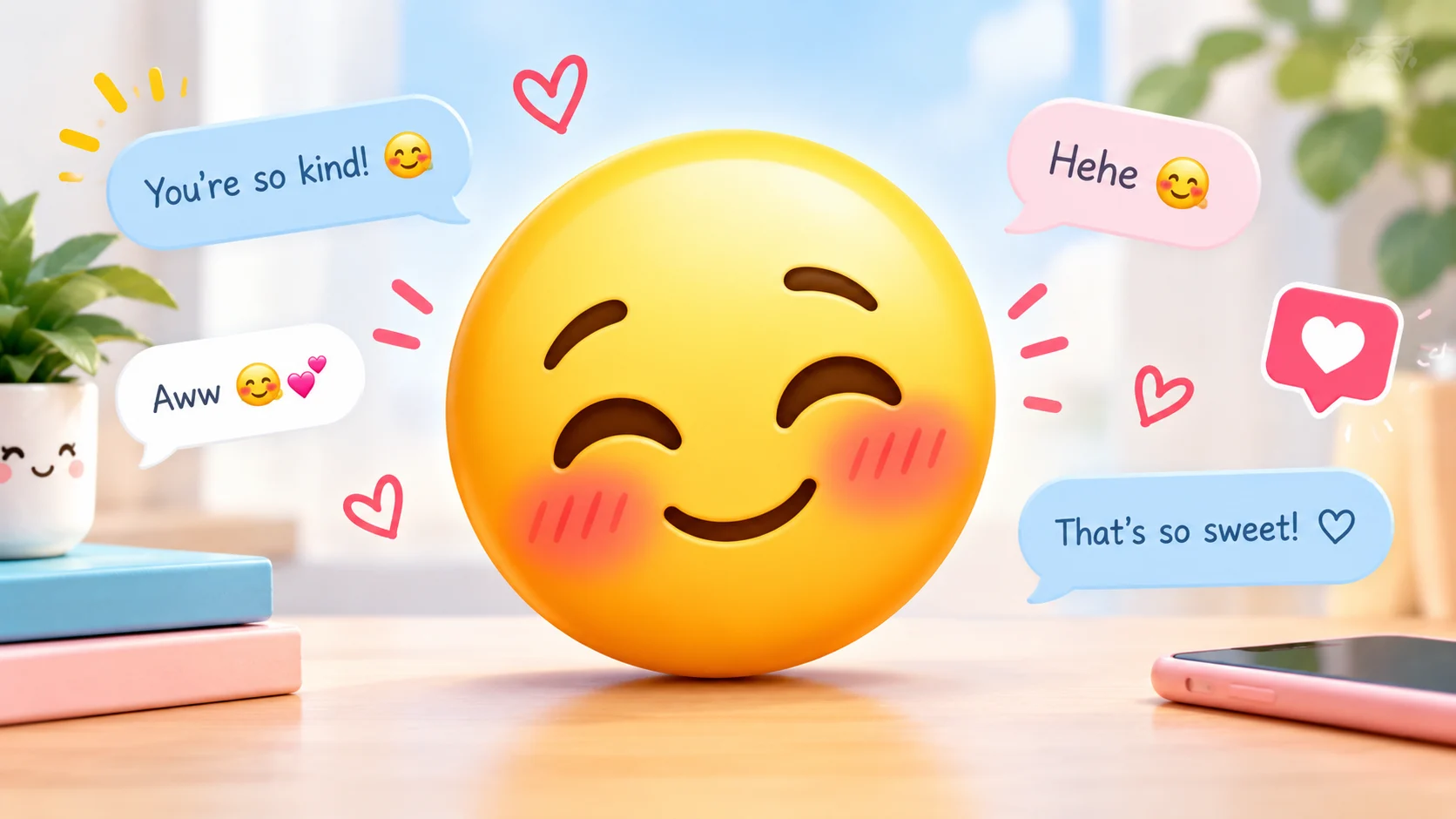
😊 usually expresses warm happiness, friendliness, satisfaction, or a shy/blushing reaction. It can make a message feel softer and more cheerful. In a meme, the same emoji can become awkward, exaggerated, innocent-looking, or humorous, especially when the words and expression create a contrast.
The blushing emoji meme usually refers to the use of 😊, the Smiling Face with Smiling Eyes, in a funny, shy, sweet, awkward, or slightly embarrassed reaction. The emoji has smiling eyes, a closed smile, and rosy cheeks, which can make it feel warm or bashful depending on the message around it. Unicode lists its official name as Smiling Face with Smiling Eyes and identifies “blush” among its associated keywords.
In memes, 😊 is often used beyond its basic meaning. A short sentence followed by the emoji can make an ordinary statement sound overly innocent, playfully awkward, secretly pleased, or intentionally funny. The exact meaning comes from the text, situation, and the sender’s usual style.
What Does the Blushing Emoji 😊 Mean?
The emoji commonly called the blushing emoji is 😊. Its official Unicode name is Smiling Face with Smiling Eyes. Unicode’s current emoji data associates it with ideas such as blush, gladness, satisfaction, and smiling.
Emojipedia describes 😊 as a yellow face with smiling eyes, a broad closed smile, and rosy cheeks. It often expresses genuine happiness and other warm, positive feelings.
In everyday texting, 😊 can communicate:
- Happiness or appreciation
- A friendly response
- Shyness or bashfulness
- Satisfaction with something
- A gentle reaction to a compliment
- Playful innocence
- A soft emotional tone
It does not automatically mean romantic attraction. For example, “Thanks for helping me 😊” can simply sound grateful and friendly, while “You looked really good today 😊” may feel more personal depending on the relationship and the rest of the conversation.
Why Is 😊 So Common in Memes?
The expression on 😊 makes it useful for humor because it looks pleasant and innocent. A meme can place that cheerful face after a statement that is awkward, bold, ridiculous, or unexpectedly honest.
For example:
“I definitely did not eat the entire cake 😊”
Here, the emoji can make the statement sound deliberately innocent rather than serious.
Another example:
“Me pretending I wasn’t waiting for your reply 😊”
The emoji adds a shy or self-aware tone. The humor comes from the contrast between the words and the sweet facial expression.
So, a blushing emoji meme is not necessarily about literal blushing. It can be a visual way to exaggerate a reaction.
😊 in Texting: Shy, Sweet, or Just Friendly?
Context makes a major difference.
If someone sends:
“That was really nice of you 😊”
the emoji usually softens the message and adds warmth.
If someone says:
“You remembered my favorite song? 😊”
it can suggest genuine happiness or pleasant surprise.
If the message says:
“Okay, I might have a tiny crush 😊”
the same emoji can support a shy or embarrassed tone. Even here, the words matter more than the emoji alone.
A useful rule is to read the entire message, not just the face. Conversation history, timing, relationship, and the sender’s normal communication style can all change how 😊 feels.
Is 😊 Flirty or Romantic?
It can appear in a flirty conversation, but 😊 does not prove that someone is flirting.
Compared with more explicitly affectionate emojis, 😊 is relatively open-ended. A person may use it after a compliment because they feel shy, happy, grateful, friendly, or amused.
For example:
“You always know how to make me laugh 😊”
could be friendly or affectionate.
By contrast, adding 🥰, 😍, or 😘 can make a message more clearly affectionate, although even those emojis still depend on context.
The safest interpretation is to consider the surrounding words and the existing relationship instead of treating one emoji as a definite signal.
Blushing Emoji Meme Examples
“I wasn’t trying to impress anyone 😊”
Likely meaning: Playful embarrassment or pretending to be innocent.
Why context matters: The sentence suggests the person actually cared about making an impression, while 😊 makes the denial humorous.
“You actually noticed? 😊”
Likely meaning: Shy happiness or pleasant surprise.
Why context matters: The words create the reaction; the emoji simply strengthens the warm, bashful feeling.
“I said I wanted one cookie. I ate six 😊”
Likely meaning: Comedic guilt or fake innocence.
Why context matters: The emoji makes the admission sound deliberately unapologetic and cute.
“Stop complimenting me 😊”
Likely meaning: Playful embarrassment or enjoyment of the compliment.
Why context matters: Depending on the conversation, it can be genuinely shy, joking, or lightly flirtatious.
Emojis Similar to the Blushing Emoji
| Emoji | Official Name | Common Meaning | Tone | Where or When It Is Used |
|---|---|---|---|---|
| 😊 | Smiling Face with Smiling Eyes | Warm happiness, blush, friendliness | Warm, shy, positive | Thank-you messages, compliments, friendly reactions, memes |
| ☺️ | Smiling Face | Gentle happiness, warmth, affection | Soft, calm | Sweet messages, appreciation, affectionate reactions |
| 😳 | Flushed Face | Embarrassment, surprise, being flustered | Awkward, surprised | Unexpected compliments, embarrassing moments, shocked reactions |
| 🥰 | Smiling Face with Hearts | Affection, love, adoration | Loving, affectionate | Romantic or deeply warm messages |
| 😉 | Winking Face | A wink, teasing, playful implication | Playful, teasing | Jokes, teasing, suggestive or lighthearted comments |
| 😌 | Relieved Face | Relief, contentment, calm | Peaceful, satisfied | After good news, relaxing moments, reassuring reactions |
| 😅 | Grinning Face with Sweat | Nervous laughter or awkward relief | Nervous, humorous | Mistakes, uncomfortable situations, close calls |
| 😍 | Smiling Face with Heart-Eyes | Strong admiration or infatuation | Excited, affectionate | Compliments, people or things someone loves |
The most easily confused emojis are 😊 and 😳 because both can appear in situations involving embarrassment or being flustered. 😊 has a more openly warm smile, while 😳 has wide eyes and is more strongly associated with being startled, embarrassed, or caught off guard. Emojipedia notes that 😳 has several possible interpretations, including embarrassment, surprise, admiration, affection, and excitement.
😊 and 🥰 are also close, but 🥰 adds hearts and therefore carries a clearer affectionate or loving signal.
Meanwhile, 😉 changes the expression from straightforward warmth to a wink, which can introduce teasing or an implied meaning. Unicode’s current annotations include “flirt” and “tease” among its associated concepts.
How to Choose Between 😊, 😳, and 🥰
Use 😊 when you want a warm smile, friendly blush, or gentle happiness.
Use 😳 when the reaction is more about being caught off guard, embarrassed, surprised, or visibly flustered.
Use 🥰 when you want the message to carry stronger affection or adoration.
Use 😉 when the wink itself is part of the joke, teasing, or implied message.
The difference is not absolute. People can use emojis creatively, especially in memes, where exaggeration and irony are part of the humor.
What Does a Blushing Emoji Meme Mean From Someone?
If someone sends you 😊 as part of a meme or reaction, it may simply mean that they find the situation cute, funny, awkward, or relatable.
If the message is a response to a compliment, it may communicate shyness or pleasure. If it follows an obviously exaggerated statement, it may be intentionally ironic.
Rather than asking what 😊 always means, ask what the emoji is doing in that particular message.
How to Respond to 😊
Your response can match the tone of the conversation.
Friendly:
“Aw, you’re welcome 😊”
Playful:
“Why are you acting so innocent? 😂”
Warm:
“I’m glad you liked it 😊”
Clarifying:
“Okay, was that a shy smile or a guilty smile? 😄”
If the situation feels ambiguous, a normal conversational response is usually better than trying to decode the emoji as a definite romantic signal.
Official Details About 😊
- Official Unicode name: Smiling Face with Smiling Eyes
- Emoji: 😊
- Code point: U+1F60A
- Unicode approval: Unicode 6.0, 2010
- Emoji version: Emoji 1.0, 2015
Unicode’s current Emoji 18.0 charts list 😊 as Smiling Face with Smiling Eyes, while Emojipedia records its approval in Unicode 6.0 in 2010 and addition to Emoji 1.0 in 2015.
Its appearance can vary slightly between platforms, but the basic concept remains a smiling face with smiling eyes and rosy cheeks.
FAQs
Is 😊 a blushing emoji?
Yes. Although its official Unicode name is Smiling Face with Smiling Eyes, its rosy cheeks and associated “blush” keyword are why many people call it the blushing emoji.
What does a blushing emoji meme mean?
A blushing emoji meme usually uses 😊 to make a reaction look shy, innocent, pleased, awkward, or humorously self-conscious. The words surrounding it determine the specific joke.
Is 😊 a flirty emoji?
It can be used in a flirty conversation, but 😊 alone does not establish romantic interest. The surrounding message and relationship provide more useful context.
What is the difference between 😊 and 😳?
😊 has a warm, smiling expression and can suggest happiness or a gentle blush. 😳 has wide eyes and a more visibly startled or embarrassed expression, so it often feels more intense.
What is the difference between 😊 and 🥰?
😊 is broader and can be friendly, happy, shy, or warm. 🥰 includes hearts and usually gives a stronger affectionate or loving impression.
Can 😊 be used sarcastically?
Yes. In memes especially, 😊 can create an intentionally innocent contrast with the words. The sarcastic or ironic meaning comes from the overall message rather than the emoji having a fixed sarcastic definition.
Conclusion
The blushing emoji meme works because 😊 combines a warm smile with rosy cheeks, making it easy to use for happiness, shyness, awkwardness, fake innocence, and playful humor. Its official name is Smiling Face with Smiling Eyes, but everyday users may call it a blushing or shy emoji.
The best way to understand it is to read the emoji together with the words around it. In a meme, that context can turn a simple smile into the punchline.
Discover More Related Articles:
- Yoga Emoji | Balance, Peace, Mindfulness & Calm In 2026
- Blue Emoji Thumbs Up | Support, Approval & Positive Vibes In 2026
- Black Cat Emoji | What This Mysterious Cat Really Says In 2026

Matthew Garcia is a content writer at EmojisPeace.com, where she creates fun, expressive and easy-to-use emoji collections for every mood and moment. Passionate about digital expression, she helps readers find the perfect emojis to make every message more creative and memorable.
9 thoughts on “Blushing Emoji Meme | 😊 Meaning, Uses & Funny Reactions In 2026”