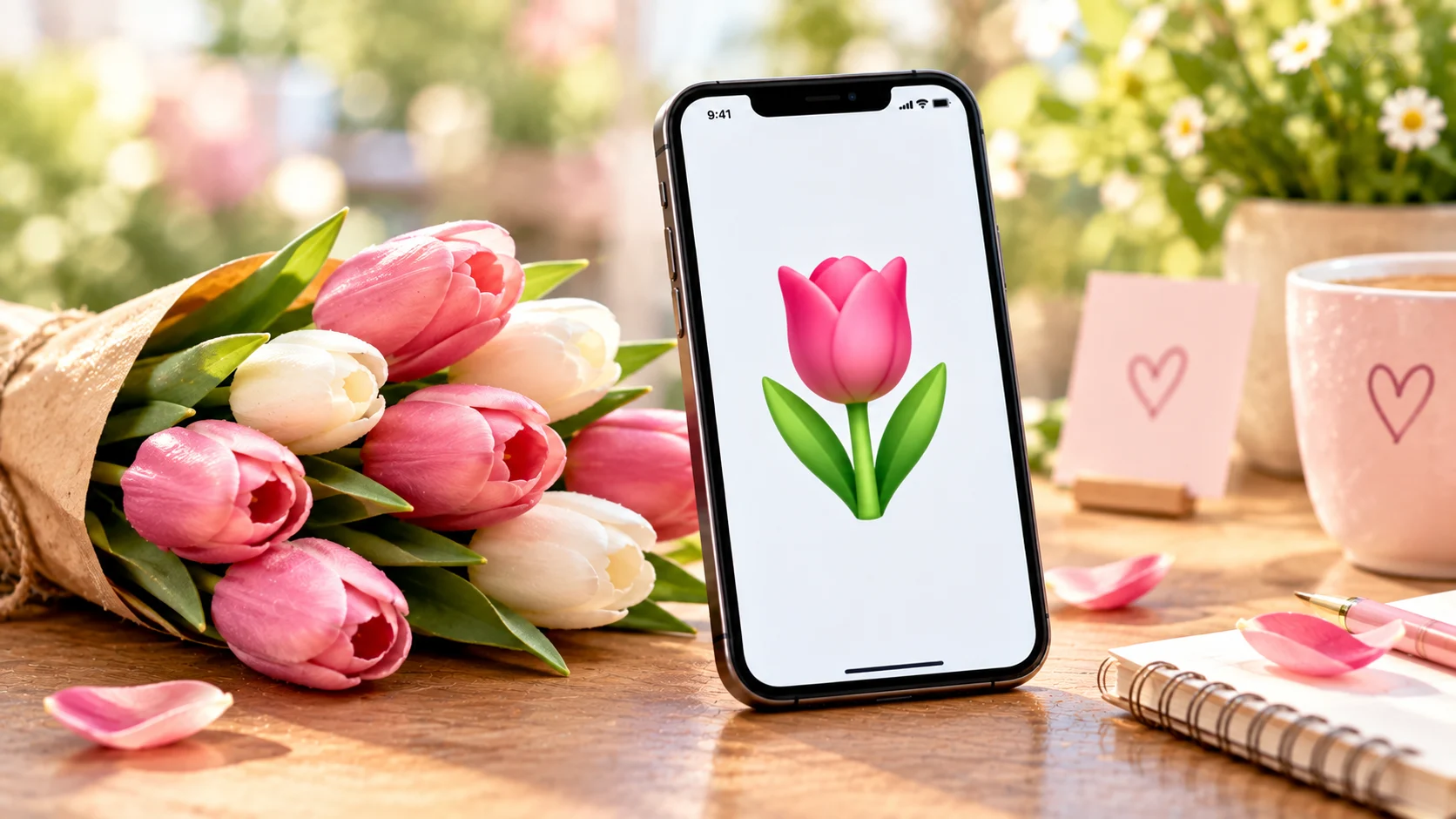
🌷 Tulip emoji usually means flowers, spring, beauty, affection, appreciation, or happiness. It can also be used for Valentine’s Day, Mother’s Day, special occasions, or references to the Netherlands. In a text, 🌷 can feel sweet, caring, romantic, friendly, or simply decorative. The words around it and the relationship between the sender and receiver usually determine the intended tone.
The 🌷 tulip emoji usually represents a tulip flower, spring, beauty, affection, appreciation, or happiness. Its meaning can shift depending on the message and relationship between the people using it. It may be sent as a simple flower, a warm compliment, a romantic gesture, or a reference to spring and the Netherlands.
Unlike some flower emojis with stronger romantic associations, 🌷 often feels gentle and positive. It can express affection without necessarily suggesting romance, so the surrounding words are important when interpreting it.
What Does the 🌷 Tulip Emoji Mean?
The 🌷 Tulip emoji shows a single tulip on a green stem. Unicode lists its official short name as tulip, with keywords including flower, blossom, growth, plant, and tulip. Its code point is U+1F337.
In everyday messages, the emoji is commonly connected with:
- Flowers and gardening
- Springtime
- Beauty
- Love and affection
- Appreciation
- Happiness
- Special occasions
- The Netherlands
- Pink-colored themes
Emojipedia notes that 🌷 is commonly used for Valentine’s Day, Mother’s Day, and other special occasions, while also being used to express love, appreciation, and happiness.
The emoji does not have one fixed emotional meaning. A friend sending “Good morning 🌷” may simply be sharing a warm, cheerful feeling, while “You looked beautiful today 🌷” may sound more affectionate.
🌷 Tulip Emoji Meaning in Text
When someone sends 🌷 in a text, it usually adds a soft, positive, or affectionate tone.
For example:
“Hope you have a beautiful day 🌷”
Here, the tulip works like a small floral gesture. It can make the message feel warmer without necessarily making it romantic.
Another example:
“Thank you for everything 🌷”
In this context, 🌷 can suggest appreciation or kindness.
And:
“Spring is finally here! 🌷”
Here, the meaning is much more literal. The emoji represents flowers and the arrival of spring rather than affection.
This is why the surrounding message matters more than the flower alone.
What Does 🌷 Mean From Someone?
If someone sends you 🌷 by itself, it can be difficult to know exactly what they mean.
Depending on the conversation, it may be:
- A friendly flower
- A sign of appreciation
- A gentle compliment
- A symbol of affection
- A spring or nature reference
- A decorative addition to a message
- A romantic gesture
The emoji alone does not prove romantic interest. Look at the words, previous messages, relationship, timing, and the sender’s normal communication style before reading more into it.
Is the Tulip Emoji Romantic?
🌷 can be romantic, but it is not exclusively a romantic emoji.
Tulips are real flowers that can be given as gifts, so 🌷 can naturally appear in romantic messages. It may communicate tenderness or affection without having the stronger romantic association that some people attach to ❤️ or 🌹.
For example:
“Thinking of you today 🌷”
This could be affectionate or romantic depending on the relationship.
But:
“Happy Mother’s Day! 🌷”
is more clearly a warm greeting for a special occasion.
The context changes the interpretation.
🌷 Tulip Emoji Meaning in Love
In a romantic conversation, 🌷 can represent affection, tenderness, beauty, or a thoughtful gesture.
Someone might use it after:
“I had such a great time with you 🌷”
The flower can add warmth and affection to the message.
However, 🌷 by itself does not establish that someone is in love or wants a relationship. It is better understood as a possible emotional cue, not proof of a specific feeling.
Does 🌷 Mean “I Love You”?
Not necessarily.
🌷 can accompany “I love you,” but the emoji itself does not officially mean those words. Unicode’s emoji data identifies it as tulip, while common usage gives it additional associations such as love, appreciation, happiness, and special occasions.
For example:
“I love you 🌷”
The words provide the direct romantic meaning. The tulip adds a floral, affectionate touch.
By comparison:
“Beautiful flowers today 🌷”
uses the same emoji in a completely different way.
🌷 Tulip Emoji and Friendship
The tulip can work very naturally in friendly messages.
“Proud of you 🌷”
“Hope your day gets better 🌷”
“Thank you for being there for me 🌷”
In these examples, the flower can communicate warmth and appreciation without requiring a romantic interpretation.
That makes 🌷 useful when you want a message to feel kind and personal but not overly intense.
What Does 🌷 Mean on Social Media?
On social media, 🌷 may appear in posts and captions about:
- Spring
- Flowers
- Gardens
- Nature
- Beauty
- Self-care
- Mother’s Day
- Valentine’s Day
- Travel
- The Netherlands
- Pink-themed content
Its use can also be purely decorative. Someone may add 🌷 to a caption simply because it matches the visual style or mood of a post.
There is no universal social-media meaning that overrides the normal context of the post.
Tulip Emoji and the Netherlands 🇳🇱
🌷 is also commonly associated with the Netherlands, where tulips are a major cultural and horticultural symbol.
A message such as:
“Amsterdam in spring 🌷🇳🇱”
makes the geographic meaning much clearer because the tulip is paired with the Netherlands flag.
The combination 🌷🇳🇱 can therefore suggest Dutch culture, travel, tulip fields, or the Netherlands rather than romance.
🌷 vs. 🌹: What’s the Difference?
The 🌷 Tulip and 🌹 Rose can both express affection and beauty, but they often create different impressions.
🌷 tends to feel fresh, gentle, cheerful, and spring-like.
🌹 can feel more strongly romantic, passionate, or traditional, especially in messages about love.
Neither interpretation is guaranteed. The message determines the actual intent.
For example:
“Thank you for always supporting me 🌷”
feels gentle and appreciative.
“You are the love of my life 🌹”
has a much stronger romantic tone because both the wording and emoji point in that direction.
Related Flower Emojis and Their Meanings
| Emoji | Official Name | Common Meaning | Tone | Where or When It Is Used |
|---|---|---|---|---|
| 🌷 | Tulip | Flowers, spring, affection, appreciation | Gentle, warm | Spring posts, gifts, thanks, affection |
| 🌹 | Rose | Love, romance, beauty | Romantic, affectionate | Love messages, Valentine’s Day, compliments |
| 🌸 | Cherry Blossom | Beauty, spring, renewal | Soft, cheerful | Spring, nature, aesthetic posts |
| 🌺 | Hibiscus | Tropical flowers, beauty | Bright, cheerful | Travel, summer, flowers |
| 🌻 | Sunflower | Happiness, warmth, positivity | Cheerful, uplifting | Encouragement, summer, nature |
| 💐 | Bouquet | Flowers, gifts, celebration | Warm, celebratory | Congratulations, gifts, special occasions |
| 🪷 | Lotus | Lotus flower, calm, beauty | Peaceful, reflective | Nature, wellness, spiritual contexts |
| 🥀 | Wilted Flower | Sadness, loss, disappointment | Sad, dramatic | Heartbreak, disappointment, darker humor |
The most common confusion is between 🌷 and 🌹. Both can express affection, but 🌷 often gives a lighter floral feeling, while 🌹 more readily fits traditional romantic messages.
🌷 and 🌸 can also overlap when talking about spring or beauty. 🌸 specifically represents cherry blossom, while 🌷 represents a tulip.
🥀 is almost the opposite in emotional tone: it depicts a wilted flower and can suggest sadness, heartbreak, grief, or disappointment.
When Should You Use 🌷?
🌷 works especially well when you want your message to feel warm, pretty, gentle, or appreciative.
You could use it for:
A thank-you:
“Thanks for helping me today 🌷”
A spring message:
“Hello, spring! 🌷”
A compliment:
“You look lovely today 🌷”
A supportive message:
“Hope things get better soon 🌷”
A special occasion:
“Happy Mother’s Day! 🌷”
A romantic message:
“Thinking about you 🌷”
The same emoji can fit all of these situations because its meaning is broad rather than tied to one emotion.
Is 🌷 Flirty?
🌷 can appear in a flirty message, but it does not have a standard flirty meaning.
For example:
“You looked amazing tonight 🌷”
could feel romantic or flirty depending on the relationship.
But:
“Happy Mother’s Day 🌷”
is not a flirtatious use.
If you’re trying to determine someone’s message is flirting, don’t rely on 🌷 alone. The wording and the overall conversation provide much stronger clues.
Can 🌷 Be Sarcastic?
Yes, like many emojis, 🌷 can be used sarcastically when the surrounding text creates an unexpected contrast.
For example:
“Another three-hour meeting. Lovely. 🌷”
The flower can make the sentence sound deliberately sweet even though the words suggest annoyance.
This is a contextual use, not a standard meaning of the tulip emoji.
Tulip Emoji Examples in Messages
“Good morning 🌷”
The tulip adds a warm, cheerful touch to a simple greeting.
“Thank you so much for your help 🌷”
Here, it suggests appreciation and makes the message feel softer.
“Happy Valentine’s Day 🌷”
The emoji supports a romantic or affectionate occasion, although it is less intense than some heart emojis.
“The tulip fields were incredible! 🌷”
This is a literal flower and nature reference.
“I hope you’re feeling better soon 🌷”
The flower adds a gentle, supportive tone.
“Amsterdam was beautiful 🌷🇳🇱”
The combination points toward the Netherlands and travel rather than romance.
How to Respond to 🌷
Your response can depend on what the sender appears to mean.
If it’s friendly:
“Aww, thank you! 🌷”
If someone is being supportive:
“That means a lot. Thank you ❤️”
If it’s clearly about flowers or spring:
“Tulips are one of my favorites! 🌷”
If you’re unsure the message is affectionate:
“That’s sweet of you 😊”
You do not need to assign a romantic meaning to the emoji unless the rest of the conversation supports it.
Does the Tulip Emoji Have a Hidden Meaning?
Usually, 🌷 is simply a flower emoji with positive and affectionate associations.
As with other emojis, people can give it personal or contextual meanings. Unicode itself explains that emoji can have different meanings depending on language, culture, and context, and that an emoji’s Unicode character name does not define every possible meaning.
So there is no single hidden interpretation that applies to every 🌷 message.
Official Tulip Emoji Details
Here are the key facts about 🌷:
- Emoji: 🌷
- Official Unicode name: tulip
- Code point: U+1F337
- Unicode version: Unicode 6.0
- Emoji version: Emoji 1.0
- Category: Animals & Nature
- Keywords: blossom, flower, growth, plant, tulip
Unicode lists 🌷 as tulip and places it among flower and plant emoji.
The emoji was approved as part of Unicode 6.0 in 2010 and added to Emoji 1.0 in 2015.
Does the Tulip Look the Same on Every Device?
Not exactly.
The basic concept stays the same, but individual platforms can change details such as the flower’s shade, shape, stem, leaves, and overall rendering. Emojipedia notes that Google’s tulip was once orange, while Microsoft and Samsung previously used red versions.
So a 🌷 sent from one device may look slightly different when viewed on another.
The meaning generally remains recognizable as a tulip.
FAQs
What does the 🌷 tulip emoji mean?
The 🌷 tulip emoji commonly represents flowers, spring, beauty, affection, appreciation, and happiness. It can also be used for special occasions or references to the Netherlands.
What does 🌷 mean from a girl or guy?
The tulip does not have different standard meanings based on the sender’s gender. Its meaning depends more on the message, relationship, context, and communication style.
Does 🌷 mean love?
It can express love or affection, especially in a romantic conversation, but 🌷 does not specifically mean “love.” The surrounding words determine the message is romantic, friendly, or simply about flowers.
Is 🌷 a romantic emoji?
It can be romantic, but it is not exclusively romantic. Tulips are also used for friendship, appreciation, spring, Mother’s Day, nature, and other positive occasions.
What is the difference between 🌷 and 🌹?
🌷 often gives a softer, fresher, or spring-like feeling, while 🌹 is more strongly associated with traditional romance and love. Their meanings can overlap depending on context.
What does 🌷 mean in texting?
In texting, 🌷 can add warmth, appreciation, affection, beauty, or a cheerful floral feeling. A message such as “Thank you 🌷” will usually feel different from “I love you 🌷” because the words change the context.
What does 🌷 mean on Instagram or social media?
It can represent flowers, spring, beauty, nature, travel, affection, or a decorative aesthetic. There is no single social-media meaning that applies to every post.
Conclusion
The 🌷 tulip emoji is a flexible flower symbol that can express spring, beauty, appreciation, affection, happiness, and love. It can be romantic in the right conversation, but it works just as naturally in friendly, supportive, seasonal, and decorative messages.
If you want a soft floral feeling, 🌷 is a useful choice. If you want a stronger traditional romance signal, 🌹 may fit better; if you want a cheerful spring or nature feeling, 🌸 or 🌻 may be a better match.
Discover More Related Articles:
- Hehe Emoji Meaning | What [hehe] Means on TikTok & in Texts In 2026
- Chain Emoji Meaning | What Does It Mean in Text In 2026
- Thumbs Up Emoji Copy & Paste | What It Means & Why One Small Gesture Can Say So Much In 2026

Jessica Miller is a content writer at EmojisPeace.com, where she creates fun and easy-to-follow guides about emojis, their meanings and creative ways to use them. She loves helping readers express themselves with the perfect emoji for every moment.
2 thoughts on “Tulip Emoji Meaning 🌷 | What It Means in Text, Love & More In 2026”