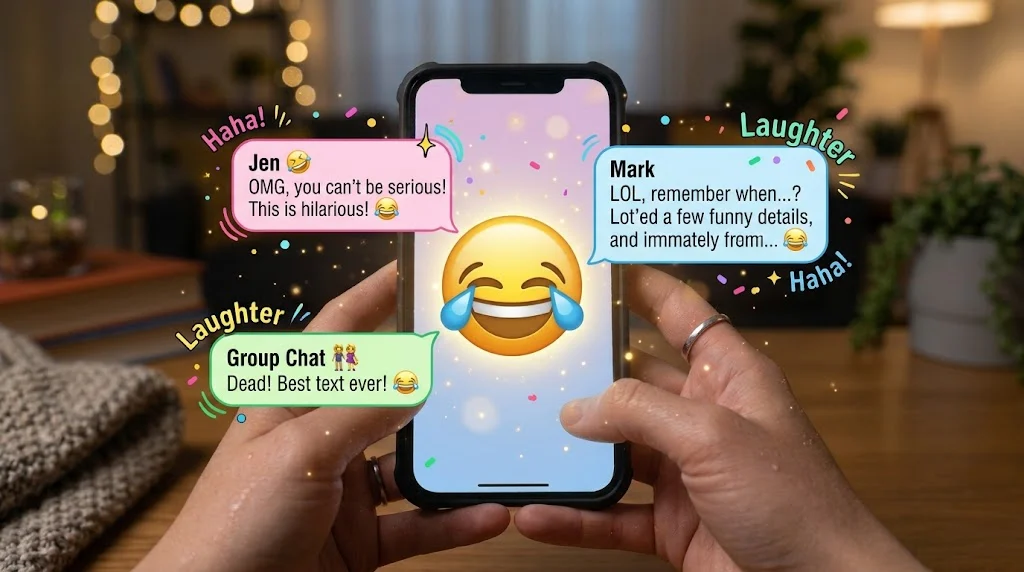
LOL emoji 😂 meaning: Laughing out loud, amusement, or finding something hilarious. Emotional tone: Usually funny, playful, cheerful, or lighthearted; it can also express sarcasm or awkward laughter depending on context.
The 😂 emoji, officially called Face with Tears of Joy, represents laughing so hard that tears come out of your eyes. It is commonly used to express laughter, amusement, and reactions to something funny. People often call it the LOL emoji because it conveys the feeling of “laughing out loud” in text messages, online chats, and social media conversations.
The emoji can also communicate playful teasing, exaggerated amusement, or a lighthearted response to an awkward situation. In some conversations, it may soften a message that could otherwise sound serious or blunt. However, its meaning depends on the surrounding words, the relationship between the people communicating, and their usual texting style. While 😂 generally expresses humor, it does not always mean that someone is literally laughing. Understanding the context helps you recognize the sender is genuinely amused, joking around, reacting sarcastically, or simply keeping the conversation friendly.
What Is the Main Meaning of 😂?
The 😂 emoji shows a yellow face with a wide grin, smiling eyes, and tears streaming down both sides. Its expression suggests intense laughter rather than sadness.
People use it when a message, joke, meme, story, or unexpected situation makes them laugh.
Here are its most common interpretations:
- Genuine laughter: Something is funny enough to make the sender laugh.
- Amusement: The sender finds a comment or situation entertaining.
- Playful teasing: Someone is joking with a friend in a friendly way.
- Exaggerated reaction: The sender wants to make their amusement feel stronger.
- Awkward humor: A strange or embarrassing situation is being treated humorously.
- Sarcasm: The emoji can signal that a statement is not meant to be taken seriously.
For example, if someone sends a funny video and you reply “That was hilarious 😂,” the emoji reinforces your laughter.
The emoji is generally positive, but the tone can change when it appears alongside criticism, uncomfortable news, or a sarcastic statement.
What Does the LOL Emoji Mean in Text Messages?
In texting, 😂 is a visual way to communicate the reaction “LOL,” “haha,” or “that’s funny.”
Unlike the written abbreviation LOL, which can sometimes feel casual or understated, 😂 provides a facial expression that makes the emotional reaction easier to recognize.
Consider these examples:
| Text Message | Likely Meaning |
|---|---|
| “You are so funny 😂” | Genuine amusement |
| “I can’t believe you did that 😂” | Playful surprise or teasing |
| “That joke was terrible 😂” | Laughing at an intentionally bad joke |
| “I forgot my own password 😂” | Laughing at an embarrassing mistake |
| “Yeah, that sounds like a great idea 😂” | Potential sarcasm, depending on context |
The emoji can make ordinary messages feel more expressive. It may also help prevent a playful comment from being interpreted as serious criticism.
However, it cannot completely remove ambiguity. When a message is sensitive or potentially hurtful, clear wording is more reliable than an emoji alone.
Is 😂 a Friendly, Sarcastic, or Flirty Emoji?
The 😂 emoji is most often friendly and humorous. It can appear in conversations between friends, family members, coworkers, or romantic partners.
Its meaning changes according to the message it accompanies.
Friendly meaning
When used between friends, 😂 often expresses shared humor or playful teasing.
Example:
“Remember when you walked into the wrong classroom? 😂”
Likely meaning: The sender is laughing about a funny memory, not trying to embarrass you seriously.
Sarcastic meaning
The emoji can also make a sarcastic comment more obvious.
Example:
“Oh, another three-hour meeting. Amazing 😂”
Likely meaning: The sender is probably expressing frustration through humor rather than genuine excitement.
Flirty meaning
In a romantic or flirtatious conversation, 😂 may show that someone enjoys your humor or feels comfortable joking with you.
Example:
“You always know how to make me laugh 😂”
Likely meaning: The sender appreciates your sense of humor. It may feel warm or flirtatious, but it does not automatically indicate romantic interest.
Awkward or nervous meaning
Sometimes the emoji is used to make an uncomfortable moment feel less serious.
Example:
“I accidentally sent that message to the wrong person 😂”
Likely meaning: The sender is laughing at an embarrassing situation or trying to make it seem less awkward.
Important: The emoji alone cannot prove that someone is flirting, mocking you, or being sarcastic. The conversation and the sender’s usual communication style matter more.
😂 vs. 🤣 vs. 😆: What Is the Difference?
The 😂 and 🤣 emojis are especially easy to confuse because both communicate strong laughter. However, their facial expressions and common interpretations differ.
| Emoji | Official Name | Common Meaning | Emotional Tone | Where or When It Is Used |
|---|---|---|---|---|
| 😂 | Face with Tears of Joy | Laughing so hard that tears appear | Cheerful, amused | Funny texts, jokes, memes, and reactions |
| 🤣 | Rolling on the Floor Laughing | Extremely intense laughter | Exaggerated, hilarious | An unexpectedly funny joke or ridiculous situation |
| 😆 | Grinning Squinting Face | Big laugh or delighted reaction | Energetic, playful | Funny comments, jokes, and happy reactions |
| 😅 | Grinning Face with Sweat | Nervous laughter or relief | Awkward, relieved | Embarrassing moments or stressful situations |
| 😹 | Cat Face with Tears of Joy | A cat-themed laughing reaction | Cute, playful | Funny messages, pet jokes, and humorous reactions |
| 😭 | Loudly Crying Face | Intense crying or exaggerated emotional reaction | Dramatic, emotional | Sadness, overwhelming feelings, or sometimes extreme laughter |
| 💀 | Skull | “I’m dead” from laughter | Informal, dramatic | Extremely funny jokes, memes, or ridiculous situations |
| 🤭 | Face with Hand Over Mouth | Suppressed laughter, surprise, or a secret | Mischievous, amused | Gossip, funny secrets, or cheeky reactions |
Which Laughing Emoji Should You Use?
- 😂: Use it for ordinary laughter or a funny reaction.
- 🤣: Choose it when something feels ridiculously hilarious.
- 😆: Use it for an energetic, happy laugh.
- 😅: Choose it when the humor includes awkwardness or nervousness.
- 💀: Use it for a dramatic reaction to something extremely funny.
- 🤭: Choose it when you are giggling at something cheeky or surprising.
The most important distinction is that 😂 is a general laughing reaction, while 🤣 suggests more exaggerated laughter. 😅 introduces a nervous or relieved feeling, and 😭 can communicate a completely different emotional reaction.
LOL Emoji 😂 Message Examples
These hypothetical examples show how the same emoji can communicate different feelings depending on the message.
“That joke was so bad 😂”
Likely meaning: The sender is laughing at an intentionally terrible joke.
Why context matters: The words “so bad” make the laughter playful rather than critical.
“You actually believed that? 😂”
Likely meaning: Friendly teasing or amusement.
Why context matters: Between close friends, the message may feel harmless. In a serious conversation, it could sound dismissive.
“I studied all night and still failed 😂”
Likely meaning: Laughing at an unfortunate or frustrating situation.
Why context matters: The emoji may reflect ironic humor or an attempt to cope with disappointment.
“Stop, I can’t breathe 😂”
Likely meaning: The sender finds something extremely funny.
Why context matters: The phrase is commonly used as an exaggerated reaction to laughter, not necessarily a literal statement about breathing.
“You look amazing in that picture 😂”
Likely meaning: The sender may be joking, teasing, or expressing amusement.
Why context matters: Depending on the relationship and conversation, the message could be affectionate or potentially insulting. The words alone do not establish the sender’s intent.
“I said I would be productive today 😂”
Likely meaning: Self-deprecating humor about failing to follow through on a plan.
Why context matters: The emoji makes the statement feel like a joke about the sender’s own behavior.
What Does It Mean When Someone Sends You 😂?
When someone sends you 😂, the most reasonable interpretation is that they found your message or something in the conversation funny.
However, the precise meaning can depend on several factors:
- The message before it: A funny story usually suggests genuine laughter.
- Your relationship: Close friends may use it for teasing, while coworkers may use it to keep conversations light.
- The surrounding emojis: 😂 combined with ❤️ may feel warmer, while 😂 combined with 🙄 may suggest sarcasm or annoyance.
- Their usual texting style: Some people use laughing emojis frequently, even when something is only mildly amusing.
Avoid treating a single emoji as a complete emotional message. If the conversation matters, consider the entire exchange rather than interpreting 😂 in isolation.
How to Respond to the LOL Emoji 😂
The best response depends on the sender is laughing with you, teasing you, or reacting to a funny story.
| Situation | Natural Response | Why It Works |
|---|---|---|
| Someone laughs at your joke | “I knew you’d laugh 😂” | Keeps the humor going |
| A friend teases you | “Don’t expose me like that 😭” | Responds playfully |
| Someone shares a funny meme | “This is actually hilarious 🤣” | Matches their reaction |
| Someone laughs at an embarrassing moment | “I can’t believe that happened 😂” | Acknowledges the situation |
| You don’t understand the joke | “Wait, what am I missing? 😂” | Clarifies without sounding upset |
| Someone uses sarcasm | “Okay, I see what you did there 😅” | Recognizes the playful tone |
If the emoji appears in a serious or uncomfortable conversation, you do not need to respond with another laughing emoji. A straightforward response may be more appropriate.
Copy and Paste the LOL Emoji 😂
😂
Face with Tears of JoyCopy 😂 Emoji
Popular LOL emoji combinations
😂🤣
😂😭
😆😂
💀😂
😂😅
Use these combinations for laughter, dramatic reactions, jokes, and playful conversations.
Official Name and Unicode Details
The LOL emoji is officially identified as Face with Tears of Joy by the Unicode Consortium.
File:Noto Emoji v2.034 1f602.svg – Wikimedia Commons

| Detail | Official Information |
|---|---|
| Emoji | 😂 |
| Official Unicode Name | Face with Tears of Joy |
| Unicode Code Point | U+1F602 |
| Unicode Version | Unicode 6.0 |
| Emoji Version | Emoji 1.0 |
| Approval Year | 2010 |
| Emoji Category | Smileys & Emotion |
| Common Keywords | Laugh, funny, haha, lol, joy, tears |
| Common Text Meaning | Laughing out loud |
According to the Unicode emoji list, the character’s keywords include “lol,” “laugh,” “haha,” “hilarious,” and “joy.” These keywords help identify its association with laughter and amusement. Unicode+2
Does the LOL Emoji Look the Same on Every Device?
No. The general expression remains recognizable, but the emoji’s appearance can vary slightly across Apple, Google, Samsung, Microsoft, and other platforms.
Differences may include:
- The shape of the eyes
- The size and style of the tears
- The mouth’s expression
- Facial proportions
- Color and shading
These are visual design differences rather than separate emoji meanings.
FAQs
What does 😂 stand for?
😂 stands for the Face with Tears of Joy emoji. It is commonly used to represent LOL, laughing out loud, amusement, or a hilarious reaction.
Is 😂 the same as LOL?
Not exactly. LOL is a text abbreviation for “laughing out loud,” while 😂 is a visual expression of laughter. They can communicate a similar reaction, but the emoji adds facial expression and emotional tone.
Does 😂 mean someone is making fun of me?
Not necessarily. It can indicate playful teasing, but it may also express genuine laughter or amusement. Look at the message and your relationship with the sender before assuming that they are mocking you.
Is 😂 a sarcastic emoji?
It can be. For example, “Great, another problem 😂” may express frustration through sarcasm. However, the emoji is not inherently sarcastic.
Is 😂 better than 🤣?
Neither emoji is universally better. 😂 is a versatile laughing reaction, while 🤣 often conveys more exaggerated or intense laughter. Choose the one that best matches your reaction.
Can 😂 be used in professional messages?
It can be appropriate in informal workplace chats when the conversation is lighthearted. In formal emails, serious discussions, or messages to unfamiliar clients, a more neutral response may be safer.
What is the difference between 😂 and 😭?
😂 officially represents laughter through tears of joy. 😭 is the Loudly Crying Face emoji, which typically communicates sadness or overwhelming emotion. However, 😭 can also be used informally to express extreme laughter, depending on context.
Conclusion
The 😂 emoji is one of the clearest ways to express laughter, amusement, and funny reactions in digital conversations. Known officially as Face with Tears of Joy, it can make a message feel cheerful, playful, or sarcastic depending on the surrounding words.
You are reacting to a joke, teasing a friend, or laughing at an embarrassing moment, 😂 adds an expressive touch to your message. Just remember that its meaning is not universal, and the context of the conversation is always important.
Discover More Related Articles:
- Praying Hands Emoji | How to Express Gratitude, Faith & Heartfelt Thanks In 2026
- IDK Emoji | The Best Reactions for “I Don’t Know,” Confusion & Uncertain Moments In 2026
- Cringe Emoji | What It Really Means in Texts & Online Conversations in 2026

Matthew Garcia is a content writer at EmojisPeace.com, where she creates fun, expressive and easy-to-use emoji collections for every mood and moment. Passionate about digital expression, she helps readers find the perfect emojis to make every message more creative and memorable.