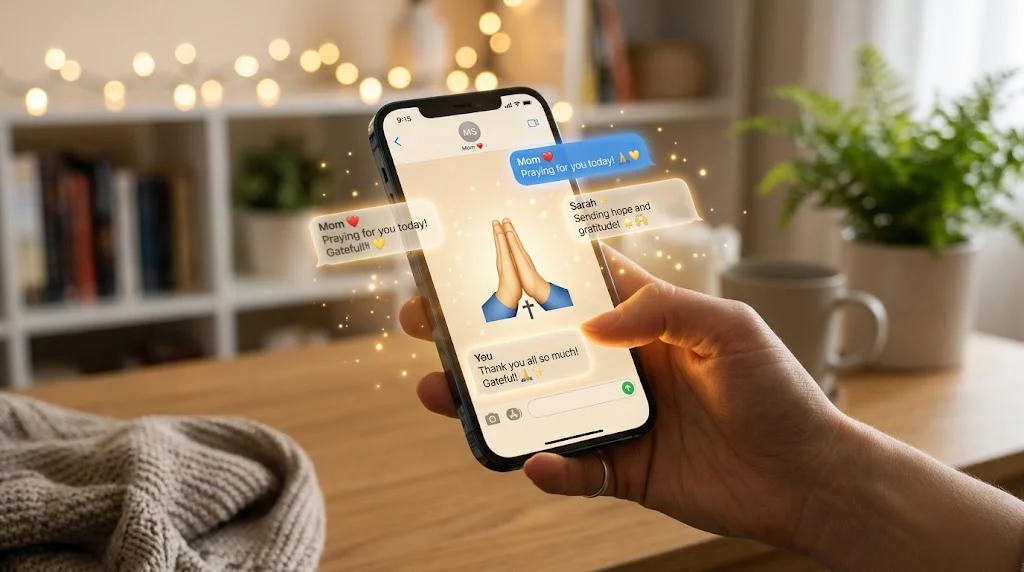
🙏 commonly means prayer, thank you, please, or hope. It usually carries a respectful, grateful, or heartfelt tone, but its exact meaning depends on the message.
The praying hands emoji 🙏 usually represents prayer, gratitude, hope, or a heartfelt request. It shows two hands pressed together, often associated with praying or expressing thanks. In text messages, people also use it to say “please,” ask for support, show appreciation, or wish someone well. Its meaning depends on the conversation and the sender’s intention.
For example, someone might send 🙏 after receiving a kind favor to say thank you. Another person might use it before an important exam to express hope or ask for prayers. It can also communicate a sincere request, such as “Please let me know when you arrive 🙏.”
Although many people call it the praying hands emoji, it can communicate more than religious devotion. Understanding the surrounding words helps you tell someone is praying, showing appreciation, making a polite request, or asking for encouragement.
What Does 🙏 Mean in Different Situations?
The same gesture can communicate different feelings depending on the conversation. Here is a quick guide to its most common uses.
| Situation | Possible Meaning | Example Message |
|---|---|---|
| Prayer | Asking for divine help or guidance | “Praying for your recovery 🙏” |
| Gratitude | Expressing sincere thanks | “Thank you for everything 🙏” |
| Polite request | Asking someone for a favor | “Please send me the details 🙏” |
| Hope | Wishing for a positive outcome | “Hope everything goes well tomorrow 🙏” |
| Support | Showing care and encouragement | “You’ve got this! 🙏” |
| Apology | Showing regret or asking forgiveness | “I’m sorry for what happened 🙏” |
| Respect | Expressing appreciation or reverence | “Much respect for your hard work 🙏” |
These are common conversational interpretations, not separate official emoji meanings.
Is 🙏 a Prayer Emoji or a Thank You Emoji?
It can be both. The folded hands gesture is associated with prayer in several religious and cultural traditions, but it also communicates gratitude, respect, and polite requests.
The surrounding words usually make the intended meaning clearer.
When expressing prayer:
“Keeping your family in my prayers 🙏”
Here, the emoji reinforces a religious or spiritual message.
When expressing gratitude:
“Thanks for helping me move this weekend 🙏”
Here, it communicates heartfelt appreciation.
When asking for something:
“Please give me one more day to finish 🙏”
Here, it makes the request feel more polite or sincere.
Does 🙏 Mean a High Five?
This is one of the most common questions about the praying hands emoji.
Although some people interpret 🙏 as two hands coming together for a high five, its intended and widely documented uses center on folded hands, prayer, gratitude, requests, and respect.
Emojipedia explains that the high-five interpretation is relatively uncommon and is connected to a widespread misunderstanding about the gesture. Emojipedia – The Latest Emoji News+1
If you want to show an actual celebration or enthusiastic reaction, these alternatives may be clearer:
- 🙌 — Raising hands, celebration, or praise.
- 👏 — Clapping hands, applause, or congratulations.
- 🤝 — Handshake, agreement, or cooperation.
The distinction matters because 🙏 generally communicates a more thoughtful or respectful feeling than a celebratory gesture.
What Does 🙏 Mean When Someone Sends It to You?
If someone sends you folded hands, they may be thanking you, asking for help, expressing hope, or showing support.
Consider these examples:
After you help someone:
“Thank you so much 🙏”
They are likely expressing sincere appreciation.
Before an important event:
“Wish me luck tomorrow 🙏”
They may be hoping for encouragement or a positive outcome.
After sharing difficult news:
“I’m sorry you’re going through this 🙏”
They are likely showing sympathy and support.
After making a request:
“Can you please check this for me? 🙏”
They are politely asking for your help.
Do not automatically interpret it as romantic interest or a religious statement. The conversation provides the most useful clues.
Related Hand Emojis and Their Meanings
The folded hands emoji is often confused with other hand gestures. These alternatives have different visual meanings and are useful in different conversations.
| Emoji | Official Name | Common Meaning | Tone | Where or When It Is Used |
|---|---|---|---|---|
| 🙏 | Folded Hands | Prayer, thanks, please, respect | Respectful, grateful | Prayers, requests, appreciation |
| 🤲 | Palms Up Together | Prayer, asking, receiving | Hopeful, sincere | Supplications, blessings, requests |
| 🙌 | Raising Hands | Celebration, praise, excitement | Joyful, enthusiastic | Good news and achievements |
| 🫶 | Heart Hands | Love, affection, appreciation | Warm, affectionate | Thank-you messages and support |
| 👏 | Clapping Hands | Applause and congratulations | Celebratory | Praising someone’s achievement |
| 🤝 | Handshake | Agreement, partnership, cooperation | Professional, friendly | Deals, teamwork, and agreements |
| 👐 | Open Hands | Openness, welcome, or a hug | Friendly, welcoming | Greetings and supportive messages |
| 💪 | Flexed Biceps | Strength, determination, confidence | Motivational | Encouragement and achievements |
🙏 vs. 🤲: What’s the Difference?
Both emojis can communicate prayer, but their gestures are different.
- 🙏 Folded Hands: Shows hands pressed together and can express prayer, thanks, or a polite request.
- 🤲 Palms Up Together: Shows open palms facing upward and is often associated with supplication, asking, or receiving blessings.
If you want to express a traditional folded-hands gesture, 🙏 is the clearer choice. For a message about asking for blessings or making a supplication, 🤲 may fit better.
🙏 vs. 🙌: Prayer or Celebration?
These emojis have different hand positions and emotional tones.
- 🙏 often expresses prayer, gratitude, or respect.
- 🙌 usually expresses excitement, celebration, or praise.
For example, use 🙏 when wishing someone well before surgery. Use 🙌 when celebrating that they have recovered or achieved something.
🙏 vs. 🫶: Gratitude or Love?
The heart hands emoji 🫶 is more directly associated with affection, love, and emotional appreciation.
The folded hands emoji can express gratitude too, but it often has a more respectful, prayerful, or humble tone.
Use 🫶 when you want to send warmth and affection. Choose 🙏 when you want to express sincere thanks, prayer, or respect.
How to Respond to the Praying Hands Emoji
Your response should match the reason someone sent it.
| If Someone Sends | Natural Response | Why It Works |
|---|---|---|
| “Thank you 🙏” | “You’re very welcome!” | Acknowledges their gratitude |
| “Pray for me 🙏” | “Of course. Wishing you the best.” | Shows support |
| “Hope I pass the exam 🙏” | “You’ve got this! Good luck!” | Offers encouragement |
| “Please help me 🙏” | “Sure, what do you need?” | Responds to the request |
| “God bless you 🙏” | “Thank you, wishing you the same.” | Returns the kind sentiment |
If someone shares something deeply personal, a thoughtful written response is usually more meaningful than replying with an emoji alone.
Copy and Paste the Praying Hands Emoji
🙏
Folded Hands / Praying Hands Copy Praying Hands Emoji
You can also use skin-tone variations:
Praying Hands Skin Tone Variations
🙏🏻Copy
🙏🏼Copy
🙏🏽Copy
🙏🏾Copy
🙏🏿Copy
Tap any variation to copy it.
These variations allow people to select a skin tone that represents them. The underlying gesture and general meaning remain the same.
Official Name and Unicode Information
The praying hands emoji has an official Unicode identity, even though people commonly call it by several informal names.
| Detail | Information |
|---|---|
| Emoji | 🙏 |
| Common Name | Praying Hands |
| Official CLDR Name | Folded Hands |
| Unicode Character Name | Person with Folded Hands |
| Unicode Code Point | U+1F64F |
| Unicode Version | Unicode 6.0 |
| Original Approval Year | 2010 |
| Emoji Version | Emoji 1.0 (2015) |
| Category | People & Body |
The Unicode Consortium originally included this character under the name Person with Folded Hands. Its documented meanings include praying, thanking, pleading, bowing, sorrow, and regret. Unicode+2
Does It Look Different on Apple, Android, and Other Devices?
The general gesture remains recognizable across major platforms, but small design details can vary.
Depending on the device, you may notice differences in:
- Sleeve color
- Hand shading
- Finger details
- Overall illustration style
These visual changes do not create a different Unicode emoji or automatically change its meaning.
FAQs
What does 🙏 mean from a girl or a guy?
The meaning does not depend on the sender’s gender. It can express gratitude, prayer, hope, respect, or a polite request regardless of who sends it. The conversation matters more than the sender’s gender.
Does 🙏 mean thank you?
Yes. It is commonly used to express sincere appreciation, especially after someone provides help, support, or kindness.
Does 🙏 mean please?
Yes. It can make a request feel more polite, humble, or heartfelt. For example, “Please help me with this 🙏” communicates a sincere request.
Is the praying hands emoji religious?
It can have a religious meaning, particularly when used in messages about prayer, faith, or blessings. However, it also has everyday uses related to gratitude, requests, and respect.
Is 🙏 the same as Namaste?
The folded-hands gesture is associated with Namaste and similar respectful greetings in some cultural and religious traditions. However, the emoji does not automatically mean Namaste every time someone uses it. Context determines the intended message.
What is the difference between 🙏 and 🤲?
🙏 shows two hands pressed together, while 🤲 shows two open palms facing upward. The first is often associated with prayer and gratitude; the second is commonly associated with supplication, asking, and receiving.
Can I use 🙏 in a professional message?
Yes. It can be suitable for polite requests, expressions of appreciation, and supportive messages in casual workplace conversations. For formal business communication, use clear wording and add the emoji only if it fits the tone.
Conclusion
The 🙏 emoji communicates more than prayer. It can express heartfelt thanks, hope, respect, support, and polite requests. Although it is commonly called the praying hands emoji, its official Unicode name is Folded Hands. Pay attention to the surrounding message to understand someone is praying, appreciating your help, or simply asking for a favor.
Discover More Related Articles:
- Dog Emoji Mean | From Puppy Love to Everyday Texts In 2026
- Waxing Gibbous Emoji Meaning | What This Moon Really Represents In 2026
- Pumpkin Emoji Mean | Halloween, Fall & Everyday Uses In 2026

Jessica Miller is a content writer at EmojisPeace.com, where she creates fun and easy-to-follow guides about emojis, their meanings and creative ways to use them. She loves helping readers express themselves with the perfect emoji for every moment.
3 thoughts on “Praying Hands Emoji 🙏 | How to Express Gratitude, Faith & Heartfelt Thanks In 2026”