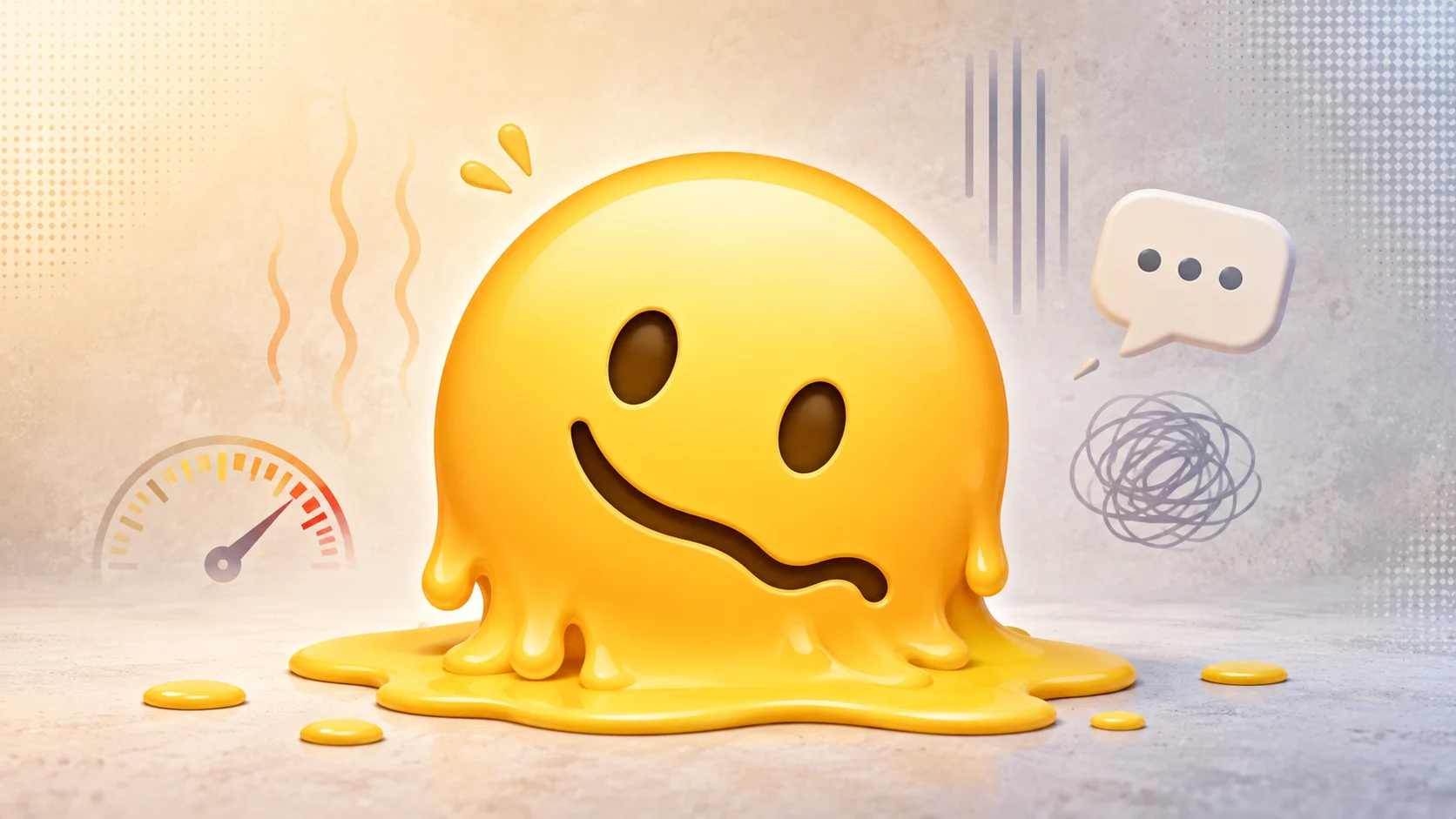
The “disintegrating emoji” 🫠 usually refers to the Melting Face emoji. It can express embarrassment, overwhelm, awkwardness, heat, or the feeling that you are mentally or emotionally falling apart while still trying to smile. Its exact meaning depends on context. In a funny message, 🫠 can mean “I can’t handle this” or “I’m dying of embarrassment,” while a conversation about hot weather may use it literally to mean “I’m melting.”
🫠 is officially called Melting Face by Unicode. The character is a smiling yellow face that appears to be melting downward into a puddle. Unicode lists keywords including “disappear,” “dissolve,” “embarrassed,” “heat,” “liquid,” “melt,” and “sarcasm,” which helps explain why the emoji can carry several related meanings.
“Disintegrating emoji” is an informal way some people describe its appearance because the face seems to lose its shape and dissolve. It is not the official Unicode name. The emoji is U+1FAE0 and was included with Emoji 14.0. Unicode’s emoji proposal records identify it as a 2021 addition.
The central idea is losing composure while still wearing a smile. That can happen because something is embarrassing, overwhelming, painfully awkward, extremely hot, or simply too much to deal with.
🫠 Common meanings at a glance
- Embarrassment: “I cannot believe I just said that.”
- Awkwardness: “That was painfully awkward.”
- Overwhelm: “I have way too much going on.”
- Heat: “It is unbelievably hot.”
- Frustrated acceptance: “Well, this is my life now.”
- Playful emotional collapse: “I am barely holding it together.”
- Sarcastic coping: “Everything is completely fine. 🫠”
The smile matters. Unlike a clearly distressed or crying face, 🫠 often adds a layer of irony or self-aware humor.
🫠 Meaning in Text Messages
In texting, the Melting Face emoji often works as a reaction to a situation that feels too awkward, intense, embarrassing, exhausting, or ridiculous.
For example:
“I accidentally called my professor ‘Mom.’ 🫠”
Here, 🫠 does not mean the person is physically melting. It communicates embarrassment and a humorous sense of emotional collapse.
It can also soften a complaint:
“Three meetings before noon and another one at 2. 🫠”
The emoji makes the message feel more self-aware and playful than a plain statement such as “I am exhausted.”
When 🫠 Is Used Literally
Sometimes the meaning really is about heat.
“It’s 100 degrees outside and I have to walk home. 🫠”
In this context, the melting appearance is a direct visual joke about being overheated.
It can also be paired with other emojis to make the intended meaning clearer:
- ☀️🫠 — overwhelmed by the heat
- 🔥🫠 — “I’m melting”
- 🫠💀 — exaggerated emotional defeat
- 😅🫠 — awkwardly trying to keep it together
The surrounding words usually tell you the emoji is about physical heat or emotional discomfort.
Is 🫠 a Sad Emoji?
Not usually.
The Melting Face emoji can communicate emotional discomfort, exhaustion, embarrassment, or overwhelm, but its smile often gives it a humorous, ironic, or resigned tone.
If someone wants to express straightforward sadness, 😢 or 😭 is generally clearer. If the feeling is “I am overwhelmed but making a joke about it,” 🫠 is a better fit.
That distinction is useful because 🫠 can look distressed at first glance, but it does not automatically mean the sender is genuinely upset.
What Does 🫠 Mean From Someone?
If someone sends you 🫠, look at the message around it before assigning a deeper meaning.
For example:
“You really remembered my coffee order? 🫠”
This could express being pleasantly overwhelmed or flattered.
But:
“I have to present this project in five minutes 🫠”
more likely means nervousness or stress.
And:
“Why did I send that text at 2 a.m. 🫠”
suggests embarrassment or regret.
The emoji by itself does not prove romantic interest, anger, rejection, or any other specific emotion. The relationship between the people, the conversation history, and the wording around the emoji matter more than the character alone.
Is the Disintegrating Emoji Flirty?
🫠 can appear in a flirty conversation, but it is not inherently a flirting emoji.
Someone might use it after receiving a compliment:
“Okay, you look really good in that photo 🫠”
Here, the emoji can suggest being flustered or playfully overwhelmed.
But the same emoji can be completely non-romantic:
“My boss just added another task to my list 🫠”
A romantic interpretation should therefore come from the overall conversation, not from 🫠 alone.
Emojis Similar to the Disintegrating Emoji
| Emoji | Official Name | Common Meaning | Tone | Where or When It Is Used |
|---|---|---|---|---|
| 🫠 | Melting Face | Embarrassment, overwhelm, heat, awkwardness | Playful, ironic, overwhelmed | Awkward moments, stress, heat, flustered reactions |
| 🫥 | Dotted Line Face | Feeling invisible, withdrawn, or unnoticed | Quiet, uneasy | Social discomfort, fading from a conversation |
| 🙃 | Upside-Down Face | Irony, awkward positivity, “sure, why not” | Sarcastic, resigned | Uncomfortable or absurd situations |
| 😅 | Grinning Face with Sweat | Nervousness, relief, awkward humor | Nervous, light | Close calls, mistakes, uncomfortable moments |
| 😳 | Flushed Face | Shock, embarrassment, shyness | Surprised, flustered | Unexpected comments, compliments, awkward situations |
| 🥴 | Woozy Face | Confusion, dizziness, discomfort, intoxication | Unsteady, goofy | Strange situations, confusion, exaggerated reactions |
| 🥵 | Hot Face | Physical heat or intense discomfort | Dramatic, overheated | Hot weather, intense situations, figurative “too much” |
| 🥹 | Face Holding Back Tears | Strong emotion, gratitude, tenderness | Emotional, affectionate | Sweet moments, gratitude, emotional reactions |
| 😮💨 | Face Exhaling | Relief, exhaustion, frustration | Weary, relieved | After stress, disappointment, or finishing something difficult |
The closest visual match is 🫠 itself because the face appears to melt or dissolve. 🙃 and 😅 can overlap with its ironic or awkward tone, but neither has the same “I am falling apart” visual idea.
🥵 is more directly about heat, while 😳 focuses more clearly on surprise or embarrassment. 🥹 is emotional in a softer way, often suggesting tears that are being held back rather than a humorous collapse.
How Intense Is 🫠?
The emotional intensity of 🫠 depends heavily on the message.
A casual:
“It’s so hot today 🫠”
is mild and playful.
A message such as:
“I have no idea how I’m going to finish all of this tonight 🫠”
can communicate stronger overwhelm.
Repeated emojis can also exaggerate the reaction:
“I have to give a speech tomorrow 🫠🫠🫠”
That does not create a new official meaning. It simply makes the emotional reaction feel more dramatic.
Examples of the Disintegrating Emoji in Texts
“I just waved back at someone who wasn’t waving at me 🫠”
Likely meaning: embarrassment. The emoji turns an awkward mistake into a self-deprecating joke.
“I forgot my password again 🫠”
Likely meaning: frustration or resignation. The sender is joking about a recurring problem rather than literally describing physical distress.
“This humidity is unreal 🫠”
Likely meaning: heat or physical discomfort. The melting image works literally here.
“You actually saved me a seat? 🫠”
Likely meaning: feeling touched, flattered, or pleasantly overwhelmed. The exact tone depends on the relationship and surrounding conversation.
“My deadline is tonight and I haven’t started 🫠”
Likely meaning: stress mixed with humor. It can communicate “I’m in trouble” without sounding completely serious or panicked.
Common Misunderstandings About 🫠
One common mistake is treating 🫠 as a simple synonym for “sad.” It is broader than that. Its melting appearance can represent embarrassment, pressure, heat, awkwardness, or an exaggerated feeling of losing control.
Another mistake is assuming it is automatically romantic when it appears after a compliment. It can indicate being flattered or flustered, but the surrounding conversation has to support that interpretation.
It is also easy to confuse 🫠 with 🥵. Both can be used when someone feels overheated, but 🥵 has a much clearer “hot or overheated” facial expression, while 🫠 adds the idea of melting, awkwardness, or emotional overload.
How to Respond to 🫠
If someone uses 🫠 to describe an embarrassing moment, a supportive response can be simple:
“Haha, you’re definitely not the first person to do that.”
If you cannot tell what they mean, asking directly is better than guessing:
“Wait, are you melting from the heat or from embarrassment? 😂”
That keeps the conversation natural and avoids reading too much into a single emoji.
Can You Copy and Paste the Disintegrating Emoji?
Yes. The emoji commonly called the disintegrating emoji is:
🫠
You can copy it directly and paste it into a text, caption, comment, email, or other message where your device supports the character.
Its official Unicode name is Melting Face, not Disintegrating Face. Unicode identifies it with the code point U+1FAE0.
Official Name and Unicode Details
Emoji: 🫠
Official Unicode name: Melting Face
Code point: U+1FAE0
Unicode category: Smileys & Emotion
Emoji version: Emoji 14.0
Common informal description: Disintegrating emoji, dissolving face, melting face
Unicode’s official emoji data associates 🫠 with words such as disappear, dissolve, embarrassed, heat, hot, liquid, melt, melting, sarcasm, and sarcastic. These are useful clues about recognized usage, but they do not mean every message containing the emoji has one fixed interpretation.
The emoji was added as part of the Emoji 14.0 set. Unicode’s proposal index lists the Melting Face proposal under the 2021 “Smileys & Emotion” additions.
Why Does It Look Different on Different Devices?
Emoji artwork is created by individual platforms and vendors, so the exact shape, shading, facial expression, and melting effect can vary.
The underlying character remains U+1FAE0, however, so the meaning is based on the same standardized emoji character even when the artwork looks slightly different.
This is also why an emoji may appear differently when you send it between devices.
FAQs
Is 🫠 the disintegrating emoji?
Yes, 🫠 is sometimes called the disintegrating or dissolving emoji because its face appears to melt away. Its official Unicode name is Melting Face, U+1FAE0.
What does 🫠 mean in texting?
🫠 commonly expresses embarrassment, awkwardness, overwhelm, heat, or a playful feeling of falling apart. The surrounding message determines which meaning fits best.
Does 🫠 mean embarrassed?
It can. The melting face is often useful when someone feels awkward or embarrassed but is expressing that feeling with humor rather than a serious emotional statement.
Is 🫠 a flirting emoji?
Not by itself. It can appear in flirty conversations when someone feels flustered or complimented, but the emoji alone does not establish romantic interest.
What is the difference between 🫠 and 🥵?
🫠 suggests melting, awkwardness, overwhelm, or ironic emotional collapse, while 🥵 more directly represents being hot or overheated. Both can work for hot-weather jokes.
What is the difference between 🫠 and 🙃?
🫠 emphasizes melting or losing composure, while 🙃 more often adds an ironic or sarcastic “everything is fine” feeling to an uncomfortable situation.
What is the Unicode code for the disintegrating emoji?
The character 🫠 is U+1FAE0, and its official Unicode name is Melting Face.
Conclusion
The “disintegrating emoji” 🫠 is officially the Melting Face emoji. Its core idea is a person figuratively melting away while still smiling, which makes it useful for embarrassment, awkwardness, heat, overwhelm, flustered reactions, and sarcastic or playful resignation.
When you see 🫠 in a message, read the words around it first. The same emoji can mean “I’m melting in this heat,” “That was so embarrassing,” or “I cannot deal with this right now.”
Discover More Related Articles:
- Donut Emoji | Sweet Cravings, Fun & Digital Expression In 2026
- Boat Emoji | Meaning, Uses & Similar Emojis Explained In 2026
- Drink Emoji | What This Refreshing Icon Really Represents In 2026

Jessica Miller is a content writer at EmojisPeace.com, where she creates fun and easy-to-follow guides about emojis, their meanings and creative ways to use them. She loves helping readers express themselves with the perfect emoji for every moment.
2 thoughts on “Disintegrating Emoji | The Strange Symbol for Feeling Like You’re Disappearing In 2026”