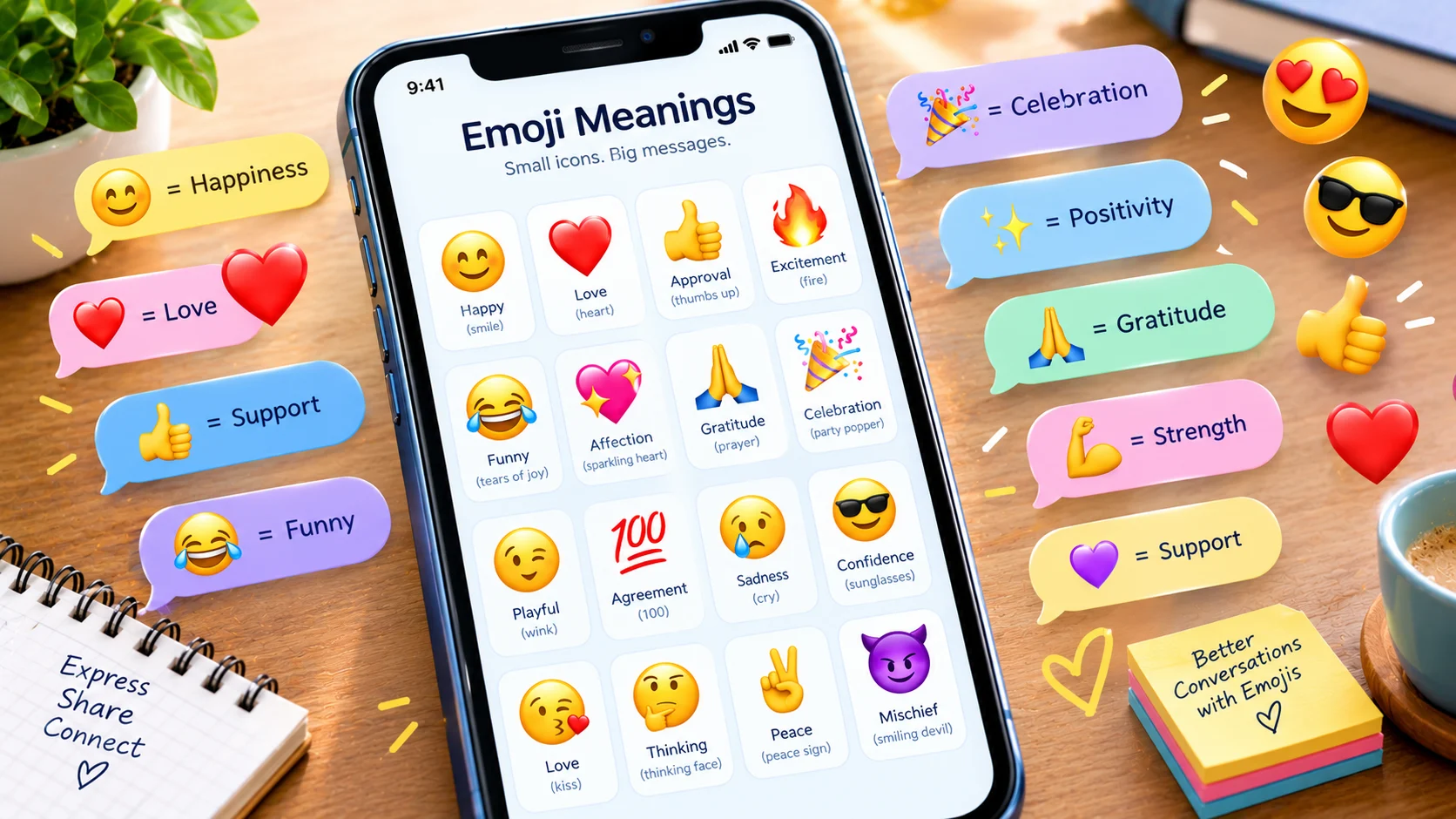
Emoji meaning is the message, emotion, or idea an emoji communicates in context. It can express happiness, love, sadness, humor, sarcasm, support, or other feelings, depending on the emoji and the conversation.
Emojis add emotion, tone, and visual meaning to text messages, social media posts, and online conversations. Emoji meaning depends on the symbol, the words around it, and the situation in which someone uses it. A ❤️ red heart often expresses love or affection, 😂 can show laughter, and 🙃 may suggest irony or playful frustration. However, no emoji has one guaranteed meaning in every conversation.
The same symbol can communicate different feelings depending on the sender and recipient. A 🙂 slightly smiling face might feel friendly in one message but sound distant or sarcastic in another. Some emojis also have official Unicode names that differ from the meanings people commonly assign to them.
Understanding these differences can help you interpret messages more accurately, choose the right emoji, and avoid misunderstandings in everyday communication.
Why Emoji Meanings Change With Context
An emoji adds a visual cue to a message, but the words and situation help determine what that cue means. Three factors are especially useful when interpreting an emoji.
- The words around it: “Great job ❤️” may express warmth and appreciation, while “Great job 🙄” may communicate sarcasm.
- Your relationship with the sender: Friends may use exaggerated or teasing emojis that would feel unusual in a formal conversation.
- The conversation’s tone: A laughing emoji after a joke usually signals amusement, while the same emoji after bad news could feel dismissive.
An emoji can also replace a word, strengthen an emotion, or soften a message. For example, “I’m sorry 😔” sounds more emotionally expressive than “I’m sorry” alone.
The safest approach is to read the entire message rather than interpreting one symbol in isolation.
Common Emojis and What They Usually Mean
The table below is a practical starting point for understanding everyday emoji use. The names identify the standard emoji characters, while the meanings describe common interpretations rather than fixed rules.
| Emoji | Official Name | Common Meaning | Tone | Where or When It Is Used |
|---|---|---|---|---|
| 😂 | Face with Tears of Joy | Laughter, amusement | Playful, humorous | Jokes, funny stories, amusing reactions |
| ❤️ | Red Heart | Love, affection, care | Warm, affectionate | Relationships, family messages, appreciation |
| 😊 | Smiling Face with Smiling Eyes | Happiness, friendliness | Warm, gentle | Greetings, thanks, positive replies |
| 😭 | Loudly Crying Face | Intense sadness or exaggerated emotion | Dramatic, emotional | Heartbreak, disappointment, or humorous overreaction |
| 🤔 | Thinking Face | Thought, uncertainty, consideration | Curious, reflective | Questions, decisions, doubtful reactions |
| 🙄 | Face with Rolling Eyes | Annoyance, disbelief, exasperation | Sarcastic, dismissive | Frustrating situations or tired reactions |
| 🥹 | Face Holding Back Tears | Being moved, gratitude, tenderness | Emotional, affectionate | Heartwarming moments and meaningful gestures |
| 🫠 | Melting Face | Embarrassment, overwhelm, or heat | Awkward, ironic | Difficult days, uncomfortable moments, hot weather |
| 🙏 | Folded Hands | Prayer, gratitude, or a request | Respectful, hopeful | Thank-you messages, requests, religious contexts |
| 👍 | Thumbs Up | Approval, agreement, acknowledgment | Positive, neutral | Confirmations, quick replies, encouragement |
How to Choose Between Similar Emojis
Some emojis communicate related emotions but create different impressions.
- 😂 vs. 😭: 😂 usually indicates laughter, while 😭 commonly represents intense crying or exaggerated emotion. In humorous conversations, either may express a strong reaction.
- ❤️ vs. 😊: ❤️ tends to convey stronger affection or care, while 😊 usually expresses friendliness or happiness.
- 🤔 vs. 🙄: 🤔 suggests that someone is thinking or questioning something; 🙄 more often signals annoyance or disbelief.
- 🙏 vs. ❤️: 🙏 can communicate thanks, a request, or prayer, while ❤️ more directly signals affection or care.
- 👍 vs. 😊: 👍 is useful for quick approval or acknowledgment, while 😊 adds a warmer facial expression.
Choose the emoji that matches your intended feeling. If a message involves a serious topic, clear words are often more reliable than relying on an emoji alone.
How Emoji Meanings Work in Text Messages
Emojis can change the emotional tone of a sentence, even when the words stay the same. Here are examples showing how context affects interpretation.
| Message Example | Likely Meaning | Why Context Matters |
|---|---|---|
| “Thank you 😊” | Warm appreciation | The smile adds friendliness. |
| “That was hilarious 😂” | Genuine amusement | The words and laughing face reinforce each other. |
| “Sure 🙄” | Possible annoyance or sarcasm | The eye-roll can make a simple agreement sound dismissive. |
| “I miss you ❤️” | Affection or love | The heart reinforces the personal message. |
| “I have five deadlines today 🫠” | Feeling overwhelmed | The melting face adds humor to a stressful situation. |
| “I’ll think about it 🤔” | Careful consideration | The emoji reinforces the idea of thinking. |
These examples are illustrative. The same emoji can mean something different in another conversation, especially when the sender and recipient have different communication styles.
Can an Emoji Have More Than One Meaning?
Yes. Many emojis have several common uses, and some meanings develop through informal online communication.
For example, 🙏 is officially named Folded Hands. Depending on the context, it can communicate prayer, gratitude, a request, or hope. The symbol alone does not establish which interpretation the sender intends.
Likewise, 💀 (Skull) can refer literally to death or danger, but in casual online messages it can also express laughter, shock, or an exaggerated reaction. Surrounding words help distinguish the literal meaning from the informal one.
The Unicode Consortium provides standardized emoji names and character information. These official labels help identify the symbols, but they do not determine every meaning an emoji can have in everyday conversation.
Do Emoji Meanings Change Across Platforms?
The underlying emoji character is standardized, but its artwork can differ across Apple, Google, Samsung, and other platforms. A face may have slightly different eyes, mouth shapes, colors, or other visual details.
These differences can affect how a symbol feels to the reader, especially when the expression is subtle. However, it is better not to assume that a particular platform gives an emoji a completely different meaning without evidence.
Emoji meaning can also depend on where it appears:
- Text messages: Emojis often add emotion, soften a response, or replace a facial expression.
- Social media comments: They may show approval, humor, surprise, disagreement, or a reaction to a post.
- Workplace chats: They can acknowledge a message or create a friendly tone, depending on workplace norms.
- Romantic conversations: They may communicate affection or playful interest, but an emoji alone cannot prove attraction.
- Public posts and captions: Emojis can reinforce a topic, mood, joke, or visual theme.
The same symbol can therefore look similar across platforms while serving different purposes in different conversations.
How to Find the Meaning of Any Emoji
If you come across an unfamiliar emoji, these steps can help you understand it.
- Identify the exact symbol. Similar-looking faces or hand gestures may have different official names.
- Check its official name. The Unicode emoji charts list emoji characters and standardized names.
- Look up common interpretations. Emojipedia’s emoji meanings directory explains common uses, alternative interpretations, and design differences.
- Read the complete message. Look at the words, the topic, and any nearby emojis before deciding what the sender means.
- Ask if the meaning matters. If a message is ambiguous or sensitive, a simple question is better than making assumptions.
You can also search for an emoji by its name, appearance, or common meaning. For example, searching for “smiling face with hearts meaning” can help you distinguish 🥰 from 😍 or ❤️.
FAQs
What is the difference between an emoji’s official name and its meaning?
An official name identifies the character in the Unicode standard. Its meaning refers to how people interpret and use it in communication. For example, the official name of 😂 is Face with Tears of Joy, while its common use is to express laughter or amusement.
Can the same emoji mean different things to different people?
Yes. Personal habits, culture, conversation history, and context can affect interpretation. One person may use 🙂 as a friendly smile, while another may read it as distant or sarcastic. Neither interpretation applies universally.
How can I tell if an emoji is sarcastic?
Look for a mismatch between the words and the situation. For example, “Another meeting that could have been an email 🙄” suggests frustration rather than genuine approval. The emoji supports the sarcastic tone, but the complete message provides the strongest clue.
Do emojis have universal meanings?
No. Some emoji interpretations are widely understood, but meanings can vary across cultures, communities, individuals, and situations. Even a familiar symbol such as ❤️ may communicate romantic love, family affection, friendship, or general appreciation.
Where can I find official emoji names?
The Unicode Consortium’s full emoji list provides standardized character names, code points, and sample artwork. Emojipedia is another useful reference for common interpretations and platform-specific designs.
Conclusion
Emoji meanings become easier to understand when you consider both the symbol and the conversation around it. Official names help you identify each character, while context helps you interpret its emotional tone. You are choosing an emoji for a message or trying to understand one you received, focus on the complete conversation rather than assuming a single symbol tells the whole story.
Discover More Related Articles:
- Pray Emoji Mean | Prayer, Gratitude & More In 2026
- Purple Heart Emoji | What It Says About Love, Loyalty & Friendship In 2026
- Celebrate Emoji | The Perfect Way to Share Excitement & Joy In 2026

Matthew Garcia is a content writer at EmojisPeace.com, where she creates fun, expressive and easy-to-use emoji collections for every mood and moment. Passionate about digital expression, she helps readers find the perfect emojis to make every message more creative and memorable.