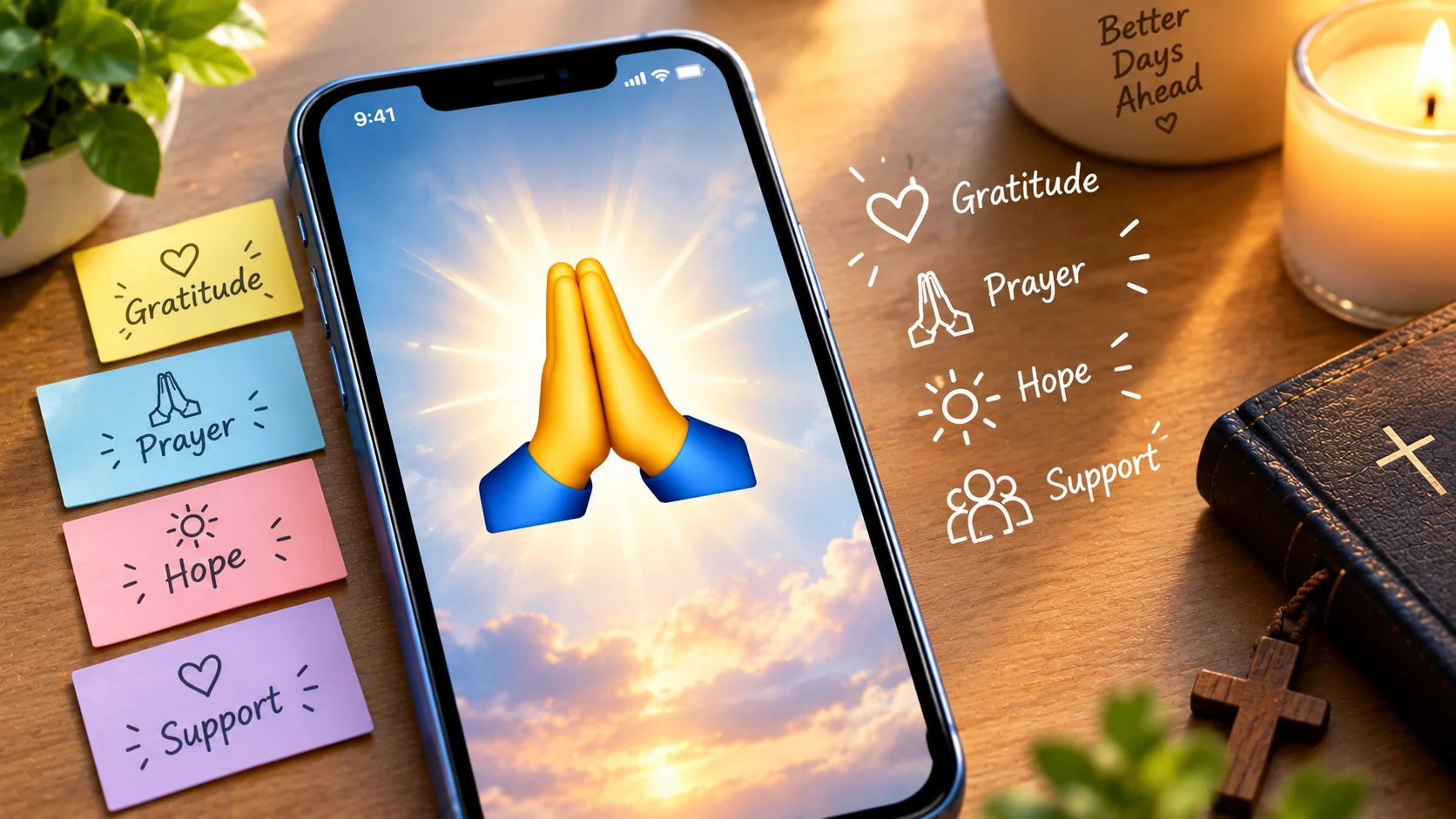
🙏 usually means prayer, thanks, hope, or “please.” It can express faith, appreciation or a heartfelt request, so read the surrounding words to understand the sender’s intention.
The pray emoji 🙏, officially named Folded Hands, commonly represents prayer, gratitude, hope, respect, or a heartfelt request. People use it in texts to say “thank you,” ask for help, wish someone well, or express religious faith. Its meaning depends on the message and the situation: it can communicate a sincere prayer, a simple “please,” or appreciation for someone’s kindness.
For example, “Thank you for helping me 🙏” expresses gratitude, while “Please let me pass this exam 🙏” conveys hope or a request. In religious conversations, the same emoji may represent praying or asking for blessings.
What Does 🙏 Mean in Text Messages?
In everyday texting, 🙏 often works as a short emotional response. It can make a thank-you message warmer, a request more heartfelt, or a difficult situation feel more personal.
Here are the main ways people use it.
1. Prayer and Religious Faith
The folded hands emoji can represent praying, worship, spiritual reflection, or asking for blessings. It may appear in messages about religious services, personal struggles, or someone’s recovery.
Example: “Keeping your family in my prayers 🙏”
Likely meaning: The sender is expressing a sincere wish for comfort, strength, or help through prayer.
2. Gratitude and Appreciation
People often add 🙏 after thanking someone for their time, kindness, support, or help.
Example: “Thanks for covering my shift. I really appreciate it 🙏”
Likely meaning: “Thank you so much.”
The emoji adds warmth and sincerity, although a simple “thanks” without it can communicate the same message.
3. Asking for Something Politely
The emoji can make a request feel more personal or pleading, especially when someone really hopes the answer will be yes.
Example: “Can you send me the notes before class? 🙏”
Likely meaning: “Please, I’d really appreciate it.”
In casual conversations, it can also be playful, particularly when someone is dramatically asking for a favor.
4. Hope and Good Wishes
Sometimes the sender is hoping for a positive outcome rather than describing a literal act of prayer.
Example: “My interview is tomorrow. Wish me luck 🙏”
Likely meaning: “I’m hoping everything goes well.”
It can express hope during exams, job interviews, medical appointments, or other uncertain moments.
5. Respect and a Sincere Greeting
Folded hands can also represent a respectful greeting or gesture of reverence in cultural and spiritual settings. Similar gestures have different meanings across traditions, so the emoji should not be treated as belonging to only one religion or culture.
Example: “Namaste 🙏”
Likely meaning: A respectful greeting, depending on the cultural context.
Does 🙏 Mean Prayer or a High Five?
The 🙏 emoji is officially named Folded Hands, and its established interpretations include prayer, gratitude, requests, and respectful gestures. Some people also use it to represent a high five, but that is not its primary documented meaning.
The confusion comes from the image of two hands pressed together. Without seeing a full person or the surrounding message, some viewers may imagine two hands meeting in a high five.
The context usually clears things up:
- “Praying everything works out 🙏” clearly points to prayer or hope.
- “Thank you for your help 🙏” communicates gratitude.
- “Please say yes 🙏” suggests a heartfelt request.
- “We did it! 🙏” could express gratitude, celebration, or relief; it does not automatically mean a high five.
If you specifically want to show a celebratory high five, 🙌 or a combination such as ✋🤚 may communicate that idea more clearly, depending on the situation.
🙏 Compared With Similar Hand Emojis
The folded hands emoji can be confused with other hand gestures because several express gratitude, support, celebration, or respect. This table highlights the key differences.
| Emoji | Official Name | Common Meaning | Tone | Where or When It Is Used |
|---|---|---|---|---|
| 🙏 | Folded Hands | Prayer, thanks, please | Sincere, respectful | Prayers, requests, thank-you messages |
| 🤲 | Palms Up Together | Prayer, offering, asking | Hopeful, open | Spiritual requests or offering support |
| 👐 | Open Hands | Openness, welcome, hug | Warm, welcoming | Friendly greetings or offering a hug |
| 🙌 | Raising Hands | Celebration, praise, excitement | Joyful, energetic | Achievements, good news, celebration |
| 👏 | Clapping Hands | Applause, congratulations | Appreciative, enthusiastic | Praising someone’s work or success |
| 🤝 | Handshake | Agreement, cooperation, deal | Professional, friendly | Making agreements or showing partnership |
| 🫶 | Heart Hands | Love, affection, appreciation | Warm, affectionate | Showing care, support, or gratitude |
| 🛐 | Place of Worship | Religion, worship, sacred space | Reverent, spiritual | Religious settings or discussions about worship |
Which Hand Emoji Should You Use?
- For prayer or a heartfelt thank-you: 🙏 is a natural choice.
- For asking or offering: 🤲 emphasizes open palms and may suggest a request, prayer, or offering.
- For celebrating good news: 🙌 conveys excitement more directly.
- For applause: 👏 makes the act of congratulating someone clearer.
- For love and emotional support: 🫶 adds an affectionate, heart-shaped gesture.
- For a religious building or worship setting: 🛐 is more specific to a place of worship.
The most important distinction is that 🙏 often carries a sincere or respectful tone, while 🙌 and 👏 are more clearly celebratory. 🤲 can resemble a prayer gesture but shows palms facing upward rather than pressed together.
How to Respond When Someone Sends 🙏
Your response depends on why the person sent it. You can reply with words, another emoji, or both.
🙏
If they thank you
“You’re very welcome! Happy to help.”
A warm response acknowledges their appreciation.
❤️
If they ask for prayers or support
“I’m thinking of you and hoping things get better ❤️”
Offers comfort without assuming the person’s religious beliefs.
🤞
If they are hoping for good news
“Fingers crossed! You’ve got this 🤞”
Matches their hopeful mood.
👍
If they make a simple request
“Sure, I’ll send it over.”
Confirms that you understood and accepted the request.
If someone sends only 🙏, consider the previous message before deciding how to respond. A single emoji may express thanks, hope, or a request, and you can ask for clarification if the meaning is unclear.
Copy and Paste the Pray Emoji
🙏
Folded Hands emoji Copy 🙏
You can use the emoji in messages, captions, comments, and other text.
Thank you so much 🙏Please let everything go well 🙏Sending prayers and strength 🙏❤️I really appreciate your help 🙏Fingers crossed for tomorrow 🙏🤞
Different combinations can change the tone. For instance, 🙏❤️ adds warmth, while 🙏🤞 emphasizes hope for a good result.
Official Name and Unicode Details
The official Unicode name for 🙏 is Folded Hands. It depicts two hands pressed together, with the fingers pointing upward.
- Emoji: 🙏
- Official name: Folded Hands
- Unicode code point: U+1F64F
- Unicode version: Unicode 6.0
- Year approved: 2010
- Emoji version: Emoji 1.0, released in 2015
The emoji has roots in earlier Japanese mobile emoji sets. Its present-day interpretations include prayer, gratitude, requests, and respectful greetings.
Does 🙏 Look Different on iPhone and Android?
The general gesture remains recognizable across devices, but details such as sleeve color, hand shape, and shading can vary between Apple, Google, Samsung, and other platforms. Older designs also differed more noticeably.
These visual differences do not change the emoji’s Unicode identity, although they may influence how a person interprets its appearance.
FAQs
Does 🙏 mean thank you or please?
It can mean both. After someone helps you, it often expresses gratitude. When added to a request, it can mean “please” or show that you strongly hope someone will agree.
Does 🙏 always mean religious prayer?
No. It can represent religious prayer, but people also use it for everyday thanks, hope, requests, and respect. The surrounding message usually makes the intended meaning clearer.
Does the pray emoji mean namaste?
It can represent namaste or a similar respectful greeting in an appropriate cultural context. However, the emoji’s official name is Folded Hands, and not every use of it is intended to mean namaste.
What does 🙏 mean from someone you like?
It may communicate appreciation, a sincere request, hope, or a respectful response. It can appear in affectionate conversations, but it does not automatically indicate flirting or romantic interest.
Is 🙏 appropriate for professional messages?
Yes, in many casual or friendly work conversations, such as thanking a colleague for help. For formal business communication, a clear written thank-you may be more suitable, depending on your workplace and audience.
Can 🙏 be used to show sympathy?
Yes. It may accompany messages of support, condolences, or prayers for someone going through a difficult time. A thoughtful sentence alongside the emoji helps make your intention clear.
Conclusion
The 🙏 emoji is a versatile gesture that can express prayer, gratitude, hope, respect, or a heartfelt request. Although some people interpret it as a high five, its established meanings center on folded hands and the feelings associated with that gesture. Let the message and cultural context guide your interpretation rather than assuming it always means the same thing.
Discover More Related Articles:
- Sad Emoji Meanings | Find the Right Face for Every Feeling In 2026
- Heart Emoji Meaning | What Different Hearts Really Say In 2026
- Hello Emoji Meaning | What the Waving Hand Really Says In 2026

Sophia Martinez is a content writer at EmojisPeace.com, where she creates fun, engaging, and easy-to-read emoji guides, meanings and digital communication content. She enjoys helping readers express themselves better with the perfect emojis for every mood and moment.
5 thoughts on “Pray Emoji 🙏 Mean | Prayer, Gratitude & More In 2026”