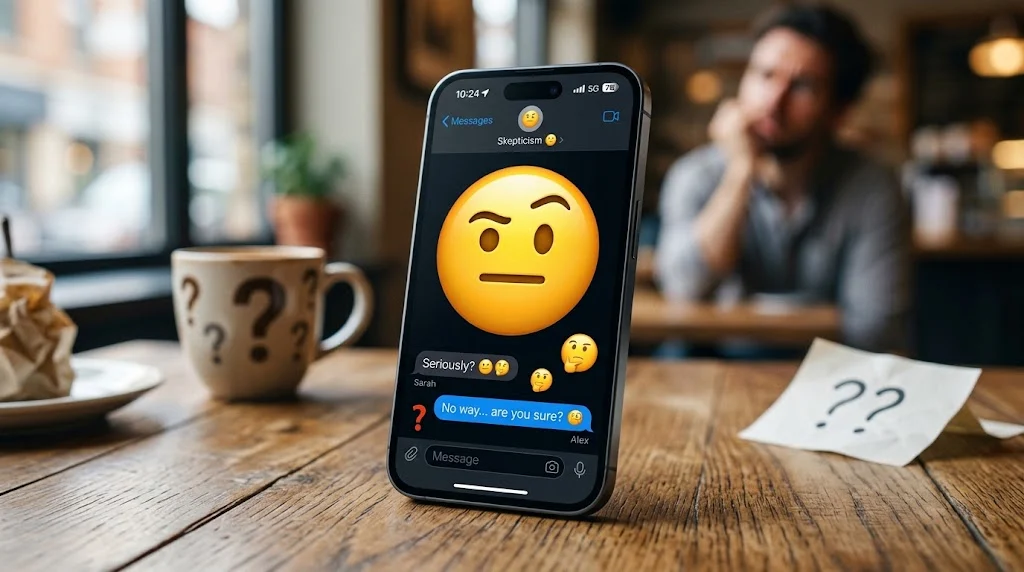
🤨 means skepticism, doubt, disbelief, suspicion, or a questioning reaction. It can be serious when someone genuinely does not believe something, or playful when used to tease someone.
For example:
- “You finished the whole thing in five minutes? 🤨” → disbelief
- “Are you sure that’s what happened? 🤨” → doubt
- “Oh really? 🤨” → questioning or teasing
- “You’re definitely not hiding anything from me 🤨” → playful suspicion
The eyebrow emoji 🤨 usually expresses skepticism, disbelief, suspicion, doubt, or mild disapproval. Its official Unicode name is Face with Raised Eyebrow, and the expression typically shows one eyebrow raised higher than the other with a straight or slightly serious mouth. Unicode
In texting, 🤨 often communicates something like “Really?”, “Are you sure?”, “I don’t believe that,” or “What do you mean?” It can also be playful when someone is teasing a friend or reacting to a questionable statement. The exact tone depends heavily on the surrounding words and the relationship between the people chatting.
Why Does 🤨 Look Skeptical?
The expression is based on a familiar facial gesture: raising one eyebrow while keeping a relatively neutral or serious expression.
In real-life communication, a raised eyebrow can signal that someone is questioning what they just heard or saw. Unicode’s annotations for 🤨 include terms such as disapproval, disbelief, distrust, skepticism, surprise, and “what.” Unicode
That makes 🤨 useful when words alone do not quite capture the reaction.
Instead of writing:
“I don’t know if I believe you.”
someone might simply write:
“🤨”
The emoji lets the reader infer the question or doubt from the facial expression.
🤨 Meaning in Texting
In texts, the eyebrow emoji often works as a nonverbal question mark.
It can suggest:
- “Really?”
- “Are you serious?”
- “I’m not convinced.”
- “That sounds suspicious.”
- “What are you talking about?”
- “Hmm…”
- “I have questions.”
For example:
“You said you didn’t eat the cookies? 🤨”
This probably communicates suspicion.
But:
“You actually got tickets?! 🤨”
could express surprise rather than distrust.
The words around 🤨 help determine which interpretation makes the most sense.
Common Meanings of 🤨
1. Skepticism
This is one of the clearest uses of 🤨.
“You think that’s going to work? 🤨”
The sender is questioning the idea is believable or realistic.
2. Disbelief
🤨 can show that someone has heard something surprising and is not completely buying it.
“He said he ran 10 miles before breakfast 🤨”
The emoji suggests, “Hmm, I’m not sure about that.”
3. Suspicion
The raised eyebrow can imply that something seems questionable.
“You suddenly need my password? 🤨”
Here, 🤨 can communicate concern or suspicion.
4. Mild disapproval
Sometimes the emoji means that the sender does not approve of what was said or done.
“You really sent that message to your boss? 🤨”
This could mean, “That was probably not a good idea.”
5. Playful teasing
Among friends, 🤨 does not always carry serious suspicion.
“So you just happened to be at the same restaurant? 🤨”
The sender may be teasing rather than accusing the other person of anything.
6. Mild surprise
🤨 can also react to something unexpected.
“Wait, you actually remembered my birthday? 🤨”
Here, the raised eyebrow can mean, “Really? You did?”
What Does 🤨 Mean From Someone?
If someone sends you 🤨, they are usually questioning something you said or did.
The important question is what came immediately before the emoji.
For example:
“I didn’t eat the last slice 🤨”
If they are responding to your claim that you ate it, the emoji may express disbelief.
But:
“You look different today 🤨”
could simply mean they noticed something unusual and are curious.
A standalone 🤨 can be especially open-ended. It may mean “Really?”, “Hmm,” or “What’s going on?” rather than communicating one fixed emotion.
Is 🤨 Rude?
It can be, but it is not automatically rude.
With friends, 🤨 can be funny and playful:
“You call that cooking? 🤨 😂”
In a serious conversation, the same emoji may feel more judgmental:
“You thought that was appropriate? 🤨”
The difference comes from the words, situation, and relationship between the people involved.
If you are communicating with someone you do not know well, using 🤨 repeatedly can make your messages feel skeptical or critical.
Is 🤨 Flirty?
The eyebrow emoji is not inherently a flirting emoji.
It can appear in playful or flirtatious conversations, especially when someone is teasing another person:
“So you noticed my new haircut? 🤨”
But the emoji alone does not establish attraction or romantic interest.
If someone sends 🤨 after a playful compliment, it might add teasing energy. In another conversation, it may simply mean they are questioning what you said.
Can 🤨 Be Sarcastic?
Yes. 🤨 is particularly useful for dry or sarcastic reactions.
For example:
“Of course I studied for the test 🤨”
If the sender clearly did not study, the emoji can make the statement feel knowingly sarcastic.
Another example:
“I definitely didn’t eat your leftovers 🤨”
The emoji can suggest that the speaker is joking or pretending to be innocent.
The sarcasm comes from the combination of the words and expression, not from the emoji alone.
🤨 vs. 😏: What’s the Difference?
These two emojis are easy to confuse because both can have a knowing or expressive look.
🤨 Face with Raised Eyebrow usually questions, doubts, or challenges something.
😏 Smirking Face generally conveys a smug, self-satisfied, sly, suggestive, or knowing expression.
Compare:
“You really believe that? 🤨”
This sounds skeptical.
“I know something you don’t 😏”
This sounds more knowing or mischievous.
If your main message is “I’m not convinced,” 🤨 is the better choice. If the message is “I know what I’m doing,” 😏 may fit better.
🤨 vs. 🙄: What’s the Difference?
🤨 and 🙄 can both express annoyance or disbelief, but their intensity is different.
🤨 usually questions or doubts something.
🙄 Face with Rolling Eyes more strongly communicates annoyance, exasperation, or “Here we go again.”
For example:
“You’re saying that again? 🤨”
sounds questioning.
“You’re saying that again? 🙄”
sounds more irritated.
🤨 vs. 🤔: What’s the Difference?
🤨 tends to question the credibility or logic of something.
🤔 Thinking Face is more about thinking, considering, or trying to figure something out.
Compare:
“You expect me to believe that? 🤨”
with:
“Let me think about it 🤔”
The first expresses doubt. The second shows consideration.
Emojis Similar to 🤨
| Emoji | Official Name | Common Meaning | Tone | Where or When It Is Used |
|---|---|---|---|---|
| 🤨 | Face with Raised Eyebrow | Doubt, skepticism, disbelief, or suspicion | Skeptical, questioning | Questionable claims, teasing, surprising statements |
| 🤔 | Thinking Face | Thinking, considering, or wondering | Thoughtful, curious | Decisions, questions, uncertainty |
| 😏 | Smirking Face | Smugness, confidence, or a knowing expression | Sly, playful, suggestive | Teasing, jokes, knowing reactions |
| 🙄 | Face with Rolling Eyes | Annoyance, disbelief, or exasperation | Irritated, dismissive | Repeated problems, frustrating comments |
| 😒 | Unamused Face | Displeasure, irritation, or lack of enthusiasm | Unimpressed, annoyed | Bad jokes, unwanted situations, frustration |
| 😐 | Neutral Face | Neutrality, uncertainty, or a flat reaction | Reserved, neutral | Awkward moments, unclear reactions |
| 😑 | Expressionless Face | Speechlessness, boredom, or lack of reaction | Flat, unimpressed | Absurd comments, awkward situations |
| 😬 | Grimacing Face | Awkwardness, nervousness, or discomfort | Tense, uneasy | Mistakes, uncomfortable situations, social awkwardness |
The most important distinction is that 🤨 specifically puts the focus on questioning or skepticism. 🤔 is more thoughtful, 🙄 is more annoyed, and 😏 is more self-assured or sly.
If you want to challenge a claim without sounding strongly angry, 🤨 can communicate that middle ground particularly well.
Realistic Text Examples With 🤨
These examples are hypothetical and show how context changes the meaning.
“You said you were going to bed two hours ago 🤨”
Likely meaning: playful suspicion or disbelief.
“Wait, they canceled the event again? 🤨”
Likely meaning: surprise mixed with doubt or concern.
“You think that’s a good idea? 🤨”
Likely meaning: questioning someone’s judgment.
“Oh, so that’s where you were last night 🤨”
Likely meaning: teasing suspicion. Depending on the relationship, it could also sound more serious.
“You actually remembered everything I told you? 🤨”
Likely meaning: mild surprise or playful disbelief.
How to Respond to 🤨
Your response depends on what the person is questioning.
If they seem genuinely doubtful:
“Yes, I’m serious. I can explain.”
If they are teasing:
“😂 I promise I’m telling the truth.”
If their message seems unclear:
“What? 🤨”
If they seem concerned:
“Is something wrong?”
You do not need to match 🤨 with another emoji. A clear written response is often better when the situation is serious.
Common Misunderstandings About 🤨
The biggest mistake is treating 🤨 as having only one meaning.
It can represent skepticism, disbelief, suspicion, mild surprise, disapproval, curiosity, or playful teasing. Unicode’s official annotations themselves cover several of these ideas. Unicode
Another common mistake is assuming that 🤨 automatically means the sender is angry. The expression is usually milder than a clearly angry emoji.
It is also easy to interpret 🤨 as flirting when it appears in a playful conversation. While that is possible, the emoji alone cannot establish romantic interest.
Official Name and Unicode Details
The official Unicode name associated with 🤨 is Face with Raised Eyebrow. Its code point is U+1F928. Unicode’s current emoji data lists keywords including disapproval, disbelief, distrust, eyebrow, skepticism, surprise, and “what.” Unicode
The emoji was approved as part of Unicode 10.0 in 2017 and added to Emoji 5.0 in the same year. The original Unicode proposal referred to it as Face With One Eyebrow Raised. Emojipedia
Its appearance can vary slightly between platforms. The general design remains a yellow face with one eyebrow raised, but details such as the mouth shape and facial proportions may differ. Emojipedia
FAQs
What does the eyebrow emoji 🤨 mean?
The eyebrow emoji 🤨 usually means skepticism, disbelief, suspicion, or a questioning reaction. It can also express mild surprise or playful teasing, depending on the message around it.
What does 🤨 mean in texting?
In texting, 🤨 often works like “Really?”, “Are you sure?”, “I don’t believe you,” or “What do you mean?” It can be serious or playful depending on the conversation.
Is 🤨 a rude emoji?
Not necessarily. 🤨 can be playful among friends, but it may sound judgmental or critical in a serious conversation. The surrounding words and relationship matter.
Does 🤨 mean flirting?
No. 🤨 is not inherently romantic or flirtatious. It can appear during playful flirting, but the emoji by itself does not prove attraction or romantic interest.
What is the difference between 🤨 and 🤔?
🤨 usually expresses doubt or skepticism about something, while 🤔 generally shows that someone is thinking, considering, or wondering about something.
What is the difference between 🤨 and 😏?
🤨 usually questions or doubts something, while 😏 has a more knowing, smug, sly, or suggestive expression. The two can overlap in playful conversations but usually communicate different attitudes.
Can 🤨 mean “really?”
Yes. A standalone 🤨 is often a visual way to communicate “Really?” or “Are you serious?” The exact tone can range from genuine doubt to playful teasing.
Can 🤨 be sarcastic?
Yes. 🤨 can strengthen a sarcastic or dry reaction, especially when the words intentionally contradict the situation. Context determines the sarcasm is obvious.
Conclusion
The eyebrow emoji 🤨, officially called Face with Raised Eyebrow, is mainly a visual reaction for skepticism, disbelief, suspicion, and questioning. It can also add playful doubt, mild surprise, or teasing to a message.
Think of 🤨 as the digital version of raising one eyebrow and saying, “Hmm… really?” Its meaning becomes clearer when you consider the words around it, the situation, and the relationship between the people communicating.
Discover More Related Articles:
- Buck Teeth Emoji | What This Funny Toothy Symbol Says About Smiles & More In 2026
- Sad Meme Emoji | The Best Emojis for Emotional Memes, Fake Tears & Relatable Moments In 2026
- Horse Emoji Meaning | What Does the Horse Emoji Mean in Text In 2026

Jessica Miller is a content writer at EmojisPeace.com, where she creates fun and easy-to-follow guides about emojis, their meanings and creative ways to use them. She loves helping readers express themselves with the perfect emoji for every moment.