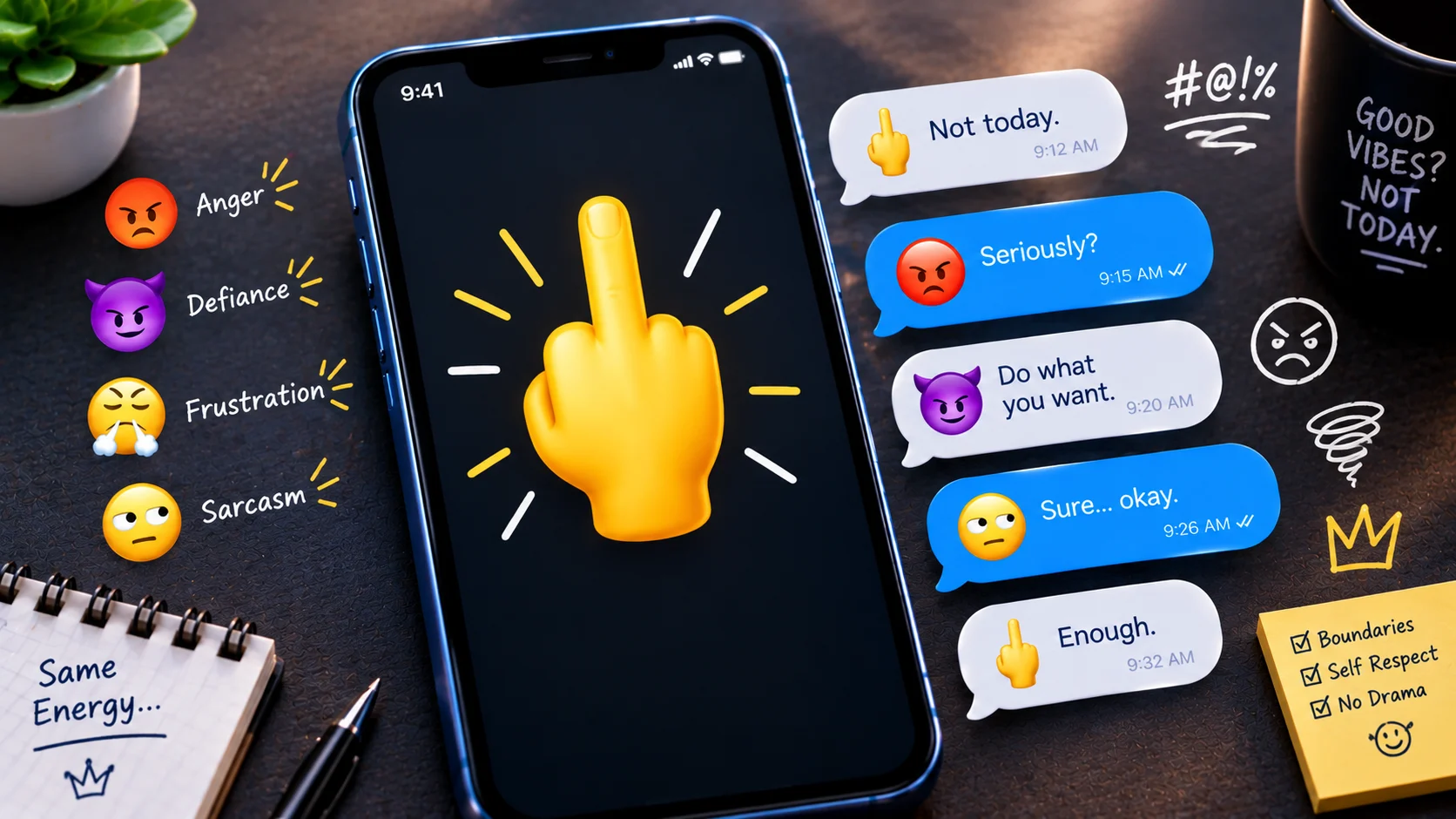
🖕 usually expresses an insult, anger, or strong frustration. Among friends, it can be playful sarcasm, but in serious conversations, it may come across as offensive or hostile.
The middle finger emoji 🖕, officially called Middle Finger, is a hand gesture commonly used to express anger, disrespect, defiance, or an insulting response. In text messages, it often means “screw you,” “I’m fed up,” or “leave me alone.” However, close friends may also use it jokingly to tease each other or react to an annoying situation.
The meaning depends on the message, the relationship between the people communicating, and their usual sense of humor. For example, sending 🖕 after a frustrating comment may show genuine anger, while sending it to a close friend after a harmless joke may be a form of teasing. Because this gesture is widely understood as offensive, it is worth considering the audience before using it.
What Does 🖕 Mean in Different Situations?
The middle finger emoji is more direct than most reaction emojis. It usually communicates a strong negative response, but the level of hostility depends on the situation.
| Situation | Example Message | Likely Meaning |
|---|---|---|
| Anger | “I’m done dealing with this 🖕” | Strong frustration or defiance |
| Insult | “Get lost 🖕” | An offensive dismissal |
| Friendly teasing | “You ate the last slice? 🖕😂” | Mock anger between friends |
| Sarcasm | “Fantastic. Another meeting 🖕” | Frustration expressed sarcastically |
| Rejection | “No thanks 🖕” | A rude or forceful refusal |
| Online argument | “Keep talking 🖕” | Hostility or an attempt to provoke |
These examples show possible interpretations, not fixed meanings. A laughing emoji can soften the gesture, but it does not guarantee that the recipient will take it as a joke.
Related Emojis: Alternatives to the Middle Finger
If you want to express anger, annoyance, or disapproval, these emojis offer different levels of intensity.
| Emoji | Official Name | Common Meaning | Tone | Where or When It Is Used |
|---|---|---|---|---|
| 🖕 | Reversed Hand with Middle Finger Extended | Insult, defiance, anger | Offensive, confrontational | Strong rejection or an insulting reaction |
| 🤬 | Face with Symbols on Mouth | Cursing, intense anger | Aggressive, furious | Expressing extreme frustration without a hand gesture |
| 😡 | Enraged Face | Anger, outrage | Strong, direct | Showing that something is upsetting |
| 😤 | Face with Steam From Nose | Frustration, determination, indignation | Defiant, irritated | Reacting to a challenge or unfair situation |
| 🙄 | Face with Rolling Eyes | Disbelief, annoyance | Dismissive, sarcastic | Responding to a frustrating comment |
| 😒 | Unamused Face | Displeasure, dissatisfaction | Unimpressed, irritated | Showing disapproval without an explicit insult |
| 🖐️ | Hand with Fingers Splayed | Stop, pause, or an open-hand gesture | Neutral, firm | Asking someone to stop or signaling a pause |
| ✌️ | Victory Hand | Peace, victory, or a casual farewell | Friendly, positive | Celebrations, greetings, or signing off |
Which Emoji Should You Use Instead?
- For anger without an explicit insult: 😡 or 🤬 can express frustration without using the middle finger gesture.
- For mild annoyance: 🙄 or 😒 is usually less confrontational.
- For determination or indignation: 😤 may fit when you feel challenged or treated unfairly.
- For telling someone to stop: 🖐️ is a clearer, less offensive choice.
- For a friendly goodbye: ✌️ is generally more appropriate than 🖕.
The biggest difference is intensity. The middle finger is a recognizable insulting gesture, while most of these alternatives communicate an emotion without directly insulting the recipient.
Is the Middle Finger Emoji Offensive?
Yes, it is generally understood as an obscene or insulting gesture in many Western contexts, including the United States. It may communicate contempt, anger, defiance, or a strong rejection of someone or something.
However, context matters:
- With close friends: It may be part of mutual teasing or an established joking style.
- During an argument: It is more likely to be read as hostile or disrespectful.
- At work or school: It can be considered inappropriate, depending on the setting and rules.
- In a public comment: People who do not know your intentions may interpret it as a direct insult.
If your goal is to make a serious point, a clear sentence usually communicates your feelings more effectively than an offensive gesture.
How to Respond When Someone Sends 🖕
You do not have to respond with the same gesture. Choose a reply based on the situation and your relationship with the sender.
😂
If it is friendly teasing
“Wow, okay, rude 😂”
Keeps the exchange playful without escalating it.
🤔
If you are unsure what they mean
“Are you joking, or are you actually upset?”
Asks for clarification instead of assuming intent.
😐
If the gesture feels disrespectful
“I’m happy to talk, but please don’t speak to me that way.”
Sets a boundary without returning the insult.
🖐️
If you want to end an escalating exchange
“Let’s take a break and talk later.”
Helps prevent a disagreement from getting worse.
If the sender is clearly trying to provoke you, ignoring the message may be more useful than continuing the argument.
Copy and Paste the Middle Finger Emoji
🖕
Middle finger emoji Copy 🖕
The emoji can also appear with different skin tones:
- 🖕🏻 Light Skin Tone
- 🖕🏼 Medium-Light Skin Tone
- 🖕🏽 Medium Skin Tone
- 🖕🏾 Medium-Dark Skin Tone
- 🖕🏿 Dark Skin Tone
Skin tone changes the emoji’s appearance, not its basic gesture. The intended meaning still depends on the context.
Official Name and Unicode Details
The middle finger emoji has a formal Unicode character name and a shorter everyday label.
- Emoji: 🖕
- Common name: Middle Finger
- Formal Unicode name: Reversed Hand with Middle Finger Extended
- Code point: U+1F595
- Unicode version: Unicode 7.0
- Year approved: 2014
- Emoji version: Emoji 1.0, released in 2015
Unicode standardizes the character and its encoding. Its official name describes the hand gesture, while the insulting, sarcastic, or playful meanings come from how people use it.
The artwork may vary slightly across Apple, Google, Samsung, and other platforms, but the intended hand gesture remains recognizable.
FAQs
Does 🖕 always mean “F you”?
Not always, but that is a common interpretation. It can also communicate anger, defiance, frustration, or joking annoyance among people who share that sense of humor.
What does 🖕 mean from a friend?
A friend may be expressing mock anger, teasing you, or genuinely showing frustration. Consider what happened just before the emoji and this kind of joking is normal in your friendship.
Does 🖕 mean someone is angry with you?
It may signal anger or hostility, especially during a disagreement. However, it can also be sarcastic or playful. One emoji alone cannot tell you exactly how someone feels.
Is sending 🖕 worse than using an angry face?
It can be more offensive because the middle finger is a direct insulting gesture in many contexts. An angry face such as 😡 communicates displeasure without necessarily directing an insult at another person.
Can I use the middle finger emoji at work?
It is generally best to avoid it in professional communication. Even if you intend it as a joke, coworkers or managers may see it as disrespectful or inappropriate.
What does 🖕 mean on social media?
It can express anger at a post, defiance, frustration with a situation, or provocative humor. The caption, discussion, and relationship between the people involved help determine the intended tone.
Conclusion
The 🖕 middle finger emoji is a strong gesture that often expresses anger, disrespect, defiance, or an insulting rejection. Among close friends, it can also be a joke, but that interpretation is not guaranteed. When the recipient or situation is unfamiliar, consider a less confrontational emoji or use words to make your meaning clear.
Discover More Related Articles:
- Pray Emoji Mean | Prayer, Gratitude & More In 2026
- Purple Heart Emoji | What It Says About Love, Loyalty & Friendship In 2026
- Celebrate Emoji | The Perfect Way to Share Excitement & Joy In 2026

Jessica Miller is a content writer at EmojisPeace.com, where she creates fun and easy-to-follow guides about emojis, their meanings and creative ways to use them. She loves helping readers express themselves with the perfect emoji for every moment.