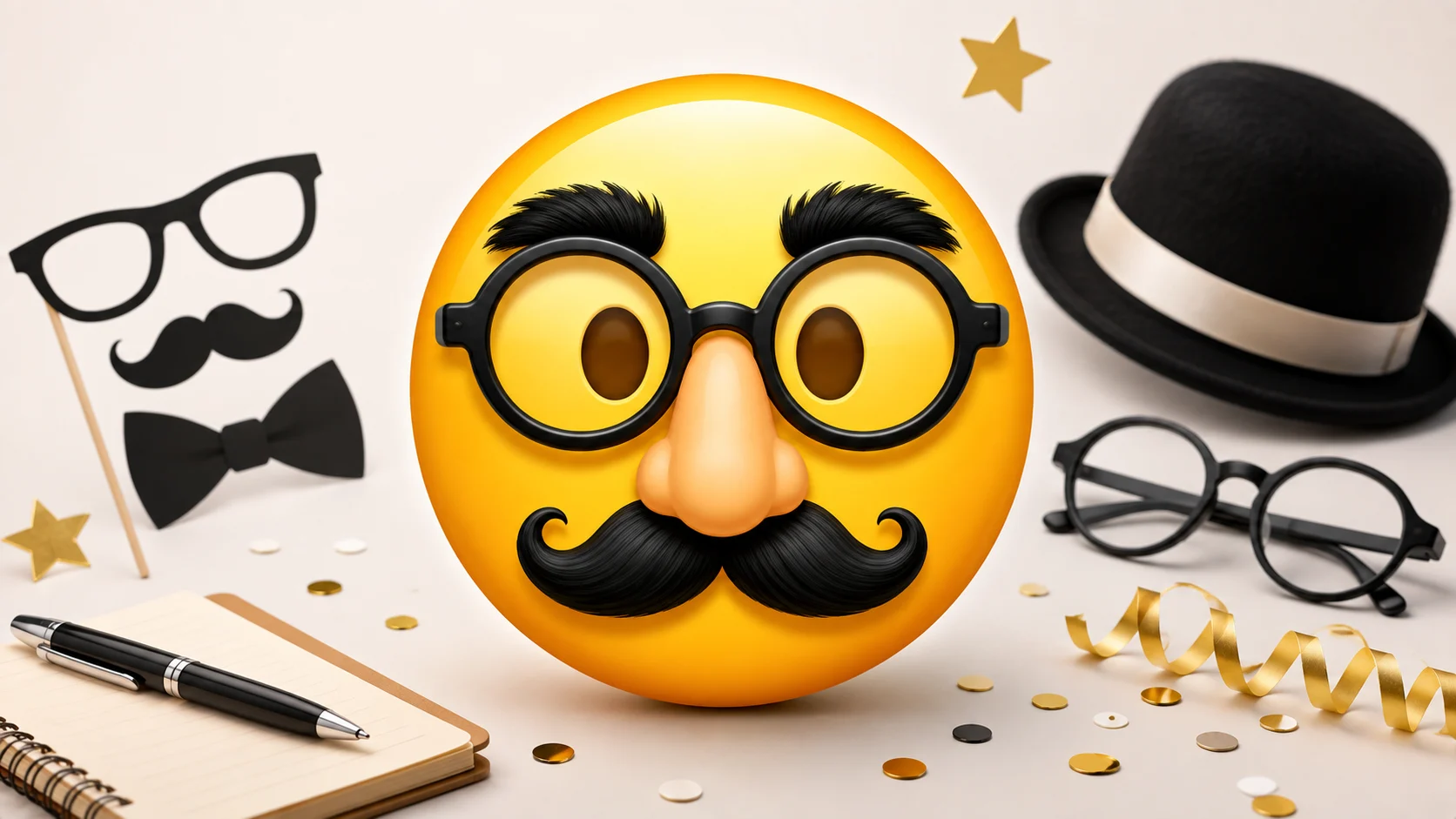
🥸 usually means disguise, pretending, hiding your identity, or acting suspiciously in a playful way. Its tone is generally humorous rather than serious. It can also be used literally when talking about mustaches, costumes, or funny disguises, but the surrounding message determines the emoji is meant as a joke, a reaction, or a reference to hiding something.
The mustache emoji 🥸 usually refers to the Disguised Face emoji, which features a mustache, oversized glasses, a large nose, and thick eyebrows. It commonly represents being in disguise, pretending to be someone else, or joking about hiding your identity.
The mustache itself is not a standalone Unicode emoji. Instead, 🥸 is the emoji most closely associated with a mustache because the mustache is one of its defining visual features.
What Does the Mustache Emoji 🥸 Mean?
When people search for the mustache emoji, they are often referring to 🥸, officially called Disguised Face. Unicode lists the emoji with keywords including “moustache,” “mustache,” “disguise,” “spy,” and “incognito.”
The main idea is disguise. The face looks like someone wearing a novelty disguise with glasses, a large nose, eyebrows, and a prominent mustache. Emojipedia notes that its design is based on the well-known “Groucho” disguise or glasses-and-mustache mask.
Depending on the conversation, 🥸 can suggest:
- pretending to be someone else
- hiding your identity
- acting like a secret agent or spy
- joking about being undercover
- making a silly disguise
- playfully hiding something
- adding a mischievous or theatrical tone
It does not automatically mean that someone is actually lying or secretly doing something wrong.
Mustache Emoji Meaning in Text
In texting, 🥸 often adds a playful idea of “I’m undercover” or “You don’t recognize me.”
For example:
“Nobody will know it’s me 🥸”
Here, the emoji reinforces the idea of a silly disguise.
It can also make an ordinary statement sound more secretive or mischievous:
“I may have eaten the last cookie 🥸”
In this case, 🥸 can suggest joking guilt or pretending to hide responsibility. The words around the emoji matter more than the emoji alone.
Is 🥸 Actually a Mustache Emoji?
Not officially. 🥸 is the Disguised Face emoji, not an emoji named “Mustache.”
The mustache is one of its visual elements and is included among Unicode’s keywords for the character. Unicode’s current emoji data identifies it as U+1F978, with the CLDR short name “disguised face.”
So if you need a simple copy-and-paste emoji that visually represents a mustache, 🥸 may be what you are looking for. But if you need the official Unicode name, use Disguised Face.
The Tone of 🥸
The disguised face usually has a playful, humorous, or mischievous tone.
It can feel:
- Playful: “My secret identity is safe 🥸”
- Funny: “Time for my undercover mission 🥸”
- Mischievous: “I definitely didn’t take your fries 🥸”
- Theatrical: “Allow me to introduce my alter ego 🥸”
- Literal: “I’m wearing a fake mustache for the costume party 🥸”
The emoji is usually lighthearted. However, a sarcastic message can make it feel more suspicious or teasing.
Does 🥸 Mean Someone Is Hiding Something?
It can suggest that someone is pretending to hide something, but it does not prove that they are actually hiding anything.
For example:
“I have absolutely no idea who finished the cake 🥸”
The emoji can make the statement sound deliberately suspicious or joking.
Compare that with:
“Wearing my disguise for Halloween 🥸”
Here, the meaning is literal and straightforward.
This is why it is better to read 🥸 as a tone marker rather than a factual statement about someone’s behavior.
Is the Mustache Emoji Flirty?
🥸 is not inherently a flirting emoji. It is much more closely associated with disguises, jokes, pretending, and playful mischief.
Someone could use it in a flirtatious conversation, but the surrounding message and relationship between the people would create that meaning.
For example:
“Guess who is coming to see you tonight 🥸”
This could feel teasing or playful, but the emoji alone does not establish romantic interest.
Avoid assuming that 🥸 means attraction simply because it appears in a conversation between two people who are interested in each other.
What Does 🥸 Mean From Someone?
When someone sends 🥸 by itself, the most likely interpretation depends on what was happening immediately before it.
It might mean:
- “I’m joking.”
- “I’m undercover.”
- “I’m pretending.”
- “You won’t recognize me.”
- “I’m being sneaky in a playful way.”
- “Look at my funny disguise.”
- “I’m hiding behind a silly persona.”
If the conversation involved a secret, surprise, costume, prank, or joke, the disguise meaning becomes especially clear.
Mustache Emoji in Funny or Sarcastic Messages
One of the most useful ways to understand 🥸 is to look at how it changes the tone of a sentence.
“I have never seen that missing chocolate bar before 🥸”
The words claim innocence, while the emoji adds a jokingly suspicious expression.
Another example:
“Just doing some completely normal undercover work 🥸”
Here, 🥸 makes the sentence intentionally theatrical.
The emoji can therefore work almost like a visual wink toward the reader: “I’m pretending, and you know I’m pretending.”
Mustache Emoji Examples
Example 1
Message: “Nobody will recognize me with this disguise 🥸”
Likely meaning: A literal or playful reference to changing one’s appearance.
Why context matters: The word “disguise” directly supports the emoji’s main meaning.
Example 2
Message: “Who, me? I know nothing 🥸”
Likely meaning: Playful denial or pretending to be innocent.
Why context matters: The wording creates a jokingly suspicious tone.
Example 3
Message: “Going undercover for the weekend 🥸”
Likely meaning: A humorous secret-agent or disguise reference.
Why context matters: “Undercover” gives the emoji a spy-like interpretation.
Example 4
Message: “I finally grew a mustache 🥸”
Likely meaning: A visual joke or playful reference to facial hair.
Why context matters: The message focuses on the mustache itself rather than hiding an identity.
Emojis Similar to the Mustache Emoji
| Emoji | Official Name | Common Meaning | Tone | Where or When It Is Used |
|---|---|---|---|---|
| 🥸 | Disguised Face | Disguise, pretending, hiding identity | Playful, mischievous | Jokes, costumes, secret-agent themes, playful reactions |
| 🧔 | Person: Beard | Beard or facial hair | Neutral, casual | Talking about beards, grooming, or appearance |
| 🧔♂️ | Man: Beard | A bearded man | Neutral, descriptive | References to a man with a beard or facial hair |
| 🕵️ | Detective | Detective, investigation, looking for clues | Curious, playful | Mystery jokes, investigations, detective themes |
| 🥷 | Ninja | Ninja, stealth, staying hidden | Playful, adventurous | Jokes about secrecy, stealth, or costumes |
| 🤫 | Shushing Face | Keep quiet, secrecy | Quiet, playful, secretive | Secrets, confidential jokes, telling someone to be quiet |
| 😏 | Smirking Face | Smugness, confidence, suggestiveness | Teasing, sly | Teasing or suggestive comments |
| 🤭 | Face with Hand Over Mouth | Surprise, embarrassment, hiding a reaction | Playful, amused | Awkward moments, jokes, or suppressed laughter |
The biggest distinction is that 🥸 focuses on disguise and pretending, while 🧔 and 🧔♂️ are primarily about facial hair. 🕵️ and 🥷 can suggest secrecy or being undercover, but they do not specifically represent a fake mustache disguise. 🤫 focuses on keeping something quiet, while 😏 can create a more suggestive or teasing tone.
🥸 vs. 🧔: What’s the Difference?
🥸 Disguised Face is about a disguise, altered appearance, or playful pretending. Its mustache is part of a larger costume-like face.
🧔 Person: Beard is about facial hair. It is a better choice when the subject is genuinely a beard or a bearded person rather than a disguise. Unicode identifies 🧔 as Person: Beard.
So:
“Trying a fake mustache for my costume 🥸”
works naturally with the disguised face.
But:
“Finally grew a beard 🧔”
is better represented by the beard emoji.
🥸 vs. 🕵️: What’s the Difference?
Both can suggest being undercover, but they do it differently.
🥸 emphasizes the disguise itself.
🕵️ emphasizes the detective or investigation role.
If you are joking about wearing glasses and a fake mustache, 🥸 is the more direct choice. If you are investigating a mystery, 🕵️ is more specific.
🥸 vs. 🥷: What’s the Difference?
🥸 suggests a humorous disguise or altered identity, while 🥷 represents a ninja and can suggest stealth, secrecy, or martial-arts imagery.
Use 🥸 for:
“My disguise is foolproof 🥸”
Use 🥷 for:
“Sneaking into the kitchen for a midnight snack 🥷”
Both can be playful, but their visual ideas are different.
How to Respond to 🥸
Your response can match the tone of the message.
If it is a joke:
“Nice disguise 😂”
If they are pretending to be undercover:
“Your secret is safe with me 🤫”
If they are talking about a costume:
“That disguise is actually pretty convincing!”
If you’re unsure what they mean:
“Okay, what are you hiding? 😂”
There is no single required response. A short playful reply is usually enough when 🥸 is being used as a joke.
Copy and Paste the Mustache Emoji
You can copy the emoji here:
🥸
Its official name is Disguised Face. Unicode assigns it the code point U+1F978.
Official Name and Unicode Details
The emoji commonly called the “mustache emoji” is officially Disguised Face.
- Emoji: 🥸
- Official Unicode/CLDR name: Disguised Face
- Unicode code point: U+1F978
- Unicode version: Unicode 13.0
- Emoji version: Emoji 13.0
- Main visual idea: A face wearing a novelty disguise with glasses, a large nose, eyebrows, and a mustache
Unicode’s current emoji charts list 🥸 as Disguised Face and include “mustache” and “moustache” among its keywords.
Emojipedia states that Disguised Face was approved in Unicode 13.0 and added to Emoji 13.0 in 2020.
FAQs
What is the mustache emoji?
The emoji most commonly associated with a mustache is 🥸, officially called Disguised Face. It shows a face with a novelty disguise that includes a mustache, glasses, a large nose, and thick eyebrows.
What does 🥸 mean in texting?
🥸 usually means disguise, pretending, hiding your identity, or acting undercover in a playful way. It can also be used simply to joke about a mustache or costume.
Is 🥸 called the mustache emoji?
Not officially. Unicode calls it Disguised Face, although “mustache” and “moustache” are among its associated keywords.
Is there a separate mustache emoji?
There is no standalone Unicode emoji officially named “Mustache.” 🥸 is the closest standard emoji because its design prominently includes a mustache.
Does 🥸 mean flirting?
Not by itself. It can appear in a playful or flirtatious conversation, but the emoji primarily represents disguise, pretending, or humorous secrecy.
What is the difference between 🥸 and 🧔?
🥸 represents a disguised face and includes a fake-looking mustache as part of the disguise. 🧔 represents a person with a beard and is more appropriate when the topic is facial hair rather than disguise.
Conclusion
The mustache emoji 🥸 is officially the Disguised Face emoji, not a standalone mustache symbol. Its main meaning is disguise, pretending, or playful secrecy, while its mustache can also make it useful for jokes about facial hair or costumes.
As with most emojis, the surrounding words matter. A message about a costume, secret, prank, or undercover joke will make 🥸 feel different from a simple comment about someone’s appearance.
Discover More Related Articles:
- Donut Emoji | Sweet Cravings, Fun & Digital Expression In 2026
- Boat Emoji | Meaning, Uses & Similar Emojis Explained In 2026
- Drink Emoji | What This Refreshing Icon Really Represents In 2026

Matthew Garcia is a content writer at EmojisPeace.com, where she creates fun, expressive and easy-to-use emoji collections for every mood and moment. Passionate about digital expression, she helps readers find the perfect emojis to make every message more creative and memorable.