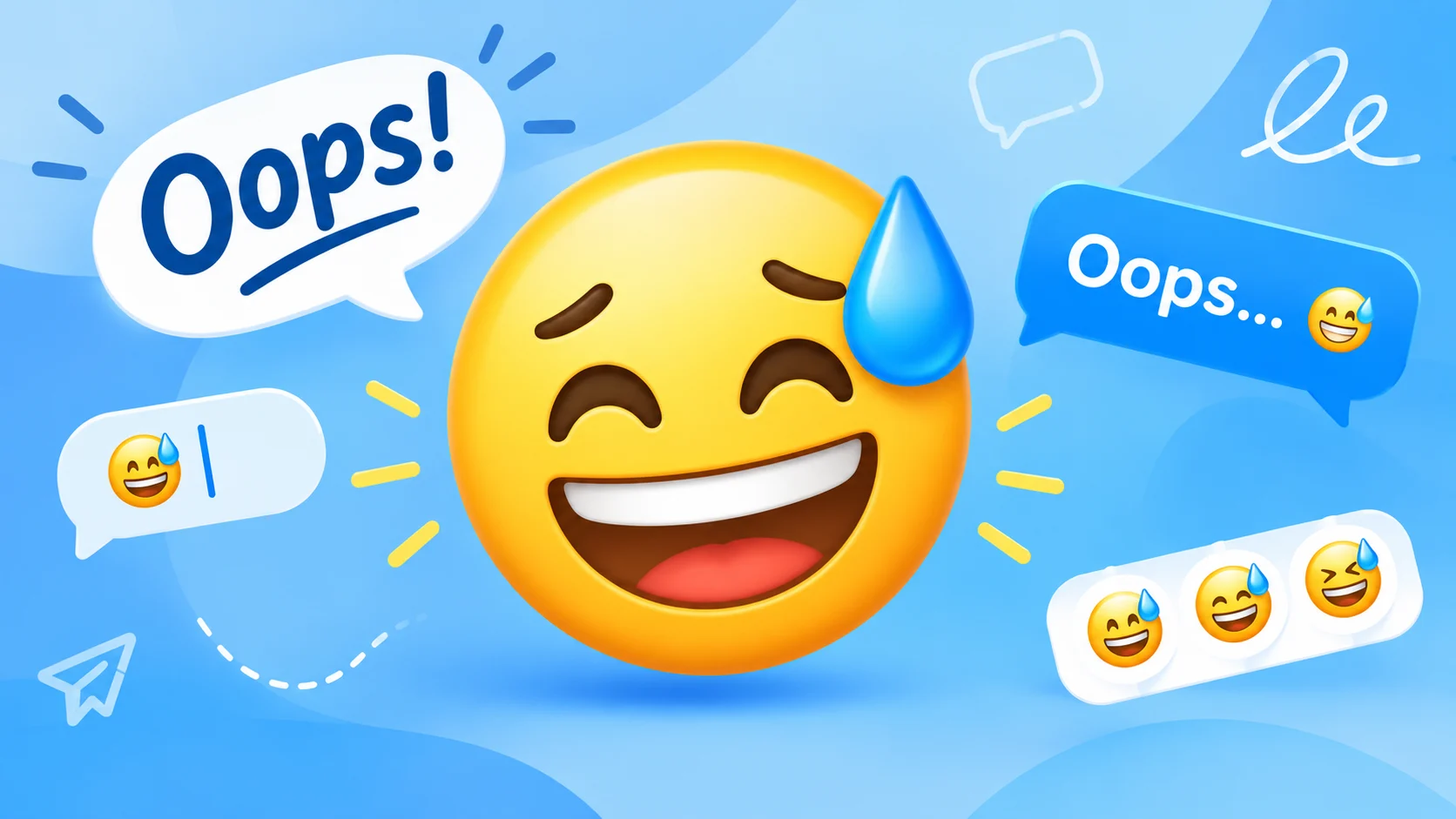
😅 usually means “Oops,” “That was awkward,” “Whew, I got lucky,” or “I’m a little embarrassed.” It often makes a mistake or uncomfortable moment sound lighter.
😅 The oops emoji usually means “oops,” awkwardness, nervous laughter, embarrassment, or relief after a close call. Its official Unicode name is Grinning Face with Sweat. The combination of a broad smile and a single sweat drop gives it a mixed emotional tone: the sender may be amused, uncomfortable, relieved, or trying to make a small mistake feel less serious. The exact meaning depends on the message around it and the situation.
It can also show nervous laughter or relief after something almost went wrong, so it does not always mean the sender is simply happy.
What Does the Oops Emoji 😅 Mean?
The 😅 emoji is commonly used when something feels slightly embarrassing, awkward, stressful, or unexpectedly close to going wrong.
The smile keeps the message from sounding too serious, while the sweat drop adds a sense of tension or discomfort. That combination is why 😅 works especially well for situations where someone is thinking, “Well… that could have gone better.”
For example:
- “Oops, I sent that to the wrong group 😅”
- “I completely forgot about the meeting 😅”
- “Almost missed my flight 😅”
- “I thought today was Friday 😅”
In each case, the emoji can soften the situation. It may communicate embarrassment without making the message sound overly serious.
😅 Meaning in Text Messages
In texting, 😅 can carry several closely related meanings:
Oops: The sender made a small mistake and is acknowledging it.
Awkward: Something uncomfortable happened, and the smile shows an attempt to laugh it off.
Nervous: The sender feels uneasy but does not want to sound overly worried.
Relieved: Something almost went wrong but ultimately turned out fine.
Embarrassed: The sender knows they made a mistake or said something awkward.
Playfully uncomfortable: The situation is not truly serious, but the sender wants to show a little discomfort.
The words around the emoji are important. “I forgot your birthday 😅” sounds embarrassed, while “Made it just in time 😅” sounds more relieved.
Why Does 😅 Feel Like “Oops”?
The visual design explains much of its common use. 😅 has a smiling face with an open mouth and a single drop of sweat. The smile suggests friendliness or humor, while the sweat suggests tension, nervousness, or discomfort.
That combination makes it useful for a situation where someone wants to admit a mistake without making the conversation feel heavy.
It is different from a normal happy smile because the sweat drop adds an extra emotional layer.
Is 😅 a Happy or Embarrassed Emoji?
It can be either, but embarrassment, awkwardness, nervousness, and relief are often more relevant than simple happiness.
Compare these:
“That was so funny 😄”
Here, 😄 mainly expresses happiness or amusement.
“I accidentally called my boss ‘Mom’ 😅”
Here, 😅 suggests embarrassment and nervous laughter.
So when you see 😅, do not automatically read it as “happy.” The sender may be smiling because they feel awkward.
😅 as a Nervous or Awkward Emoji
The oops emoji can act like a written nervous laugh.
For example:
“I didn’t realize everyone could see that message 😅”
The sender is not necessarily laughing because the situation is genuinely funny. The emoji can show discomfort while keeping the tone casual.
It may also appear after an uncomfortable realization:
“Wait… I was supposed to bring the tickets 😅”
The emoji adds a softer reaction than simply writing “I forgot.”
😅 as a Relief Emoji
Another common use is relief after a close call.
For example:
“Almost deleted the whole file, but I recovered it 😅”
Here, the emoji can communicate something like “That was close!”
The same idea appears in:
“Made it through security with two minutes to spare 😅”
In this context, the sweat represents the tension of the moment, while the smile suggests that everything worked out.
Can 😅 Be Sarcastic?
Yes. Like many expressive emojis, 😅 can be used sarcastically, but the emoji itself does not guarantee sarcasm.
For example:
“Sure, I’ll finish this giant project in five minutes 😅”
The surrounding sentence makes the sarcasm clear. Without that context, the emoji could simply indicate nervousness or humor.
Look at the words, the conversation history, and the sender’s usual style before interpreting 😅 as sarcasm.
Is 😅 Flirty?
😅 is not inherently a flirting emoji.
Someone might use it in a playful or slightly awkward romantic conversation, but that does not automatically make the message romantic.
For example:
“I may have checked your profile a few times 😅”
In this situation, the emoji could soften an admission and make it sound playful. However, the meaning comes mainly from the words and relationship between the people, not from 😅 alone.
What Does 😅 Mean When Someone Sends It to You?
When someone sends 😅, consider what they just said.
If they made a mistake, it may mean “Oops” or “Sorry about that.”
If something almost went wrong, it may mean “That was close.”
If the conversation is awkward, it may mean “This is a little uncomfortable, but I’m trying to laugh it off.”
If they made a joke or exaggerated something, it may simply soften the humor.
A single emoji is rarely enough to determine someone’s exact intention.
Oops Emoji 😅 Examples
| Message | Likely meaning | Why the context matters |
|---|---|---|
| “Oops, wrong chat 😅” | Embarrassment or apology | The sender made a clear mistake. |
| “I forgot to attach the file 😅” | Awkwardness | The sweat softens an admission of error. |
| “We got there just in time 😅” | Relief | The situation almost went wrong. |
| “I may have eaten the last slice 😅” | Playful guilt | The mistake is being presented humorously. |
| “I thought you were already here 😅” | Mild awkwardness | The sender is acknowledging an incorrect assumption. |
These are illustrative examples. The same emoji can have a different tone when the surrounding conversation changes.
Emojis Similar to 😅 and How They Differ
| Emoji | Official Name | Common Meaning | Tone | Where or When It Is Used |
|---|---|---|---|---|
| 😅 | Grinning Face with Sweat | Oops, awkwardness, nervousness, relief | Awkward, nervous, playful | Mistakes, close calls, uncomfortable moments |
| 😬 | Grimacing Face | Tension, discomfort, awkwardness | Uncomfortable, uneasy | Cringe moments, difficult situations |
| 😓 | Downcast Face with Sweat | Stress, disappointment, sadness | Worried, discouraged | Difficult or frustrating situations |
| 😄 | Grinning Face with Smiling Eyes | Happiness, amusement, friendliness | Cheerful, positive | Genuine smiles and happy reactions |
| 😂 | Face with Tears of Joy | Strong amusement | Very playful, laughing | Something is extremely funny |
| 🙃 | Upside-Down Face | Irony, awkward humor, resignation | Playful, ironic | Situations that are strange or frustrating |
| 😳 | Flushed Face | Shock, embarrassment, surprise | Embarrassed, startled | Unexpected or awkward moments |
| 🫠 | Melting Face | Overwhelmed, embarrassed, exhausted | Dramatic, humorous | Situations that feel too much to handle |
The closest alternatives are 😬, 😓, and 😳, but they change the emotional emphasis. 😅 keeps a clear smile, making it more casual and often more playful. 😬 looks more uncomfortable, 😓 leans toward stress or disappointment, and 😳 emphasizes surprise or embarrassment.
If you are laughing at something genuinely funny, 😂 is usually clearer. If you are admitting a small mistake while trying to keep things light, 😅 is a better fit.
😅 vs. 😬
Both emojis can communicate awkwardness, but they do it differently.
😅 often says, “Oops, that was awkward, but it’s okay.”
😬 is more like, “Yikes, this is uncomfortable.”
For example:
“I accidentally replied-all 😅”
sounds like the sender is laughing off a mistake.
“I have to tell them we lost the documents 😬”
sounds more tense and uncomfortable.
😅 vs. 😓
These emojis are easy to confuse because both include sweat.
😅 has a broad grin and often softens an awkward or stressful situation. 😓 has a downcast expression and is more closely associated with sadness, frustration, disappointment, or stress.
Use 😅 when the situation can be laughed off. Use 😓 when the feeling is more genuinely discouraged or troubled.
😅 vs. 😂
The difference is mainly emotional purpose.
😂 clearly communicates strong laughter or amusement. 😅 can involve humor, but the sweat drop adds nervousness, embarrassment, or relief.
“That movie was hilarious 😂”
is straightforward laughter.
“I accidentally wore my shirt inside out all day 😅”
is more about embarrassment than intense laughter.
How to Respond to 😅
Your response should match the message rather than treating the emoji as a fixed signal.
If someone made a harmless mistake, a friendly response might be:
“Haha, no worries!”
If they seem embarrassed:
“It happens 😅”
If they are describing a close call:
“Glad it worked out!”
If you are unsure they are joking, a simple question can clear things up:
“Wait, are you serious? 😂”
There is no need to assume that 😅 means flirting, guilt, sarcasm, or romantic interest without other context.
Can You Copy and Paste the Oops Emoji?
Yes. Here it is:
😅
You can copy and paste it into texts, comments, captions, chats, or other messages. Its official Unicode name is Grinning Face with Sweat, while “oops emoji” is a common informal way to describe one of its conversational uses.
Official Name and Technical Details
The emoji 😅 is officially named Grinning Face with Sweat in the current Unicode emoji data. Its Unicode code point is U+1F605. Unicode’s current emoji list also associates it with terms such as nervous, stress, stressed, and sweat.
The character was approved in Unicode 6.0 in 2010 under the earlier name “Smiling Face with Open Mouth and Cold Sweat” and was included in Emoji 1.0 in 2015.
Different platforms can draw the emoji somewhat differently. For example, the position of the sweat drop may vary, so its visual appearance is not identical everywhere.
FAQs
What does the 😅 emoji mean?
😅 commonly expresses an awkward “oops,” nervous laughter, embarrassment, or relief after a close call. Its exact meaning depends on the surrounding message.
Is 😅 the oops emoji?
Yes, people commonly use 😅 as an “oops” emoji because it combines a smile with a sweat drop, making it useful for small mistakes and awkward moments.
Does 😅 mean embarrassment?
It can. When someone admits a mistake or describes an awkward moment, 😅 often softens the embarrassment with humor or nervous laughter.
Does 😅 mean relief?
It can mean relief when something almost went wrong but ended well. In that context, it can feel like saying “Whew, that was close.”
Is 😅 a flirty emoji?
Not by itself. It can appear in playful or romantic conversations, but the words, relationship, and overall context matter more than the emoji alone.
Is 😅 sarcastic?
Sometimes, but not automatically. A sarcastic sentence may use 😅 to reinforce the joke, while another message may use the same emoji simply to show nervousness or awkwardness.
Conclusion
The 😅 emoji is best understood as a smile mixed with a little tension. It can say “oops,” “that was awkward,” “I’m embarrassed,” “I’m nervous,” or “whew, that was close.”
When interpreting it, focus on the complete message and situation rather than assigning one fixed meaning to the emoji.
Discover More Related Articles:
- Yoga Emoji | Balance, Peace, Mindfulness & Calm In 2026
- Blue Emoji Thumbs Up | Support, Approval & Positive Vibes In 2026
- Black Cat Emoji | What This Mysterious Cat Really Says In 2026

Sophia Martinez is a content writer at EmojisPeace.com, where she creates fun, engaging, and easy-to-read emoji guides, meanings and digital communication content. She enjoys helping readers express themselves better with the perfect emojis for every mood and moment.
11 thoughts on “Oops Emoji 😅 | The Perfect Little Reaction for Awkward, Funny & Unexpected Moments In 2026”