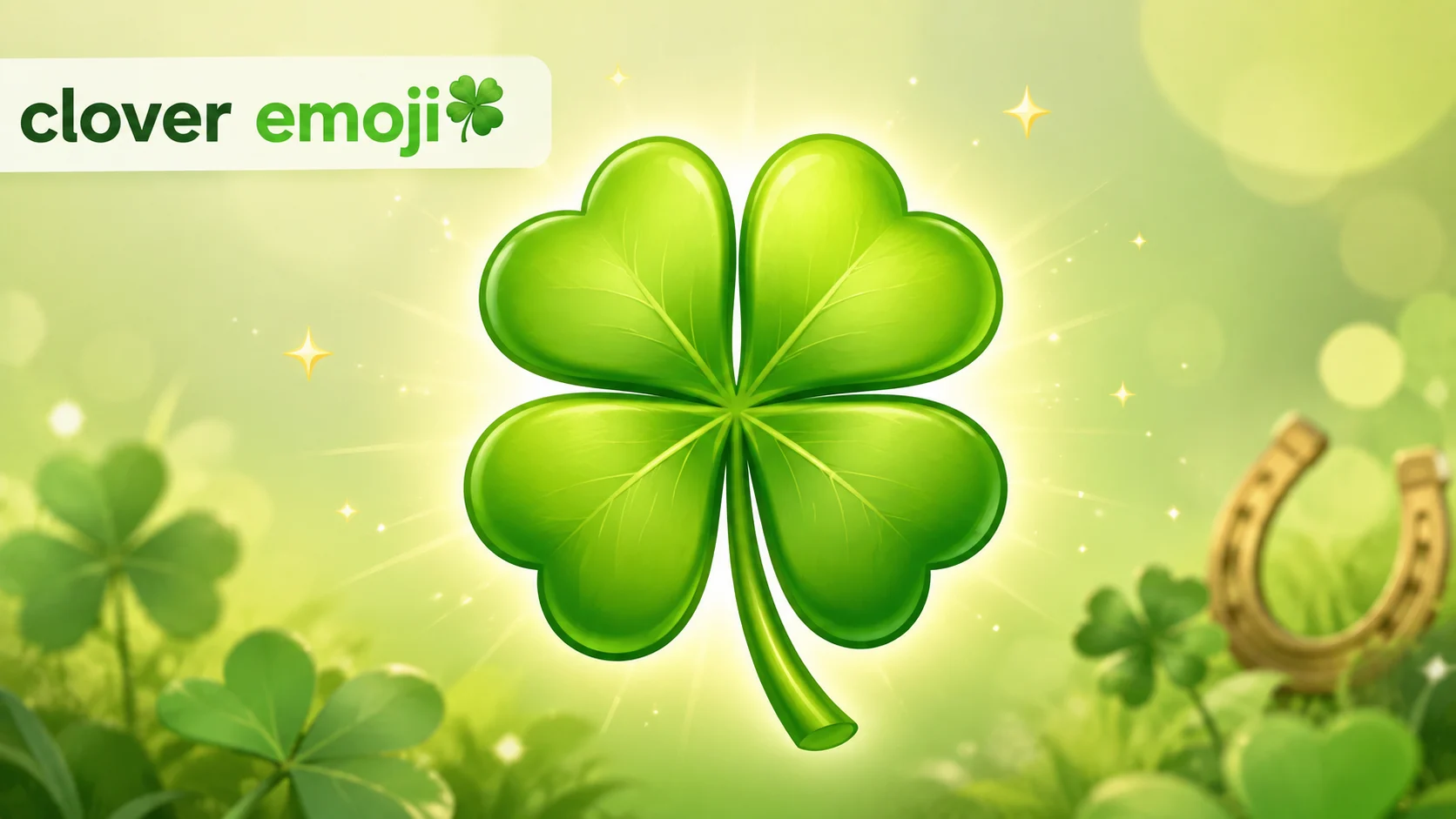
🍀 means good luck most of the time. It is the Four Leaf Clover emoji, officially named by Unicode. People commonly use it to wish someone success, express hope for a favorable outcome or celebrate something fortunate. It can also have an Irish or St. Patrick’s Day connection, although the four-leaf clover is different from the traditional three-leaf shamrock ☘️.
The clover emoji 🍀 usually represents good luck, hope, and positive wishes. It can be used when someone wants to wish another person luck, celebrate a fortunate moment, or add a cheerful nature-related touch to a message. It may also appear in conversations about Ireland, St.
Patrick’s Day, or lucky symbols. The exact feeling depends on the surrounding message: 🍀 can be sincere and encouraging, playful, celebratory, or simply decorative.
What Does the Clover Emoji 🍀 Mean?
The 🍀 emoji depicts a four-leaf clover, a plant commonly associated with luck. Its strongest conversational meaning is therefore good fortune.
Someone might add 🍀 to a message when they want to:
- Wish someone luck before an important event
- Express hope that something works out
- Celebrate a fortunate outcome
- Show optimism about what is coming
- Add a cheerful, natural, or seasonal feeling
- Refer to lucky symbols or traditions
For example, if someone says, “Big interview tomorrow 🍀,” the emoji is most naturally read as “Wish me luck” or “I hope this goes well.”
It does not automatically mean that something lucky has already happened. The surrounding words determine 🍀 expresses a wish, a celebration, or a general positive feeling.
🍀 Meaning in Text Messages
In texting, 🍀 is usually friendly and positive. It often works as a small emotional signal attached to a sentence.
Consider these examples:
“Hope you get the job! 🍀”
Likely meaning: A sincere wish for success. The emoji reinforces the encouraging tone.
“I finally found my missing keys 🍀”
Likely meaning: The sender feels fortunate or relieved about the outcome.
“Wish me luck on my exam 🍀”
Likely meaning: The sender is asking for encouragement and hoping for a good result.
“Maybe this is our lucky day 🍀”
Likely meaning: Hopeful or playful optimism. It could refer to anything from a good opportunity to a fortunate coincidence.
Because 🍀 is generally positive, it rarely carries a harsh or confrontational tone on its own.
The Emotional Tone of 🍀
The four-leaf clover has a naturally hopeful, encouraging, and upbeat tone. Its emotional intensity is usually mild rather than dramatic.
Compare:
- 🍀 — “I hope things go well.”
- 🤞 — “Fingers crossed.”
- 🎉 — “This is worth celebrating.”
- ✨ — “This feels special or exciting.”
These can overlap, but they are not interchangeable in every message.
🍀 tends to focus on luck or favorable outcomes, while 🤞 more directly represents hope or a wish. 🎉 is about celebration, and ✨ often adds excitement or a magical or positive touch.
Is 🍀 Friendly, Flirty, or Romantic?
The clover emoji is not inherently romantic or flirty. Its usual meaning is related to luck and positive wishes.
If someone sends:
“Good luck tomorrow 🍀”
the most natural interpretation is simply encouragement.
In a romantic conversation, however, the surrounding message can give it a warmer meaning. For example:
“Hope your presentation goes perfectly tomorrow 🍀❤️”
Here, the heart supplies much of the affectionate tone. 🍀 itself still mainly communicates good wishes.
The same principle applies to friendship. A friend, coworker, family member, or romantic partner can all use 🍀 without the emoji itself establishing a particular relationship.
What Does 🍀 Mean From Someone?
When someone sends you 🍀, look at the message around it before assigning a deeper meaning.
It may mean:
“Good luck.”
Especially when you are about to take a test, attend an interview, travel, compete, perform, or face another uncertain situation.
“I hope this works out.”
The emoji can express optimism when the result is not yet known.
“That was lucky.”
After a fortunate event, 🍀 can emphasize how well things turned out.
“I’m feeling positive.”
Sometimes the emoji is simply a cheerful symbol without a specific request or prediction.
There is no universal hidden message behind 🍀. Conversation history and the sender’s usual style matter more than the symbol alone.
🍀 and St. Patrick’s Day
🍀 can appear in messages about St. Patrick’s Day, Ireland, Irish culture, and green-themed celebrations. However, it is useful to distinguish the four-leaf clover from the shamrock ☘️.
Unicode lists 🍀 as “four leaf clover” and ☘️ as “shamrock.”
The two symbols can look similar in casual conversation, but they represent different plants or symbols. The four-leaf clover is especially associated with luck, while the shamrock has a stronger traditional Irish association.
Emojis Related to 🍀 and How They Differ
| Emoji | Official Name | Common Meaning | Tone | Where or When It Is Used |
|---|---|---|---|---|
| 🍀 | Four Leaf Clover | Good luck, fortune, hope | Cheerful, hopeful | Good-luck wishes, fortunate moments, positive messages |
| ☘️ | Shamrock | Irish identity, shamrock, St. Patrick’s Day | Festive, cultural | Irish-themed messages and St. Patrick’s Day |
| 🤞 | Crossed Fingers | Hope, wishing for success | Hopeful, playful | Waiting for results, hoping something works |
| 🧿 | Nazar Amulet | Protection from the evil eye | Protective, symbolic | Good wishes, protection, cultural references |
| 🌈 | Rainbow | Hope, positivity, beauty | Bright, uplifting | Encouragement, celebrations, positive reactions |
| ✨ | Sparkles | Excitement, magic, emphasis | Cheerful, enthusiastic | Celebrations, compliments, special moments |
| 🎉 | Party Popper | Celebration and congratulations | Excited, festive | Achievements, good news, milestones |
| 🌱 | Seedling | Growth, new beginnings | Fresh, hopeful | New starts, progress, personal or creative growth |
The most important distinction is between 🍀 and ☘️. They are both green plant symbols, but 🍀 specifically represents a four-leaf clover and is strongly connected with luck, while ☘️ is the shamrock and has a stronger Irish and St. Patrick’s Day association. Unicode separately identifies both symbols.
🍀 and 🤞 can also be easy to confuse because both can appear when someone hopes for a good result. 🍀 emphasizes luck, while 🤞 more directly communicates “fingers crossed” or hoping.
When Should You Use 🍀?
🍀 works particularly well when you want to add a positive wish without making the message overly emotional.
Examples include:
Before an exam:
“Go crush that exam 🍀”
Before a job interview:
“Good luck with the interview today 🍀”
Before a competition:
“You’ve got this 🍀”
After good fortune:
“That worked out better than expected 🍀”
For a new opportunity:
“Here’s hoping this is the one 🍀”
It can also be used by itself as a quick response to someone who says they need luck.
How to Respond When Someone Sends 🍀
Your response should depend on what the sender is saying.
For a good-luck wish:
“Thank you! I really hope so.”
For a playful exchange:
“Fingers crossed 🤞🍀”
If someone is telling you about a lucky event:
“Wow, that worked out perfectly!”
If you are unsure they mean luck or something else, simply respond to the words around the emoji rather than trying to decode 🍀 by itself.
Common Misunderstandings About 🍀
One common mistake is assuming that every use of 🍀 refers to Ireland or St. Patrick’s Day. It can certainly be used that way, but good luck is the broader and more direct interpretation.
Another mistake is treating 🍀 and ☘️ as identical. They are separate Unicode emoji characters with different official names.
It is also easy to overinterpret the emoji in relationship conversations. 🍀 alone does not prove that someone is flirting, expressing romantic interest, or sending a secret message. Those meanings must come from the broader conversation.
Official Name and Technical Details
The official Unicode name for 🍀 is Four Leaf Clover. Its Unicode code point is U+1F340. Unicode’s current emoji charts list it under the plant-related emoji and include keywords such as “clover,” “four-leaf,” “lucky,” and “plant.”
Four Leaf Clover was approved in Unicode 6.0 in 2010 and later included in Emoji 1.0 in 2015.
The exact artwork can vary between operating systems and apps, so the shade of green, leaf shape, stem, and overall styling may look slightly different. The underlying emoji remains the same character.
FAQs
What does 🍀 mean in texting?
🍀 usually means good luck, good fortune, or hope that something goes well. It can also celebrate a lucky outcome or add a positive tone to a message.
Is 🍀 the Irish emoji?
🍀 can be used in Irish or St. Patrick’s Day contexts, but its official name is Four Leaf Clover. The separate ☘️ emoji is officially named Shamrock and has the stronger direct association with the shamrock symbol.
What is the difference between 🍀 and ☘️?
🍀 is a four-leaf clover and is mainly associated with luck. ☘️ is a shamrock and is more closely connected with Irish symbolism and St. Patrick’s Day.
Does 🍀 mean flirting?
Not by itself. 🍀 normally communicates luck or positive wishes. A romantic interpretation would depend on the surrounding conversation and other signals.
What does 🍀 mean from a friend?
A friend may use it to wish you luck, encourage you, or celebrate something fortunate. The meaning is usually friendly rather than romantic.
What does 🍀 mean from someone you like?
It can simply mean “good luck” or “I hope things go well.” Even in a romantic conversation, the emoji alone is not enough to establish romantic interest.
Can 🍀 be sarcastic?
Yes, but usually only when the surrounding words clearly create a sarcastic tone. For example, “Lucky me 🍀” after an obviously frustrating situation could be ironic.
Conclusion
The 🍀 Four Leaf Clover emoji is mainly a symbol of good luck, hope, and favorable outcomes. It can be sincere, playful, celebratory, or culturally themed depending on the conversation. If you are choosing between 🍀 and ☘️, remember the simplest distinction: 🍀 leans toward luck, while ☘️ is the shamrock.
Discover More Related Articles:
- Hammer & Sickle Emoji ☭ | The Surprising Digital Meanings Behind This Icon In 2026
- Sob Emoji Copy Paste | Meaning & How to Use It In 2026
- German Flag Emoji | What the Black, Red & Gold Flag Really Represents Online In 2026

Jessica Miller is a content writer at EmojisPeace.com, where she creates fun and easy-to-follow guides about emojis, their meanings and creative ways to use them. She loves helping readers express themselves with the perfect emoji for every moment.