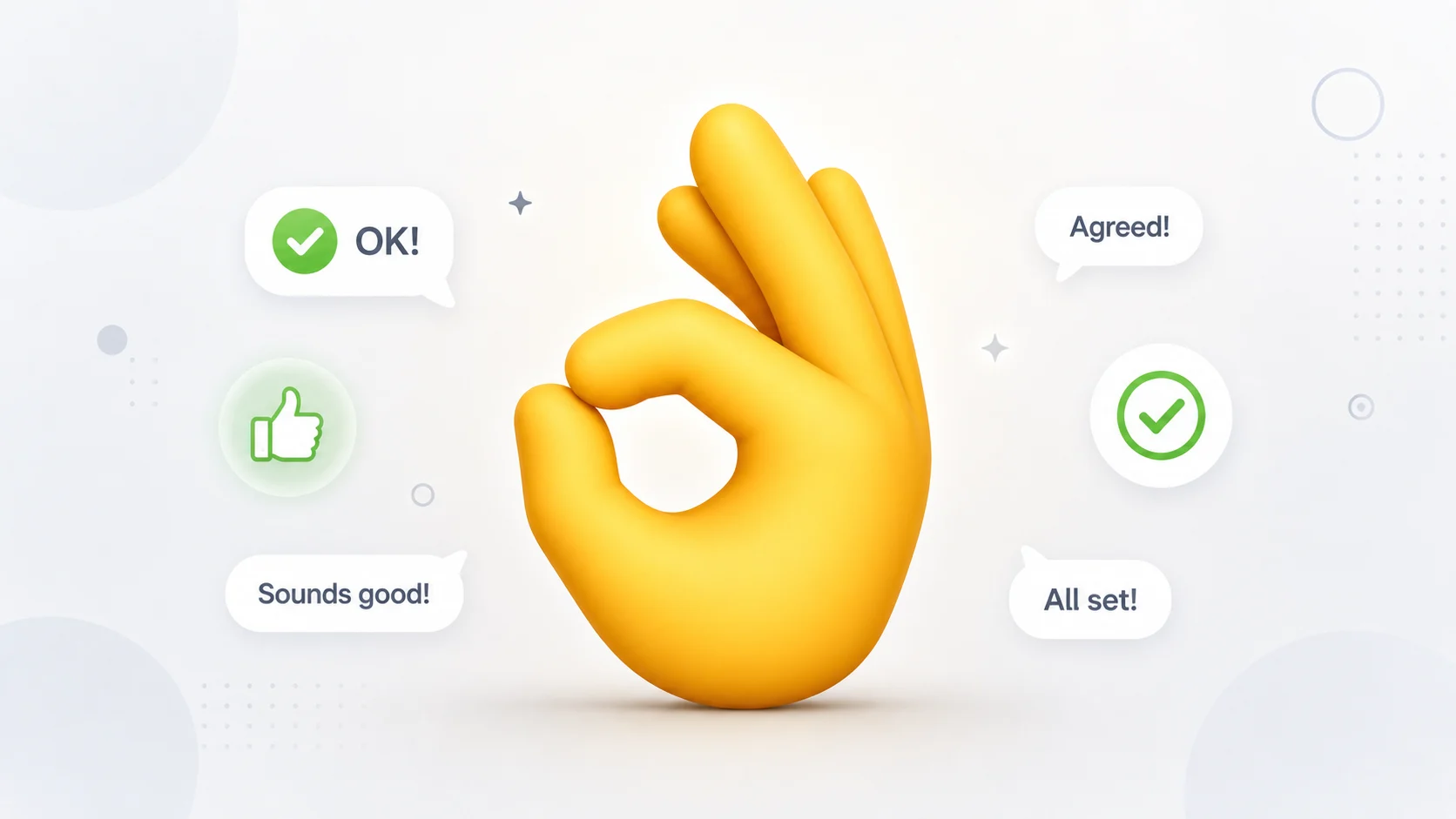
The okay emoji 👌 usually means “OK,” “good,” “agreed,” or “everything is fine.” It is generally positive, neutral, or casually approving. In some conversations, 👌 can also suggest “perfect,” “exactly,” or “that works.” Depending on the wording and relationship between the people, it may sometimes feel dry, dismissive, playful, or sarcastic.
The okay emoji 👌, officially called OK Hand, usually means “okay,” “all good,” “yes,” “correct,” or “sounds good.” It can show agreement, approval, satisfaction, or reassurance in a quick visual way.
Its tone depends on the message around it. A simple “Got it 👌” can feel friendly and confident, while “Okay 👌” after an argument may sound more distant or sarcastic. The emoji itself does not guarantee a particular emotion, so context matters.
What Does the Okay Emoji 👌 Mean?
The 👌 emoji shows a hand making the familiar OK gesture, with the thumb and index finger forming a circle. Unicode lists its short name as OK hand, while Emojipedia identifies its Unicode name as OK Hand Sign. It represents the general idea of “OK” and can communicate agreement, acceptance, approval, or that something is satisfactory.
Common meanings include:
- Okay: “Everything is fine.”
- Agreement: “Yes, I agree.”
- Approval: “That looks good.”
- Confirmation: “Got it.”
- Satisfaction: “Perfect.”
- Reassurance: “No problem.”
- Acknowledgment: “I understand.”
For example:
“I’ll meet you at 7 👌”
Here, 👌 most naturally means “Sounds good” or “That works.”
The emoji can also make a short response feel less abrupt than simply writing “OK.”
👌 Meaning in Text Messages
In texting, 👌 is often used as a compact response to confirm that someone understands, agrees, or accepts something.
For example:
“Can you send me the address?”
“Sure 👌”
This usually means “Sure, no problem.”
It can also be added after a statement:
“Dinner at 8 👌”
That can mean “Dinner at 8 works for me.”
The surrounding words are important. Compare:
“Thanks for helping 👌” — likely appreciative and friendly.
“Fine 👌” — could be neutral, annoyed, or dismissive depending on the conversation.
A short emoji response is therefore not always enough to determine someone’s mood.
Is 👌 a Positive or Negative Emoji?
The OK hand is usually positive or neutral, especially when it follows an ordinary request, plan, compliment, or confirmation.
It can communicate:
Positive:
“Great job 👌”
Neutral:
“See you at 6 👌”
Reassuring:
“Don’t worry, I’m okay 👌”
But tone can shift when the conversation is tense:
“Whatever you want 👌”
In this setting, the emoji may make the message feel sarcastic or passive-aggressive. That interpretation comes from the entire sentence and conversation rather than from the emoji alone.
Can 👌 Be Sarcastic?
Yes. The okay emoji can be used sarcastically, but 👌 does not inherently mean sarcasm.
For example:
“Yeah, because that worked so well last time 👌”
Here, the words clearly create an ironic tone, and 👌 reinforces it.
By contrast:
“Your idea works for me 👌”
would normally be read as straightforward approval.
When deciding someone is being sarcastic, look at the wording, previous messages, punctuation, and the situation rather than treating the emoji as proof of sarcasm.
What Does 👌 Mean From Someone?
If someone sends you 👌 by itself, the most likely interpretation is a simple acknowledgment such as “okay,” “got it,” “sure,” or “sounds good.”
For example:
“I’ll call you after work.”
“👌”
That response probably means “Okay” or “Sounds good.”
However, if the conversation has been emotional, the same emoji could feel less warm:
“I’m sorry about what happened.”
“👌”
Here, the sender might simply be acknowledging the message, or they might be signaling that they do not want to continue the discussion. You need the surrounding conversation to tell the difference.
Is the Okay Emoji 👌 Flirty?
The 👌 emoji is not inherently flirty.
Someone could use it in a playful or flirtatious conversation, but the emoji alone does not establish romantic interest.
For example:
“You looked great tonight 👌”
could feel complimentary or playful depending on the relationship.
But:
“The tickets are booked 👌”
is simply confirmation.
If you’re trying to understand a message is romantic, consider the actual words, the broader conversation, and the relationship rather than relying on 👌 alone.
Does 👌 Mean “Perfect”?
It can.
Because the OK gesture can express approval or satisfaction, 👌 may mean “perfect,” “excellent,” or “just right” when the context supports that reading.
For example:
“This is exactly what I needed 👌”
Here, the emoji strengthens the sense of approval.
Unicode’s CLDR annotations also associate 👌 with “OK” and “perfect,” supporting these common interpretations.
Emojis Similar to the Okay Emoji 👌
| Emoji | Official Name | Common Meaning | Tone | Where or When It Is Used |
|---|---|---|---|---|
| 👌 | OK Hand | Okay, good, perfect, agreed | Positive or neutral | Confirmation, approval, plans, casual texts |
| 👍 | Thumbs Up | Yes, good, approved | Positive or casual | Agreement, acknowledgment, approval |
| ✅ | Check Mark Button | Correct, complete, confirmed | Clear and direct | Tasks, plans, confirmations, factual agreement |
| 🆗 | OK Button | OK, approved, accepted | Direct and neutral | Clear confirmation or agreement |
| 🙆 | Person Gesturing OK | Okay, all good | Positive and expressive | Reassurance, playful approval, reactions |
| 🤝 | Handshake | Agreement, cooperation, deal | Friendly and cooperative | Agreements, teamwork, mutual understanding |
| ✌️ | Victory Hand | Peace, victory, positive sign-off | Playful or upbeat | Casual messages, celebrations, greetings |
| 🤌 | Pinched Fingers | Emphasis, questioning, expressive reaction | Playful or dramatic | Strong reactions, jokes, expressive comments |
The closest alternatives are 👍, 🆗, and ✅, but they are not interchangeable in every situation. 👍 tends to feel like a straightforward thumbs-up, while ✅ is more about confirmation or completion. 🆗 is a literal OK button, whereas 👌 has the more personal feel of a hand gesture.
🤌 can sometimes overlap with 👌 visually because both involve the fingers and thumb, but its meaning is different. Unicode identifies 🤌 as Pinched Fingers, and its annotations include ideas such as a hand gesture, interrogation, and sarcasm.
👌 vs. 👍: What’s the Difference?
Both emojis can communicate approval, but their feel is slightly different.
👌 OK Hand often means:
- “Okay.”
- “Sounds good.”
- “Perfect.”
- “All set.”
👍 Thumbs Up often means:
- “Yes.”
- “Good.”
- “I approve.”
- “Got it.”
Compare:
“Meet me outside at 5 👌”
This feels like confirmation of a plan.
“That movie was great 👍”
This sounds more like a general positive reaction.
The difference is subtle, and many conversations can use either one naturally.
👌 vs. 🆗: What’s the Difference?
These two are especially close in meaning.
👌 is a hand gesture and can feel more conversational or expressive.
🆗 is a button-style symbol that directly represents “OK.”
For a casual text, “Sounds good 👌” feels natural. 🆗 can feel more literal or visually emphatic.
👌 vs. 🤌: Don’t Mix Them Up
The two gestures can look similar at a glance, but they represent different emoji concepts.
👌 OK Hand has the thumb and index finger forming a circle and commonly communicates “OK” or approval.
🤌 Pinched Fingers has the fingertips gathered together and can convey an expressive gesture, questioning, emphasis, or culturally specific meanings.
If you simply want to say “okay” or “sounds good,” 👌 is the clearer choice.
Examples of the Okay Emoji in Texts
Confirming a plan
“I’ll pick you up at 6 👌”
Likely meaning: “That’s the plan” or “Everything is set.”
Showing approval
“I finished the design. What do you think?”
“Looks great 👌”
Likely meaning: “I approve” or “It looks good.”
Reassuring someone
“Are you okay after that?”
“Yeah, I’m good 👌”
Likely meaning: “I’m fine.”
Acknowledging instructions
“Just leave the package by the door.”
“👌”
Likely meaning: “Got it.”
Possible sarcasm
“Sure, because that’s definitely going to fix everything 👌”
Likely meaning: The emoji reinforces the sarcastic wording. The sarcasm comes primarily from the sentence and context.
How to Respond to 👌
The best response depends on what the sender is confirming.
If they’re agreeing with a plan, you can simply continue the conversation:
“Perfect, see you then!”
If they’re acknowledging information:
“Thanks!”
If you’re unsure their response is annoyed or sarcastic, ask directly:
“All good?”
If the conversation is friendly and casual, you may not need to respond at all. A standalone 👌 can function as a complete acknowledgment.
Can 👌 Be Rude?
Usually, 👌 is not rude. However, any short response can feel cold or dismissive in the wrong context.
For example:
“Okay 👌”
after a friendly conversation may be completely normal.
But after a disagreement:
“Fine. 👌”
could feel dismissive or sarcastic.
There is also an important cultural consideration. The physical OK gesture does not have exactly the same meaning everywhere. emojipedia notes that the gesture can be offensive in some cultures, and the emoji has also been used in connection with white-supremacist trolling and symbolism. That does not make the emoji inherently hateful or racist; context is essential.
For ordinary everyday U.S. texting, the conventional reading remains OK, agreement, approval, or reassurance.
Cultural and Contextual Differences
Hand gestures can carry different meanings across cultures, and an emoji based on a physical gesture can inherit some of that ambiguity.
The same 👌 shape can have meanings beyond “okay” in different cultural settings. Emojipedia specifically notes that the gesture can have offensive interpretations in parts of Europe, the Middle East, and South America.
This is one reason not to assume that every emoji has one universal interpretation.
For everyday American English conversations, though, the ordinary “OK” interpretation is generally the most relevant starting point.
Official Name and Technical Details
The emoji 👌 is known in Unicode as OK hand in the current CLDR short-name system. Its code point is U+1F44C. Unicode’s emoji charts list it among the hand and finger emojis.
It was approved in Unicode 6.0 in 2010 and added to Emoji 1.0 in 2015, according to Emojipedia.
The emoji also supports skin-tone modifiers, allowing versions such as 👌🏻, 👌🏼, 👌🏽, 👌🏾, and 👌🏿 on supported systems.
Its exact artwork can vary between Apple, Google, Samsung, and other platforms, but the basic gesture remains recognizable.
FAQs
What does the okay emoji 👌 mean?
The 👌 emoji usually means “okay,” “good,” “agreed,” or “sounds good.” It can also express approval, satisfaction, or reassurance depending on the message.
Is 👌 a positive emoji?
Usually, yes. It commonly communicates approval or agreement, although the surrounding words can make it sound neutral, sarcastic, or dismissive.
What does 👌 mean in texting?
In texts, 👌 often works as a quick acknowledgment such as “got it,” “sure,” “okay,” or “that works.” The exact tone depends on the conversation.
Does 👌 mean perfect?
It can mean “perfect” when someone is expressing strong approval. For example, “That works perfectly 👌” clearly uses the emoji to reinforce satisfaction.
Is 👌 a flirting emoji?
Not by itself. It can appear in a flirtatious conversation, but 👌 alone does not prove attraction or romantic interest.
Can 👌 be sarcastic?
Yes, especially when it follows obviously ironic or exaggerated wording. The sarcastic meaning comes from the full message and context, not from the emoji alone.
Is 👌 rude?
Normally it is not rude, but a short “Okay 👌” can feel cold or dismissive during an argument or tense conversation. Context and tone matter.
What is the difference between 👌 and 👍?
Both can show approval, but 👌 often feels like “okay,” “sounds good,” or “perfect,” while 👍 more directly conveys a thumbs-up or general approval.
What is the difference between 👌 and 🤌?
👌 is the OK Hand and usually communicates “OK” or approval. 🤌 is Pinched Fingers and has a different gesture with more expressive and culturally varied uses.
Conclusion
The okay emoji 👌 is one of the clearest ways to communicate “okay,” “good,” “agreed,” or “sounds good” in a casual conversation. It can also add a sense of approval or reassurance to a message.
Still, 👌 is not a fixed emotional signal. A friendly “Sounds good 👌” and a tense “Fine 👌” can feel completely different. Read the words around it, the history of the conversation, and the sender’s usual communication style before assigning a stronger meaning.
Discover More Related Articles:
- Clover Emoji | Meaning & How to Use It In 2026
- Bone Emoji Meaning | What Does It Mean in Texts & Chats In 2026
- Speaking Head Emoji | Meaning & How to Use It In 2026

Jessica Miller is a content writer at EmojisPeace.com, where she creates fun and easy-to-follow guides about emojis, their meanings and creative ways to use them. She loves helping readers express themselves with the perfect emoji for every moment.