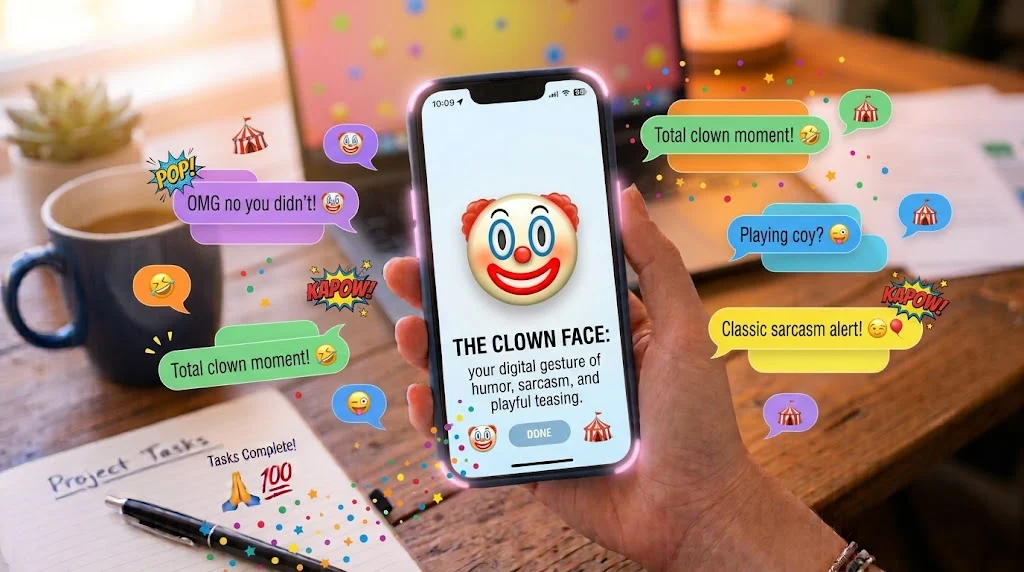
🤡 usually means “I’m being a clown,” “That was ridiculous,” or “You’re acting foolish.” It can express self-mockery, sarcasm, or an insult, so the surrounding words matter.
The clown emoji 🤡, officially called Clown Face, usually represents humor, foolish behavior, embarrassment, or someone acting ridiculous. In texts and social media comments, it can be used to make fun of yourself, joke about a bad decision, or suggest that someone else is behaving foolishly. Its tone can range from playful and funny to sarcastic or insulting, depending on the conversation.
For example, “I believed his excuse again 🤡” makes fun of the sender for falling for something. By contrast, sending 🤡 directly to another person after an argument may feel like calling them foolish or dishonest.
The key is to identify who the joke targets: the sender, another person, or a situation. That distinction often determines hether the emoji feels harmless or offensive.
When Is 🤡 Playful, and When Is It an Insult?
The clown emoji can change meaning based on who or what it targets.
- Self-mockery: “I bought another planner instead of finishing my work 🤡” — the sender is making fun of their own behavior.
- Friendly teasing: “You really forgot your own password? 🤡😂” — the emojis may soften the joke between friends.
- Sarcasm: “Great decision, genius 🤡” — the sender is criticizing a choice rather than praising it.
- Direct insult: Sending 🤡 alone in an argument can imply that the recipient is foolish, ridiculous, or not worth taking seriously.
- Literal entertainment: “The clown at the birthday party was hilarious 🤡” — the emoji refers to an actual performer.
A useful clue is the target of the joke. If the sender is laughing at themselves, it is usually self-deprecating humor. If they direct the emoji at someone during a disagreement, it may be insulting.
Clown Emoji 🤡 vs. Similar Emojis
The clown face is not the only emoji used for jokes, foolish behavior, or sarcasm. These alternatives help you choose a reaction that matches your intended tone.
| Emoji | Official Name | Common Meaning | Tone | Where or When It Is Used |
|---|---|---|---|---|
| 🤡 | Clown Face | Foolish behavior, mockery, or comedy | Sarcastic, playful, insulting | Making fun of a mistake or questionable behavior |
| 😂 | Face with Tears of Joy | Laughing hard | Amused, cheerful | Funny stories, jokes, and entertaining reactions |
| 🤣 | Rolling on the Floor Laughing | Intense laughter | Exaggerated, humorous | Reacting to something extremely funny |
| 🤦 | Person Facepalming | Frustration, disbelief, or embarrassment | Exasperated | Reacting to an obvious mistake |
| 😭 | Loudly Crying Face | Intense crying or exaggerated emotion | Dramatic, emotional | Expressing sadness or laughing so hard it feels overwhelming |
| 😬 | Grimacing Face | Awkwardness or discomfort | Nervous, uneasy | Responding to a social mistake or uncomfortable situation |
| 🙃 | Upside-Down Face | Irony, sarcasm, or playful frustration | Wry, ironic | Reacting to an inconvenient or ridiculous situation |
| 💀 | Skull | Figuratively dying from laughter, shock, or disbelief | Dramatic, humorous | Reacting to a hilarious or shocking moment |
| 🫠 | Melting Face | Embarrassment or feeling overwhelmed | Awkward, ironic | Describing an uncomfortable or exhausting situation |
Which Emoji Should You Use Instead?
The main difference is you want to laugh, show embarrassment, or criticize someone.
- Use 😂 or 🤣 when your main goal is to show laughter without insulting anyone.
- Use 🤦 when someone makes a mistake and you want to express frustration or disbelief.
- Use 🙃 for irony without directly labeling someone a fool.
- Use 💀 for exaggerated reactions to something hilarious or shocking.
- Use 🤡 when the idea of acting foolish or making a ridiculous choice is central to the joke.
The clown emoji can feel sharper than these alternatives because it may label a person, rather than simply describe an emotion.
How to Respond When Someone Sends 🤡
Your response should match the situation rather than assume every clown emoji is an insult.
😂
If they are joking with you
“Okay, I deserved that 😂”
Accepts the joke without making the exchange serious.
🤷
If you are making fun of yourself
“What can I say? Bad decisions are my specialty 🤷”
Keeps self-deprecating humor light.
🤔
If you cannot tell what they mean
“Wait, what do you mean by that?”
Asks for clarification instead of assuming hostility.
😐
If it feels insulting
“I’m happy to talk about it, but don’t call me names.”
Sets a clear boundary without escalating the argument.
If the emoji appears during a serious disagreement, you do not have to respond with another emoji. A direct, calm message is often clearer.
Copy and Paste the Clown Emoji
🤡
Clown Face Copy 🤡
Here are a few ways to use it in a message:
I'm such a clown 🤡— Making fun of yourself.That was a clown move 🤡— Criticizing a questionable decision.Me thinking I could finish everything in one hour 🤡— Joking about unrealistic expectations.Bro really said that 🤡— Expressing disbelief or mockery.The birthday party had a clown 🤡🎈— Referring to an actual entertainer.
Remember that a message such as “You are a clown 🤡” can sound much more insulting than “I’m such a clown 🤡,” because the target changes.
Official Name and Unicode Details
The official Unicode name for 🤡 is Clown Face. It depicts a traditional clown-style face with exaggerated makeup, a red nose, and brightly colored hair.
- Emoji: 🤡
- Official name: Clown Face
- Unicode code point: U+1F921
- Unicode version: Unicode 9.0
- Year introduced: 2016
The character was included in Unicode 9.0 in 2016. Its formal identity is standardized, but its informal meanings—such as foolishness, self-mockery, sarcasm, or creepiness—come from how people use it. Unicode+2
Does the Clown Emoji Look the Same on Every Device?
No. Apple, Google, Samsung, and other vendors may draw the clown with different hair colors, makeup, hats, or facial details. These visual differences do not change its Unicode identity, although they may affect how playful or unsettling the design appears to an individual reader. Meaning, Copy And Paste
FAQs
Does 🤡 mean someone is stupid?
It can imply that someone is acting foolishly or making a ridiculous decision. However, it can also be used for harmless self-mockery, jokes, or literal references to clowns.
Is the clown emoji rude?
It can be rude when directed at another person to mock their intelligence, behavior, or choices. Between friends, it may be playful teasing. The relationship and conversation determine how it is likely to be received.
What does 🤡 mean on social media?
It often accompanies jokes about bad decisions, embarrassing situations, hypocrisy, or behavior that seems ridiculous. It can also appear in comedy posts, clown-related content, and memes. The specific post determines the meaning.
What does 🤡 mean from someone you like?
It may be playful teasing, a joke about something you did, or criticism. The emoji alone does not establish the sender is flirting or expressing romantic interest.
Can the clown emoji mean someone is pretending?
Yes. In some contexts, it can suggest that a person is acting foolishly, ignoring obvious facts, or making a situation look ridiculous. However, it does not automatically mean someone is pretending or being dishonest.
Is 🤡 the same as 😂?
No. 😂 directly expresses laughter or amusement, while 🤡 can label foolish behavior or mock someone. The clown emoji can be funny, but it carries a greater risk of sounding insulting.
Conclusion
The 🤡 clown emoji can represent comedy, foolish behavior, embarrassment, self-mockery, or sarcasm. Its most important distinction is who the joke targets. When used about yourself, it often feels humorous; when aimed at another person, it can sound critical or insulting.
Discover More Related Articles:
- Pray Emoji Mean | Prayer, Gratitude & More In 2026
- Purple Heart Emoji | What It Says About Love, Loyalty & Friendship In 2026
- Celebrate Emoji | The Perfect Way to Share Excitement & Joy In 2026

Jessica Miller is a content writer at EmojisPeace.com, where she creates fun and easy-to-follow guides about emojis, their meanings and creative ways to use them. She loves helping readers express themselves with the perfect emoji for every moment.