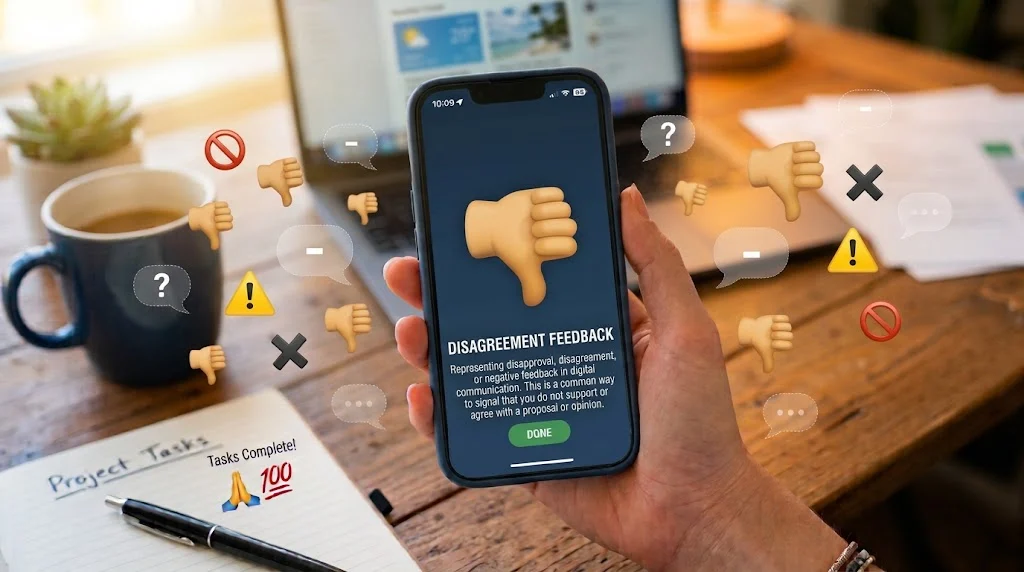
👎 generally means “I don’t like it,” “I disagree,” or “No.” It can be a simple, practical response or feel dismissive and rude when used in a sensitive conversation.
The thumbs down emoji 👎 usually means disapproval, disagreement, dislike, or a negative reaction. People use it in text messages and online conversations to show that they do not like an idea, disagree with a suggestion, or think something is wrong. Depending on the situation, it can also mean “no,” “not good,” or “I don’t approve.”
For example, if a friend suggests a restaurant and you reply with 👎, they will probably understand that you are not interested. If someone shares personal news and receives only a thumbs down, however, the reaction may feel harsh. The meaning depends on the message, your relationship with the sender, and the tone of the conversation.
The key is to distinguish between the emoji’s basic meaning and the intention behind it. A negative reaction does not always mean personal rejection, anger, or hostility.
What Does 👎 Mean in Different Conversations?
The same reaction can feel different depending on what it responds to.
| Conversation | Example | Likely Meaning |
|---|---|---|
| Making plans | “Want to go bowling?” — 👎 | No, or not interested |
| Giving an opinion | “This movie was great.” — 👎 | Disagreement or dislike |
| Reviewing work | “Here’s my first draft.” — 👎 | Negative feedback |
| Joking with friends | “I put ketchup on everything 👎” | Playful disapproval |
| Serious discussion | “I worked hard on this.” — 👎 | May feel dismissive or hurtful |
| Voting on an idea | “Should we cancel the event?” — 👎 | Vote against the proposal |
These are possible interpretations, not fixed rules. A thumbs down attached to a poll is often a straightforward vote, while the same emoji sent in a personal conversation may feel more critical.
Is the Thumbs Down Emoji Rude?
The 👎 emoji can be blunt, but it is not always rude. It is often appropriate when a quick negative response is expected, such as choosing between options or rating something.
It may feel harsh when:
- Someone shares personal news and receives only 👎.
- You disagree with someone’s idea without explaining why.
- You use it to dismiss an apology or a serious concern.
- The recipient expects a thoughtful response rather than a simple reaction.
A useful rule: If you are rejecting an idea, explain the reason when it matters. “I don’t think that plan will work because we’re short on time” is clearer and more constructive than sending only 👎.
👎 vs. 👍 and Other Reaction Emojis
The thumbs down emoji belongs to a group of hand gestures and reaction symbols that communicate approval, rejection, or disagreement.
| Emoji | Official Name | Common Meaning | Tone | Where or When It Is Used |
|---|---|---|---|---|
| 👎 | Thumbs Down | Disapproval or dislike | Negative, direct | Rejecting a suggestion or rating something |
| 👍 | Thumbs Up | Approval, agreement, or acknowledgment | Positive, concise | Confirming plans or showing approval |
| 🤷 | Person Shrugging | Uncertainty or indifference | Casual, uncertain | When someone does not know or mind |
| 🙅 | Person Gesturing No | Refusal or prohibition | Firm, clear | Setting a boundary or saying no |
| ❌ | Cross Mark | Incorrect, rejected, or not allowed | Strong, decisive | Marking an answer wrong or an option invalid |
| 💔 | Broken Heart | Heartbreak or emotional hurt | Sad, emotional | Expressing disappointment or relationship pain |
| 😒 | Unamused Face | Displeasure or annoyance | Irritated, unimpressed | Reacting to something frustrating |
| 🖕 | Middle Finger | Insult or strong contempt | Hostile, offensive | Expressing anger or giving an insult |
Which Emoji Should You Use?
- Choose 👎 to show that you dislike or disagree with something.
- Choose 🙅 when you want to communicate a refusal more clearly.
- Choose ❌ when something is incorrect, invalid, or not permitted.
- Choose 😒 when your reaction is more about annoyance than simple disagreement.
- Avoid 🖕 unless you understand that it can be read as a direct insult.
The biggest distinction is that 👎 usually evaluates an idea, choice, or situation. It does not automatically mean that you dislike the person who shared it.
How to Reply When Someone Sends 👎
Your response should depend on what the person is rejecting.
💬
If they disagree with your idea
“No worries. What would you suggest instead?”
Invites a useful alternative instead of starting an argument.
😂
If they are joking
“Okay, message received 😂”
Keeps a casual exchange friendly.
🤔
If you don’t understand their reaction
“Is there something you don’t like about it?”
Clarifies their concern without assuming hostility.
If the reaction feels hurtful, you can ask what they meant rather than immediately assuming it was meant personally.
Copy and Paste the Thumbs Down Emoji
👎
Thumbs Down Copy 👎
You can use it in messages such as:
Not a fan of that idea 👎Sorry, that doesn't work for me 👎That was not a good decision 👎Pizza with pineapple? 👎😂
The wording helps show the reaction is serious, practical, or playful.
Official Name and Unicode Details
The emoji 👎 represents a hand with its thumb pointing downward.
- Emoji: 👎
- Common official emoji name: Thumbs Down
- Unicode character name: Thumbs Down Sign
- Unicode code point: U+1F44E
- Unicode version: Unicode 6.0
- Year approved in Unicode: 2010
The Unicode Consortium lists the character as “thumbs down,” while Emojipedia provides further details about its history and appearance. The gesture was also present in early Japanese emoji sets before its inclusion in Unicode. Unicode+2
Does 👎 Look the Same on Every Device?
Not exactly. Apple, Google, Samsung, and other vendors can render the hand with slightly different shapes, colors, or orientations. Microsoft has notably displayed the hand from the opposite side in some designs. These are visual differences; the intended basic gesture remains a thumbs down. Meaning, Copy And Paste
FAQs
Does 👎 mean no?
Yes, it can mean “no,” particularly when someone asks you to choose between options or approve a suggestion. In other situations, it may mean dislike or disagreement rather than a direct refusal.
Does a thumbs down mean someone hates you?
No. The emoji usually evaluates something being discussed, such as an idea, decision, or piece of content. It does not prove that the sender dislikes you personally.
Is 👎 passive-aggressive?
It can come across that way when someone uses it instead of explaining their disagreement, especially during a serious discussion. In a poll or casual choice, it may be a perfectly ordinary response.
What is the difference between 👎 and 🙅?
👎 usually expresses disapproval or dislike. 🙅 depicts a person making a no gesture and more directly communicates refusal or prohibition. The best choice depends on you are rejecting something or expressing a negative opinion.
Can I use 👎 at work?
Yes, when quick reactions are normal in your workplace, such as voting on an informal proposal. For important feedback, performance discussions, or sensitive topics, a short written explanation is usually more helpful.
Conclusion
The 👎 thumbs down emoji is a direct way to express disapproval, dislike, or disagreement. It can be a simple vote or a playful reaction, but it may feel dismissive when used in a sensitive conversation. Consider the context and add a few words whenever your reason for disagreeing matters.
Discover More Related Articles:
- Pray Emoji Mean | Prayer, Gratitude & More In 2026
- Purple Heart Emoji | What It Says About Love, Loyalty & Friendship In 2026
- Celebrate Emoji | The Perfect Way to Share Excitement & Joy In 2026

Jessica Miller is a content writer at EmojisPeace.com, where she creates fun and easy-to-follow guides about emojis, their meanings and creative ways to use them. She loves helping readers express themselves with the perfect emoji for every moment.