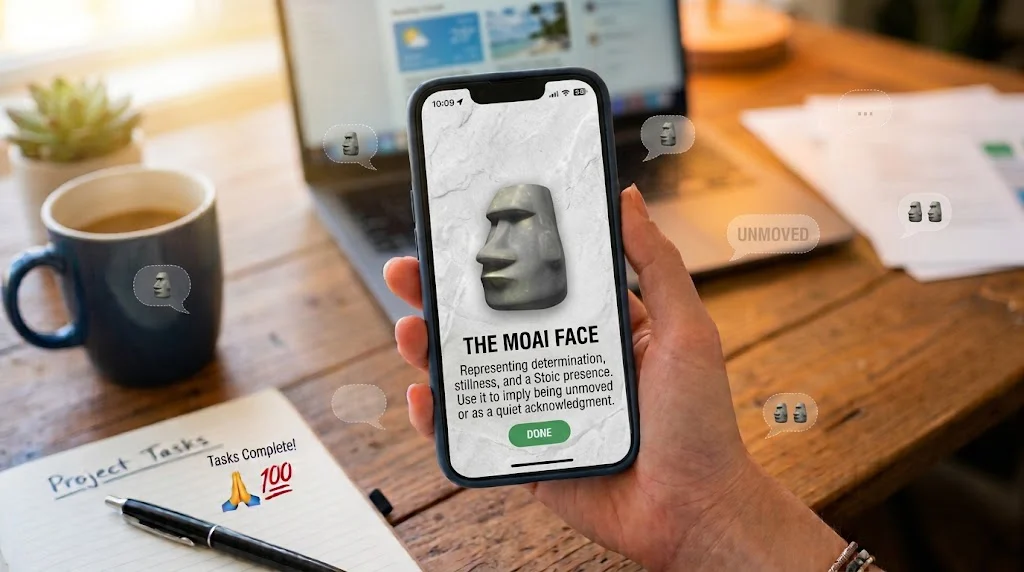
🗿 literally represents a stone statue, but in texting it often conveys a stoic, unbothered, or expressionless attitude. In memes, it can also signal ironic confidence, exaggerated toughness, or a deliberately awkward reaction.
The moai emoji 🗿 represents a large stone head inspired by the famous statues of Rapa Nui, also known as Easter Island. In texts and online conversations, it can suggest a serious, emotionless expression, silent judgment, stubbornness, or deadpan humor. It also appears in memes where the stone face adds an intentionally dramatic or absurd reaction.
The meaning depends on context. A travel post may use it to refer to the historic statues, while a meme may use the same symbol to communicate “I have no reaction,” “I’m staying unbothered,” or “that was awkward.” Its official Unicode name is Moyai, even though most English-speaking users commonly call it the moai emoji. Meaning, Copy And Paste+1
What Does 🗿 Mean in Texting?
The moai emoji can communicate different ideas depending on the conversation. Its most recognizable informal uses come from the statue’s unchanging, emotionless face.
1. A Straight-Faced or Unbothered Reaction
People may use 🗿 to show that they are keeping a straight face, refusing to react, or acting as if nothing bothers them.
Example: “Everyone panicked, but I just sat there 🗿”
Likely meaning: “I’m staying calm and showing no reaction.”
This use is often playful. It does not necessarily mean the sender is genuinely cold or emotionally detached.
2. Deadpan Humor and Awkward Silence
The statue’s expressionless face makes it a useful reaction to an awkward joke, an unexpected confession, or a conversation that leaves someone speechless.
Example: “My teacher asked who forgot the homework, and everyone looked at me 🗿”
Likely meaning: “I have nothing to say.”
It can also create humor by making an ordinary situation seem unusually serious.
3. Meme Culture and Exaggerated Confidence
In memes, 🗿 can represent an exaggeratedly stoic, tough, or self-confident character. It may accompany jokes about discipline, acting fearless, or refusing to show emotion.
Example: “Me after saying ‘you too’ when the waiter tells me to enjoy my meal 🗿”
Likely meaning: The sender is joking about an awkward moment while pretending to remain completely composed.
The emoji can also appear in so-called “sigma” or “Chad” memes that exaggerate confidence, independence, or an unbothered attitude. This is an informal internet interpretation, not its official Unicode meaning. Meaning, Copy And Paste+1
4. Silent Judgment or Disbelief
Sometimes the moai emoji acts like a wordless stare. It can suggest that something is strange, questionable, or too ridiculous to deserve a response.
Example: “He said he could finish a 20-hour project in one hour 🗿”
Likely meaning: “I’m not even going to argue with that.”
Depending on the relationship, this may come across as funny, sarcastic, or dismissive.
5. Strength, Stoicism, or Persistence
Because the statue looks solid and unchanging, people may use 🗿 as a symbol of staying firm or not giving up.
Example: “Four hours of studying. No distractions. 🗿”
Likely meaning: “I’m staying focused and committed.”
This interpretation comes from the visual symbolism of stone and the statue’s expression. It is a contextual use, not a fixed meaning.
What Does 🗿 Mean on Social Media and in Memes?
In social posts and comment threads, the moai emoji often works as a reaction rather than a literal reference to a statue.
| Context | Example | Likely Meaning |
|---|---|---|
| Awkward moment | “I called the boss by the wrong name 🗿” | Embarrassment hidden behind a straight face |
| Absurd statement | “He thinks he’s the smartest person alive 🗿” | Sarcasm or silent judgment |
| Confidence meme | “Never skip leg day 🗿” | Exaggerated toughness or discipline |
| Unexpected news | “They canceled the trip after we arrived 🗿” | Speechlessness or disbelief |
| Travel content | “Visiting Rapa Nui someday 🗿” | Interest in the famous stone statues |
| Dry humor | “I definitely did not eat the last slice 🗿” | Pretending to remain innocent or emotionless |
These examples are illustrative. The emoji does not have a separate, guaranteed meaning on every social platform.
Is the Moai Emoji Positive, Negative, or Sarcastic?
It can be any of these, depending on how it is used.
- Positive: Celebrating discipline, confidence, or staying calm under pressure.
- Neutral: Referring to the statues, a destination, or a stone sculpture.
- Sarcastic: Reacting to an unbelievable claim or questionable decision.
- Negative: Making someone feel judged, mocked, or dismissed.
- Playful: Turning an awkward situation into a joke with a completely straight face.
A single 🗿 after a message may feel funny among friends but rude in a serious disagreement. If the conversation is sensitive, the surrounding words are more informative than the emoji alone.
Moai Emoji vs. Similar Emojis
The following emojis share a connection through stone, statues, landmarks, or an expressionless reaction. Their meanings are not interchangeable.
| Emoji | Official Name | Common Meaning | Tone | Where or When It Is Used |
|---|---|---|---|---|
| 🗿 | Moyai | Stone statue, stoicism, deadpan humor | Stoic, ironic | Memes, reactions, travel references |
| 🪨 | Rock | A stone, toughness, or something solid | Literal, playful | Nature, geology, or jokes about being solid |
| 😐 | Neutral Face | A neutral or unimpressed reaction | Flat, restrained | Ordinary conversations and awkward moments |
| 😑 | Expressionless Face | Frustration, silence, or a lack of reaction | Dry, annoyed | Responding to repetitive or irritating situations |
| 🗽 | Statue of Liberty | Liberty, New York City, or the United States | Symbolic, patriotic | Travel posts and national references |
| 🗼 | Tokyo Tower | Tokyo landmark or travel | Informational, celebratory | Japan-related travel posts |
| 🗻 | Mount Fuji | Mount Fuji, nature, or travel in Japan | Scenic, neutral | Landscapes and travel content |
| 🪦 | Headstone | Graves, remembrance, or death-related humor | Somber, dark | Memorials or context-dependent jokes |
🗿 vs. 😐: Stone Face or Neutral Reaction?
The neutral face 😐 directly depicts a human facial expression with little visible emotion. The moai emoji depicts a stone sculpture and often carries an added sense of meme humor or exaggerated stoicism.
Choose 😐 for a straightforward neutral reaction. Choose 🗿 when the stone-statue appearance adds to the joke or the intended symbolism.
🗿 vs. 😑: Unbothered or Annoyed?
The expressionless face 😑 can communicate irritation, impatience, or a fed-up reaction. The moai emoji is often more deliberately stone-faced or absurd.
For example, “Another meeting that could have been an email 😑” suggests frustration, while “Me listening to the same excuse for the fifth time 🗿” can make the lack of reaction part of the joke.
🗿 vs. 🪨: Statue or Stone?
The rock emoji 🪨 represents a rock or stone. The moai emoji represents a sculpted head.
Use 🪨 for literal rocks, geology, or stone-related jokes. Use 🗿 when referring to the statue itself or when its recognizable face is part of a meme.
How to Respond When Someone Sends 🗿
The best response depends on what prompted the emoji.
😂
If they are joking
“Bro has absolutely no reaction 😂”
Keeps the exchange playful.
💪
If they are sharing a confidence meme
“Unshakable mindset 💪”
Matches the exaggerated confidence or discipline theme.
🤔
If their meaning is unclear
“Wait, what does that mean here? 🤔”
Asks for clarification without assuming their intent.
You can also reply with 🗿 if you want to match the deadpan humor. If the sender seems upset or the conversation is serious, a clear written response is usually more helpful.
Copy and Paste the Moai Emoji
🗿
Moai / Moyai Copy 🗿
Here are a few combinations you can use in messages or captions:
No reaction 🗿Stay focused 🗿💪Bro really said that 🗿Me pretending I didn't hear that 🗿Stone-cold expression 🗿😐
Official Name and Unicode Details
The emoji’s formal Unicode character name is MOYAI, while “moai” is the familiar English term for the monumental stone figures associated with Rapa Nui.
- Emoji: 🗿
- Unicode character name: MOYAI
- Unicode code point: U+1F5FF
- Unicode version: Unicode 6.0
- Year introduced: 2010
- Emoji version: Emoji 1.0 (2015)
The name “Moyai” also has a connection to a stone statue near Shibuya Station in Tokyo. Early Japanese emoji sets and historical designs help explain why the official character name differs from the name most English-speaking users recognize. Meaning, Copy And Paste+2
The emoji’s artwork can vary across Apple, Google, Samsung, and other platforms. Some versions emphasize the statue’s facial features more than others, but the encoded character remains the same.
FAQs
Does 🗿 mean sigma?
It can. In some internet memes, the moai emoji represents an exaggeratedly confident, stoic, or independent character associated with “sigma” humor. However, the emoji itself does not officially mean sigma.
Why do people use 🗿 after a joke?
Its emotionless stone face can make a joke funnier by creating a deadpan reaction. It may imply that the speaker has no words, refuses to react, or is pretending to take a ridiculous situation seriously.
Does 🗿 mean someone is ignoring you?
Not necessarily. It may represent silence, disbelief, or a joking lack of reaction. One emoji is not enough to conclude that someone is deliberately ignoring you.
Is 🗿 rude to send someone?
It can feel dismissive if sent after a serious confession, apology, or personal concern. In casual conversations and memes, it is often playful. Consider the subject and your relationship with the sender before interpreting its tone.
Is the moai emoji the same as an Easter Island statue?
It represents a moai-like stone head and is commonly associated with the monumental statues of Rapa Nui, also known as Easter Island. Its official Unicode name is “Moyai,” which also reflects a historical connection to a Japanese statue in Tokyo.
Conclusion
The 🗿 emoji combines a recognizable stone statue with a range of informal meanings, from deadpan humor and silent judgment to exaggerated confidence. In a travel post, it may refer to the actual statues; in a meme, it may communicate an unbothered or intentionally emotionless reaction. The surrounding message determines which meaning fits best.
Discover More Related Articles:
- Pray Emoji Mean | Prayer, Gratitude & More In 2026
- Purple Heart Emoji | What It Says About Love, Loyalty & Friendship In 2026
- Celebrate Emoji | The Perfect Way to Share Excitement & Joy In 2026

Matthew Garcia is a content writer at EmojisPeace.com, where she creates fun, expressive and easy-to-use emoji collections for every mood and moment. Passionate about digital expression, she helps readers find the perfect emojis to make every message more creative and memorable.