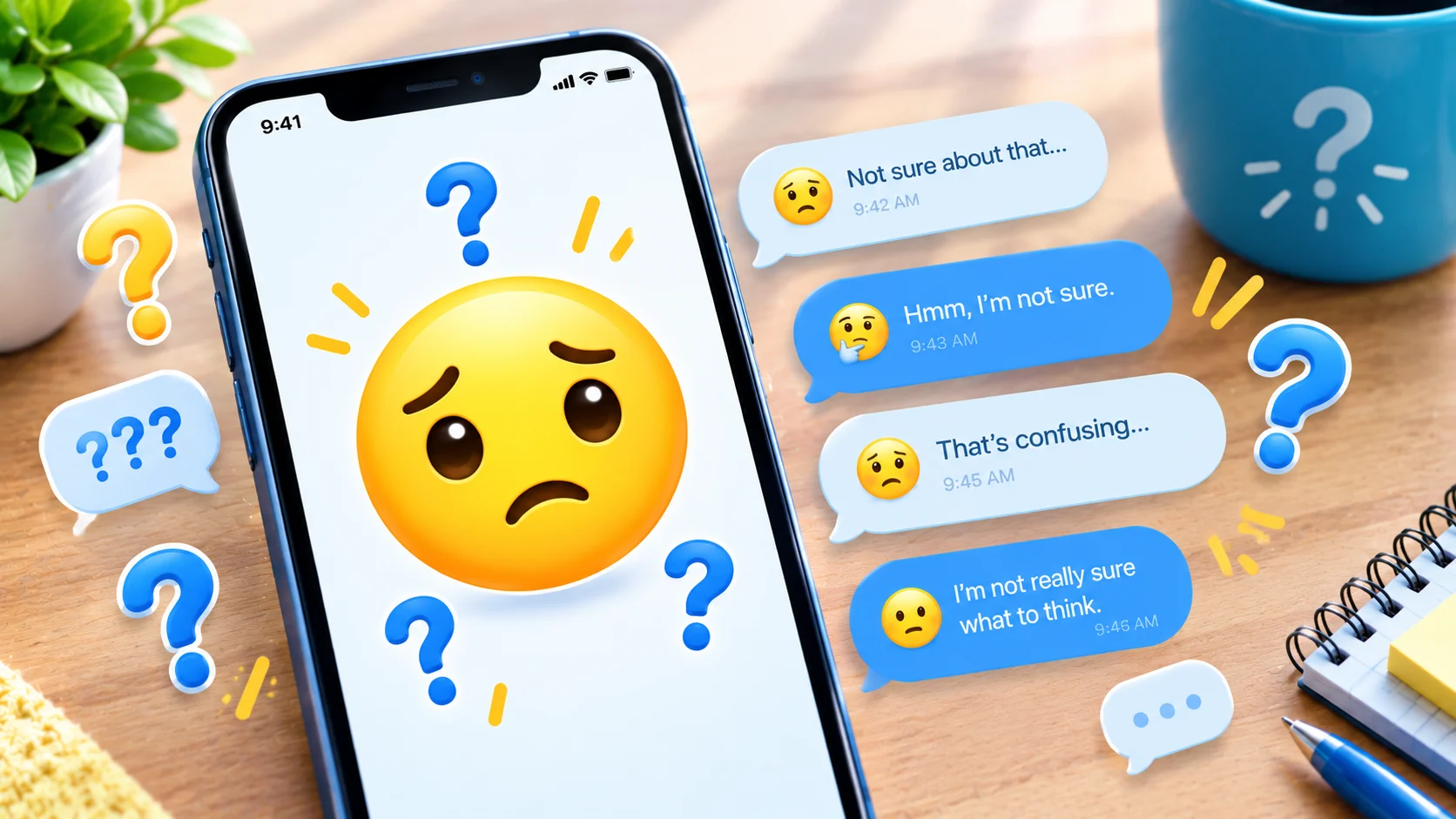
😕 usually means “I’m confused,” “I’m not sure,” or “That doesn’t feel right.” It can express uncertainty, mild sadness, or disappointment, depending on the situation.
The confused emoji 😕, officially called Confused Face, usually expresses uncertainty, puzzlement, hesitation, or mild disappointment. People use it when something does not make sense, they are unsure how to respond, or a situation leaves them feeling slightly uncomfortable. Depending on the conversation, it can also suggest sadness, frustration, or doubt.
For example, “Wait, I thought the meeting was tomorrow 😕” shows confusion about a plan. In another message, “You canceled again? 😕” may express disappointment rather than a lack of understanding. The words surrounding the emoji help determine its tone.
Although it looks like a frown, this emoji is not always a sign of sadness. It often communicates a mixture of uncertainty and concern, making it useful when someone wants to react without sounding too harsh.
What Does 😕 Mean in Text Messages?
The confused face is useful when a message leaves you uncertain, disappointed, or unsure what to think. Its expression is less intense than an angry face and often leaves room for clarification.
Here are four common ways people use it.
1. Confusion or Uncertainty
The sender does not understand something or needs more information.
Example: “You said we’re meeting at 7, but the invitation says 8 😕”
Likely meaning: “I’m not sure which information is correct.”
2. Disappointment
Sometimes 😕 means that something did not turn out as expected.
Example: “I was really looking forward to seeing you today 😕”
Likely meaning: “I’m disappointed that our plans changed.”
Here, the emoji communicates an emotional reaction rather than a question.
3. Concern or Mild Frustration
The sender may feel that something is wrong, inconvenient, or difficult to understand.
Example: “They changed the schedule again without telling us 😕”
Likely meaning: “This is frustrating, and I’m not sure what to make of it.”
4. Hesitation or Doubt
The emoji can suggest that someone is not fully convinced or feels uncertain about a decision.
Example: “I’m not sure that’s the best idea 😕”
Likely meaning: “I have some doubts about this.”
The difference between these meanings comes from the message itself. A question about a schedule points toward confusion, while a canceled plan may make the same emoji feel disappointed.
What Does 😕 Mean When Someone Sends It to You?
When someone sends you 😕, they may be confused by something you said, disappointed about a situation, or unsure how to react.
Check the context before assuming they are upset with you.
- After an unclear message: They may need you to explain what you mean.
- After a canceled plan: They may feel disappointed.
- After unexpected news: They may be processing the information.
- After a disagreement: They may have doubts or feel uncomfortable.
- After a joke: They may be confused about you are serious.
For example, if someone replies “Wait, what? 😕” to your message, a simple explanation may be all they need.
If you cannot tell what they mean, ask, “Which part is confusing?” or “Is something wrong?” These questions give them a chance to explain instead of turning a small misunderstanding into a bigger one.
Is the Confused Emoji Sad or Angry?
The 😕 emoji can suggest mild sadness or frustration, but it does not directly mean anger. Its expression generally looks uncertain or slightly unhappy.
- Confused: “I don’t understand what happened 😕”
- Sad or disappointed: “I thought you were coming 😕”
- Frustrated: “They changed the instructions again 😕”
- Doubtful: “Are you sure that’s right? 😕”
If the sender wants to express strong anger, an angry face such as 😠 may be more direct. If they want to show clear sadness, 😢 may communicate that feeling more clearly.
Confused Emoji vs. Similar Emojis
The following comparison table is placed here to help readers choose the most suitable expression for different situations.
| Emoji | Official Name | Common Meaning | Tone | Where or When It Is Used |
|---|---|---|---|---|
| 😕 | Confused Face | Uncertainty, confusion, mild disappointment | Puzzled, hesitant | Unclear messages or unexpected changes |
| 🤔 | Thinking Face | Thinking, considering, questioning | Reflective, curious | Weighing options or considering an idea |
| 😵💫 | Face with Spiral Eyes | Dizziness, mental overload, disorientation | Overwhelmed, dramatic | Too much information or a chaotic situation |
| 😟 | Worried Face | Concern, anxiety, unease | Concerned, nervous | Uncertain outcomes or worrying news |
| 🙁 | Slightly Frowning Face | Mild sadness or displeasure | Unhappy, subdued | Disappointing news or an unpleasant situation |
| 😬 | Grimacing Face | Awkwardness, tension, discomfort | Nervous, uneasy | Embarrassing moments or uncomfortable reactions |
| 🤨 | Face with Raised Eyebrow | Skepticism, suspicion, disbelief | Questioning, doubtful | Reacting to questionable claims |
| 🫤 | Face with Diagonal Mouth | Mixed feelings, uncertainty, dissatisfaction | Unsure, unimpressed | Expressing hesitation or a lukewarm reaction |
😕 vs. 🤔: Confused or Thinking?
The main difference is the sender feels unsure or is actively considering something.
- 😕 suggests, “I don’t understand” or “I’m not sure what to think.”
- 🤔 suggests, “Let me think about this.”
Use 😕 when something is unclear. Use 🤔 when you are weighing a decision or thinking through an idea.
😕 vs. 😵💫: Confused or Overwhelmed?
The confused face usually communicates uncertainty about something specific. The spiral-eyed face 😵💫 suggests a stronger feeling of disorientation, dizziness, or mental overload.
For example, “I don’t understand this question 😕” communicates confusion. “Three exams, two deadlines, and four hours of sleep 😵💫” conveys feeling overwhelmed.
😕 vs. 🙁: Confused or Unhappy?
The slightly frowning face 🙁 focuses more directly on unhappiness or disappointment. The confused face 😕 combines a frown with an uncertain expression.
If you are disappointed about canceled plans, 🙁 may fit. If you are unsure why the plans were canceled, 😕 may be more appropriate.
😕 vs. 🫤: Uncertain or Unimpressed?
Both can express mixed feelings. However, 🫤 often gives a more hesitant, dissatisfied, or “not sure about that” reaction. 😕 is a more straightforward choice when you want to convey confusion or uncertainty.
Examples of 😕 in Everyday Conversations
These hypothetical examples show how the same emoji can take on different meanings.
| Message | Likely Meaning | Why It Fits |
|---|---|---|
| “I thought the deadline was Friday 😕” | Confusion | The sender is unsure about the correct date. |
| “You left without saying goodbye 😕” | Disappointment | The message describes an unwanted outcome. |
| “They said the order was delivered, but it’s not here 😕” | Concern or uncertainty | The sender does not understand what happened. |
| “I don’t know if I should accept the offer 😕” | Hesitation | The sender is unsure about a decision. |
| “Wait, are we meeting at my place or yours? 😕” | A request for clarification | The emoji softens a direct question. |
These examples are not fixed definitions. The same message may sound more serious or more casual depending on the people involved and their usual communication style.
How to Respond to 😕
The best reply addresses what the other person seems to be communicating.
💬
If they seem confused
“Sorry, I should have explained that better.”
Clarify your message without making them feel bad for asking.
🫶
If they seem disappointed
“I’m sorry. I know you were looking forward to it.”
Acknowledge their feelings instead of dismissing them.
🤔
If they are unsure about something
“Let’s figure it out together.”
Works well when they need help making sense of a situation.
You do not always need to send another emoji. A clear, thoughtful response can communicate your meaning more effectively.
Copy and Paste the Confused Emoji
😕
Confused Face Copy 😕
Here are a few natural ways to use it:
Wait, what do you mean? 😕I'm not sure about that 😕I thought we agreed on something else 😕Why did the plans change? 😕I'm a little confused right now 😕
Official Name and Unicode Details
The official Unicode name of 😕 is Confused Face. It shows a yellow face with a slanted frown and an expression that can look uncertain or puzzled.
- Emoji: 😕
- Official name: Confused Face
- Unicode code point: U+1F615
- Unicode version: Unicode 6.1
- Year approved: 2012
- Added to Emoji 1.0: 2015
The Unicode Consortium standardizes the emoji character and its name. The informal meanings people attach to it depend on context rather than a single official emotional definition. Emojipedia describes its common interpretations as confusion, hesitation, mild sadness, disappointment, and frustration.
Does 😕 Look Different on Different Devices?
Yes. Apple, Google, Samsung, and other vendors can draw the same emoji with small differences in its eyes, mouth, and facial details. Those variations may slightly change how the expression feels, but the underlying emoji character remains the same.
FAQs
Does 😕 mean “I don’t know”?
It can. When someone uses it after a question or an uncertain statement, it may mean they do not understand, do not know the answer, or are unsure what to think.
Is 😕 a negative emoji?
It generally has a somewhat uncertain or unhappy tone, but it is not necessarily strongly negative. It can be a gentle way to express confusion or ask for clarification without sounding angry.
What does 😕 mean from a friend?
A friend may be confused by your message, disappointed about plans, or unsure how to respond. The topic and the rest of the conversation usually provide the best clues.
Can 😕 be used sarcastically?
Yes, although sarcasm is not its clearest or most direct meaning. It may be used sarcastically when the surrounding words make the sender’s real attitude obvious. 🤨 or 🙃 may communicate skepticism or irony more clearly in some situations.
What’s the difference between 😕 and 😔?
😕 usually suggests uncertainty, confusion, or mild disappointment. 😔, officially called Pensive Face, more strongly conveys sadness, regret, or quiet disappointment.
Conclusion
The 😕 confused face emoji is a useful way to express uncertainty, hesitation, mild disappointment, or concern. It can soften a question or show that something does not make sense without sounding openly angry. Read the surrounding message before deciding what the sender means, and ask for clarification if their intention is unclear.
Discover More Related Articles:
- Sad Emoji Meanings | Find the Right Face for Every Feeling In 2026
- Heart Emoji Meaning | What Different Hearts Really Say In 2026
- Hello Emoji Meaning | What the Waving Hand Really Says In 2026

Jessica Miller is a content writer at EmojisPeace.com, where she creates fun and easy-to-follow guides about emojis, their meanings and creative ways to use them. She loves helping readers express themselves with the perfect emoji for every moment.