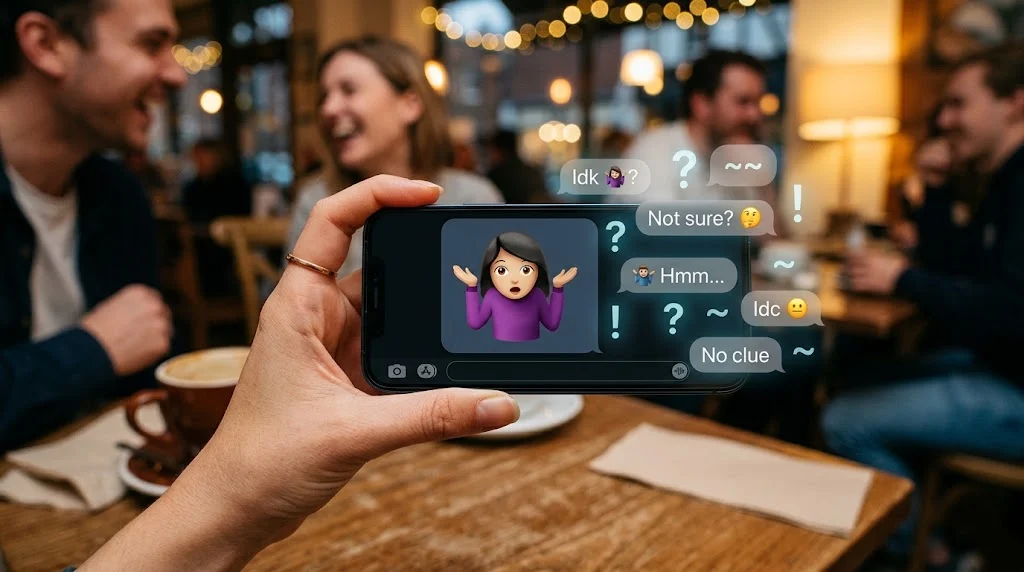
🤷 usually means “I don’t know,” “Who knows?” or “It is what it is.” It can sound neutral, casual, dismissive, or sarcastic depending on the words and situation.
The shrug emoji 🤷, officially called Person Shrugging, usually means “I don’t know,” “I’m not sure,” or “What can I do?” It shows a person raising their shoulders and hands, a gesture people often use to express uncertainty, confusion, or indifference. Depending on the conversation, it can also communicate acceptance, mild frustration, or playful sarcasm.
For example, if a friend asks, “Why did the store close early?” replying “No idea 🤷” means you do not know the answer. If someone says, “Well, that’s life 🤷,” the emoji may suggest that the situation is out of their control.
The shrug emoji is a quick way to show that you lack an answer, do not have control over an outcome, or are unsure what to make of something. Its tone matters: a casual shrug between friends may feel harmless, while the same emoji during a serious discussion can seem uncaring.
The Main Meanings of 🤷 in Everyday Conversations
The shrug emoji is useful because a physical gesture can communicate several different attitudes. Here is how to tell them apart.
“I Don’t Know”
This is one of the most direct uses of 🤷. The sender does not know the answer or does not have enough information to explain something.
Example: “Who changed the schedule? 🤷”
Likely meaning: “I have no idea who did it.”
“It Is What It Is”
Sometimes the emoji communicates acceptance of a situation that cannot easily be changed.
Example: “The concert sold out before I could get tickets 🤷”
Likely meaning: “That’s disappointing, but there’s not much I can do.”
This can sound relaxed and accepting, although it may also suggest resignation.
“I Don’t Really Care”
The shrug can suggest indifference when the sender has no strong preference or does not feel invested in the outcome.
Example: “Which movie should we watch?”
“Either one works for me 🤷”
Likely meaning: “I don’t have a preference.”
However, if someone uses it while discussing an important concern, it may come across as dismissive.
“Whatever” or Mild Sarcasm
In some conversations, 🤷 expresses frustration or a sarcastic attitude rather than genuine uncertainty.
Example: “He canceled our plans for the third time. What can you do? 🤷”
Likely meaning: “I’m frustrated, but I’m not going to argue about it.”
The emoji softens the statement in some contexts, but it does not automatically make a negative message friendly.
Is the Shrug Emoji Rude?
The shrug emoji is not inherently rude. Its tone depends on what the sender is responding to and how the message is worded.
- Friendly: “I’m good with either restaurant 🤷” communicates flexibility.
- Neutral: “I don’t know 🤷” admits that the sender lacks an answer.
- Sarcastic: “Well, that went exactly as expected 🤷” may suggest frustration or dry humor.
- Dismissive: “That’s your problem 🤷” can sound uncaring because the words reject responsibility.
If someone shares something serious and you respond with only 🤷, they may feel that you are not taking them seriously. A short sentence explaining your feelings or limits can make your intention clearer.
Related Emojis: Which Reaction Fits Best?
| Emoji | Official Name | Common Meaning | Tone | Where or When It Is Used |
|---|---|---|---|---|
| 🤷 | Person Shrugging | Uncertainty, indifference, acceptance | Casual, neutral | When you do not know or have no preference |
| 🤔 | Thinking Face | Considering, questioning, uncertainty | Thoughtful | When weighing options or seeking an answer |
| 🤦 | Person Facepalming | Frustration, disbelief, embarrassment | Exasperated | When a mistake or poor decision seems obvious |
| 😐 | Neutral Face | Little visible emotion or reaction | Flat, restrained | When responding without showing a strong opinion |
| 😶 | Face Without Mouth | Speechlessness, silence, lack of words | Quiet, awkward | When you do not know what to say |
| 😕 | Confused Face | Confusion, uncertainty, puzzlement | Hesitant | When something does not make sense |
| 🙄 | Face with Rolling Eyes | Annoyance, exasperation, disbelief | Sarcastic, dismissive | When reacting to something frustrating |
| 🤷♀️ | Woman Shrugging | The same basic shrug gesture | Casual, context-dependent | When choosing a female-presenting version |
| 🤷♂️ | Man Shrugging | The same basic shrug gesture | Casual, context-dependent | When choosing a male-presenting version |
🤷 vs. 🤔: Not Knowing or Thinking?
Use 🤷 when you do not know the answer or do not have a strong opinion. Use 🤔 when you are actively thinking about a question or trying to work something out.
For example:
- “I have no idea where he went 🤷” communicates a lack of knowledge.
- “I wonder why he left early 🤔” shows curiosity and thought.
🤷 vs. 🤦: Indifference or Frustration?
The facepalm emoji 🤦 usually conveys exasperation, embarrassment, or disbelief about something that happened. The shrug is more about uncertainty, acceptance, or not having an answer.
If you want to say “I can’t explain this,” 🤷 may fit. If you want to say “I can’t believe this happened,” 🤦 may be a better choice.
🤷 vs. 🙄: Acceptance or Annoyance?
The rolling-eyes emoji 🙄 more clearly signals irritation or exasperation. The shrug can be neutral or accepting, although it can also sound sarcastic.
Choose 🤷 when you genuinely do not know or do not mind. Choose 🙄 when your main reaction is annoyance.
The gendered versions, 🤷♀️ and 🤷♂️, do not have separate standard emotional meanings. They represent variations of the same shrugging gesture.
What Does 🤷 Mean When Someone Sends It to You?
If someone sends you the shrug emoji, they may be unsure, indifferent, accepting of the situation, or unwilling to argue. The surrounding conversation helps you work out which meaning is most likely.
Consider these examples:
- You ask a factual question: They may simply not know.
- You ask them to choose: They may be saying that either option is fine.
- You complain about a frustrating event: They may be accepting it or responding sarcastically.
- You ask why they did something: They may not know how to explain it, or they may be avoiding a direct answer.
The emoji alone cannot tell you someone is upset, uninterested, or trying to end a conversation. If the issue matters, ask a clear follow-up question rather than relying on the symbol alone.
How to Respond to 🤷
Choose a response that matches the conversation.
🤔
If they don’t know the answer
“No worries, I’ll check.”
Keeps the conversation moving without pressuring them.
😄
If they have no preference
“Cool, I’ll pick one!”
Makes it easy to move forward.
😅
If they are being sarcastic
“Yeah, that didn’t go as planned 😅”
Acknowledges the situation without making it more tense.
💬
If you cannot tell what they mean
“Do you mean you don’t know, or you don’t mind either way?”
Clarifies the message without assuming a negative attitude.
Shrug Emoji Copy and Paste
🤷
Person Shrugging Copy 🤷
Other versions
🤷♀️
Copy woman shrugging
🤷♂️
Copy man shrugging
You can also use the classic text-based shrug:
¯_(ツ)_/¯Copy text shrug
The text version is often called a shruggie. It creates the appearance of a shrug using keyboard characters rather than a standard emoji character.
Official Name and Unicode Details
The shrug emoji has a standardized identity, even though its conversational meaning can change with context.
- Emoji: 🤷
- Official Unicode name: Person Shrugging
- Unicode code point: U+1F937
- Approved in: Unicode 9.0
- Year introduced: 2016
The character was originally named “Shrug” when approved in 2016. Its current official name is Person Shrugging. Gender-specific versions, including 🤷♀️ and 🤷♂️, are separate emoji sequences.
The Unicode Consortium standardizes emoji characters and names. Emojipedia describes the shrugging gesture as a way to convey a lack of knowledge or a lack of concern about an outcome. The precise tone in a message still depends on how the sender uses it.
FAQs
Does 🤷 mean “I don’t care”?
It can, but not always. The emoji may express indifference when someone has no preference or does not feel invested in a result. In other conversations, it simply means “I don’t know” or “I’m not sure.”
Does the shrug emoji mean “whatever”?
Sometimes. It can convey “whatever” when the sender accepts a situation or does not want to argue. Depending on the wording, this may sound relaxed, resigned, or dismissive.
Is 🤷 passive-aggressive?
It can come across that way, especially when used alone in response to a serious concern. However, it is also commonly understood as a casual gesture of uncertainty. Consider the whole message before assuming hostility.
What is the difference between 🤷 and ¯_(ツ)_/¯?
Both represent a shrugging gesture. 🤷 is a standardized emoji, while ¯_(ツ)_/¯ is a text-based emoticon made from keyboard characters. Their meaning is similar, though the text version may feel more playful or old-fashioned depending on the conversation.
Does 🤷 mean someone is ending the conversation?
Not necessarily. It may indicate that the person has no answer or does not have a preference. If they repeatedly give short, noncommittal replies, the broader pattern may tell you more than a single emoji.
Conclusion
The 🤷 shrug emoji is a flexible way to communicate uncertainty, acceptance, or indifference. It can make a conversation feel casual, add a touch of sarcasm, or show that you simply do not know what to say. The clearest interpretation comes from the words around it and the situation in which it appears.
Discover More Related Articles:
- Sad Emoji Meanings | Find the Right Face for Every Feeling In 2026
- Heart Emoji Meaning | What Different Hearts Really Say In 2026
- Hello Emoji Meaning | What the Waving Hand Really Says In 2026

Jessica Miller is a content writer at EmojisPeace.com, where she creates fun and easy-to-follow guides about emojis, their meanings and creative ways to use them. She loves helping readers express themselves with the perfect emoji for every moment.