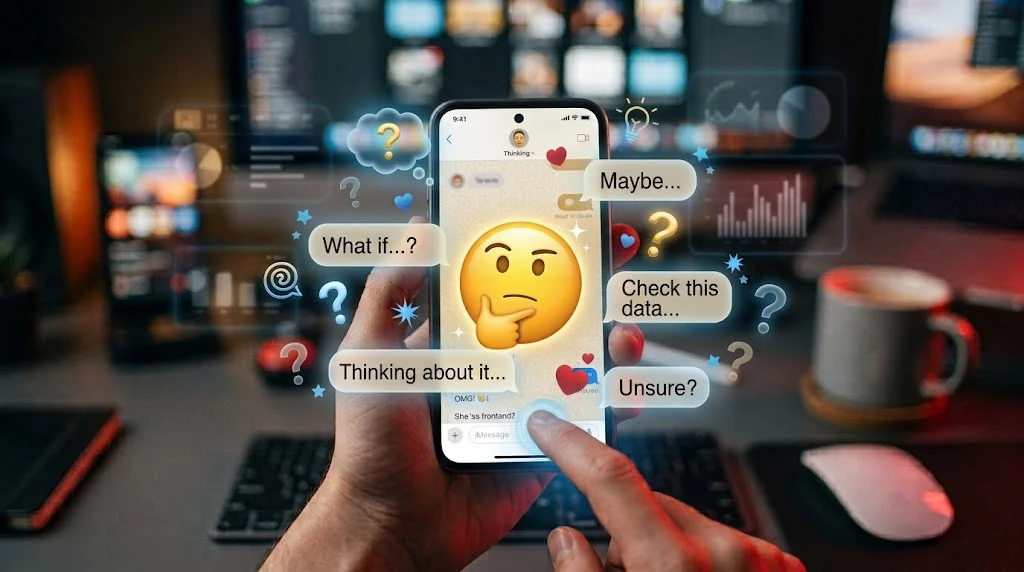
🤔 usually means “Let me think,” “Hmm, interesting,” or “I’m not sure about that.” It can show genuine thought and curiosity, but it may also suggest doubt or sarcasm when someone questions a statement.
The thinking emoji 🤔, officially called Thinking Face, usually means someone is thinking, considering an idea, asking a question, or trying to make sense of something. It shows a yellow face with a hand on its chin and eyes looking upward. In text messages, it can express curiosity, uncertainty, skepticism, or playful suspicion. The exact meaning depends on the words and situation.
For example, “Should we go out tonight? 🤔” suggests someone is considering the idea, while “You finished that whole pizza by yourself? 🤔” may express playful disbelief. The emoji does not automatically mean disagreement or suspicion; the surrounding conversation helps explain its tone.
What Does 🤔 Mean in Text Messages?
People use the thinking face to react when they need to consider something, question a claim, or show that they are not ready to make a decision. Unlike a simple question mark, it adds an emotional tone to the message.
Here are the most common interpretations.
1. Thinking or Considering an Idea
The most direct meaning is that someone is thinking something over. They may be weighing options, planning what to do, or deciding an idea makes sense.
Example: “Should I take the new job or stay where I am? 🤔”
Likely meaning: “I’m weighing my options.”
2. Curiosity or Wanting More Information
The emoji can show interest in a question, an unusual fact, or something the sender wants to understand better.
Example: “Wait, how does that actually work? 🤔”
Likely meaning: “I’m curious and want to know more.”
3. Doubt or Skepticism
When it follows a questionable claim, 🤔 can mean that the sender is not fully convinced.
Example: “He said he can learn an entire language in one week 🤔”
Likely meaning: “I’m not sure I believe that.”
This interpretation becomes more likely when the message contains an exaggerated claim or an explanation that does not seem to add up.
4. Confusion or Uncertainty
Sometimes the emoji means the sender does not understand something or cannot decide what to do next.
Example: “The instructions say to turn it off, but the next step says to turn it on 🤔”
Likely meaning: “I’m confused about what I’m supposed to do.”
5. Sarcasm or Playful Judgment
The thinking face can also make a message sound teasing or sarcastic. It may suggest that the sender is questioning someone’s logic or pretending to investigate a funny situation.
Example: “You said you’d be ready in five minutes, 45 minutes ago 🤔”
Likely meaning: “That doesn’t quite add up.”
A single emoji can sometimes sound more judgmental than intended, especially in a serious conversation. Adding a few words can make the intended tone clearer.
Is 🤔 a Positive, Negative, or Neutral Emoji?
The thinking emoji is flexible. Its tone depends on what the person is thinking about and how they phrase the message.
| Tone | Example | What It May Communicate |
|---|---|---|
| Positive | “That’s actually a great idea 🤔” | Interest or thoughtful consideration |
| Neutral | “Let me check the details 🤔” | Careful thought |
| Uncertain | “I’m not sure which one to choose 🤔” | Indecision |
| Skeptical | “You did all that in ten minutes? 🤔” | Doubt or disbelief |
| Sarcastic | “Another meeting that could have been an email 🤔” | Dry humor or mild criticism |
The emoji itself is not inherently rude or negative. It can be a simple sign of thoughtfulness, but it may feel dismissive if someone uses it to question a serious statement without explaining their concern.
What Does It Mean When Someone Sends You 🤔?
If someone sends you the thinking face, they may be considering what you said, asking for clarification, or expressing doubt. The message that came before it is usually the best clue.
- After a suggestion: They may be thinking about to agree.
- After a surprising story: They may be questioning it is true.
- After a personal question: They may be deciding how to respond.
- After a joke: They may be pretending to take it seriously for comic effect.
- During a disagreement: They may be challenging your reasoning or asking you to explain your point.
Does the Thinking Emoji Mean Someone Is Flirting?
Not necessarily. The emoji can appear in flirtatious conversations, but it does not automatically signal attraction.
For example, “So, when are you taking me out? 🤔” could be playful teasing or a genuine question about plans. The wording and relationship context matter more than the emoji alone.
If someone sends 🤔 after a compliment or romantic comment, they could be curious, amused, uncertain, or simply thinking about what you said. Avoid treating the emoji as proof of romantic interest.
🤔 Compared With Other Thinking and Reaction Emojis
Several emojis can express thought, doubt, or confusion. The main difference is the feeling each one adds to the message.
| Emoji | Official Name | Common Meaning | Tone | Where or When It Is Used |
|---|---|---|---|---|
| 🤔 | Thinking Face | Thinking, considering, questioning | Thoughtful, curious, skeptical | Decisions, questions, or doubtful reactions |
| 🤨 | Face with Raised Eyebrow | Suspicion, disbelief, disapproval | Skeptical, questioning | Reacting to questionable claims |
| 🧐 | Face with Monocle | Careful examination, scrutiny | Analytical, investigative | Checking details or jokingly investigating |
| 😕 | Confused Face | Uncertainty or confusion | Puzzled, hesitant | Responding to unclear information |
| 🤯 | Exploding Head | Shock, amazement, mental overload | Dramatic, surprised | Reacting to mind-blowing facts or ideas |
| 💭 | Thought Balloon | A thought or something being considered | Reflective, imaginative | Representing an idea or inner thought |
| 💡 | Light Bulb | An idea or realization | Insightful, positive | Sharing a solution or sudden inspiration |
| 🙄 | Face with Rolling Eyes | Annoyance, exasperation, disbelief | Sarcastic, dismissive | Reacting to repetitive or frustrating remarks |
🤔 vs. 🤨: Thinking or Doubting?
These are among the easiest emojis to confuse.
- 🤔 usually suggests that someone is considering an idea or trying to work something out.
- 🤨 more directly expresses suspicion, disbelief, or disapproval.
For example, “Which restaurant should we choose? 🤔” suggests a decision is being considered. “You paid $200 for that? 🤨” is more likely to express doubt or judgment.
🤔 vs. 🧐: Considering or Investigating?
The thinking face often shows general thought or uncertainty. The monocle face 🧐 adds a sense of careful inspection, as if someone is examining the details.
Use 🤔 when you are weighing an idea. Use 🧐 when you want to suggest that you are looking more closely at something.
🤔 vs. 😕: Thoughtful or Confused?
The thinking face can represent active consideration, while the confused face 😕 more clearly shows uncertainty or a lack of understanding.
For instance, “Should I accept the offer? 🤔” indicates deliberation. “I don’t understand this offer 😕” communicates confusion more directly.
🤔 vs. 💭: Face or Thought?
The thinking face expresses a person’s reaction through a facial expression. The thought balloon 💭 represents a thought itself.
Choose 🤔 to show that you are thinking about something. Choose 💭 when you want to represent an idea, an imagined scene, or something on your mind.
Real-Life Text Examples Using 🤔
These hypothetical messages show how the same emoji can take on different meanings depending on the words around it.
| Text Message | Likely Meaning | Why the Context Matters |
|---|---|---|
| “Pizza or tacos tonight? 🤔” | Considering options | The sender is making a decision. |
| “How did you solve that so quickly? 🤔” | Curiosity | The sender wants an explanation. |
| “He claims he never makes mistakes 🤔” | Skepticism | The statement sounds questionable. |
| “Maybe I should start saving more money 🤔” | Reflection | The sender is considering a change. |
| “You forgot your keys again? 🤔” | Doubt or mild judgment | The wording may suggest a repeated pattern. |
| “What if we took a road trip instead? 🤔” | Exploring an idea | The sender is proposing a possibility. |
These examples illustrate possible interpretations, not fixed meanings. A person’s usual communication style and the surrounding conversation can change how the emoji comes across.
How to Respond to 🤔
The best reply depends on what the sender appears to be thinking about.
💡
If they are considering an idea
“Here’s another option we could try.”
Help move the conversation forward.
😂
If they are joking or teasing
“I know, sounds suspicious, right? 😂”
Keep the tone playful.
❓
If you cannot tell what they mean
“What are you thinking about?”
Ask for clarification rather than guessing.
👍
If they are deciding between options
“Take your time. Let me know what you decide.”
Give them room to consider the choice.
If the emoji appears during a serious discussion, respond to the actual question or concern. A clear answer is often more useful than sending another reaction emoji.
Copy and Paste the Thinking Emoji
🤔
Thinking Face Copy 🤔
You can use it in text messages, social media captions, comments, and casual conversations.
Hmm, let me think 🤔Does that really make sense? 🤔What if we tried something different? 🤔I'm not sure about that 🤔Interesting idea 🤔💡
The words help show you mean genuine thought, curiosity, uncertainty, or playful skepticism.
Official Name and Unicode Details
The official Unicode emoji name is Thinking Face. The character depicts a yellow face with a furrowed brow, eyes looking upward, and a hand resting on its chin. Its design represents pondering or deep thought.
- Emoji: 🤔
- Official name: Thinking Face
- Unicode code point: U+1F914
- Unicode version: Unicode 8.0
- Year introduced: 2015
The Unicode Consortium maintains the standard that identifies emoji characters. The appearance can vary slightly across Apple, Google, Samsung, and other platforms, but the underlying character remains the same.
FAQs
What does 🤔 mean from a girl or guy?
It can mean that the sender is thinking, curious, uncertain, or skeptical. The sender’s gender does not determine the emoji’s meaning; the message and conversation history are more useful clues.
Is 🤔 a sarcastic emoji?
It can be used sarcastically, especially when someone questions a questionable claim or points out an inconsistency. However, it can also express sincere curiosity or careful thought.
Does 🤔 mean yes or no?
Neither by itself. It usually suggests that someone is still thinking, considering the options, or unsure what to say. If you need a definite answer, ask the person directly.
Is the thinking face rude?
Usually not on its own. It may seem dismissive or judgmental when used to challenge someone without explanation, but it is also commonly suitable for ordinary questions and decisions.
What is the difference between 🤔 and 🤯?
The thinking face suggests pondering, consideration, or uncertainty. The exploding head emoji 🤯 expresses shock, amazement, or a feeling that information is mentally overwhelming.
Can I use 🤔 in a professional message?
Yes, when the tone is casual and the meaning is clear. It may fit a team chat about a proposal or decision, but a direct written question is usually better for formal emails or sensitive workplace discussions.
Conclusion
The 🤔 thinking emoji can express curiosity, careful consideration, uncertainty, or doubt. Sometimes it is sincere; other times, it adds a sarcastic or playful edge to a message. The most reliable way to understand it is to read the words around it and consider what the sender is responding to.
Discover More Related Articles:
- Sad Emoji Meanings | Find the Right Face for Every Feeling In 2026
- Heart Emoji Meaning | What Different Hearts Really Say In 2026
- Hello Emoji Meaning | What the Waving Hand Really Says In 2026

Matthew Garcia is a content writer at EmojisPeace.com, where she creates fun, expressive and easy-to-use emoji collections for every mood and moment. Passionate about digital expression, she helps readers find the perfect emojis to make every message more creative and memorable.
15 thoughts on “Thinking Emoji 🤔 Meaning | Is It Curiosity, Doubt or Sarcasm In 2026”